From idea to life: St. Petersburg public spaces

Today, public spaces are seen as a full-fledged mechanism for urban development. They can change the reputation of depressed areas, set new standards for development, and become part of the daily life of residents — both in the center and in bedroom communities.
Participants in a discussion on the development of the urban environment in St. Petersburg debated what these spaces should be like, how to combine resident comfort with openness for everyone, and why there can be no universal solutions.
Space of Common Interest
The concept of public space has become extremely broad. As noted by Sergey Sofronov, commercial director of the PSC Group (GC PSK), it includes everything intended for mass gatherings: from embankments and boulevards to gastronomic clusters, skating rinks, and creative venues.
According to the expert, St. Petersburg is at the beginning of forming a system of modern public spaces. Currently, the city has between 100 and 150 such facilities. The federal project «Formation of a Comfortable Urban Environment» envisions creating 240 spaces by 2030. However, as Sofronov emphasized, more important than the quantitative deficit is the selection of appropriate formats for each district.
Mikhail Kartavkin, general director of Might of light, added that the understanding of what modern public spaces should be is formed at the intersection of approaches from the city, developers, and creative industries. He recalled that one of the first public spaces in St. Petersburg — the Summer Garden — was created under Peter the Great.
According to Kartavkin, a successful public space must be useful to several audiences: residents, citizens, and the project itself in terms of sustainable development. The expert noted that many initiatives in the city failed due to the lack of a clear economic model and legal framework.
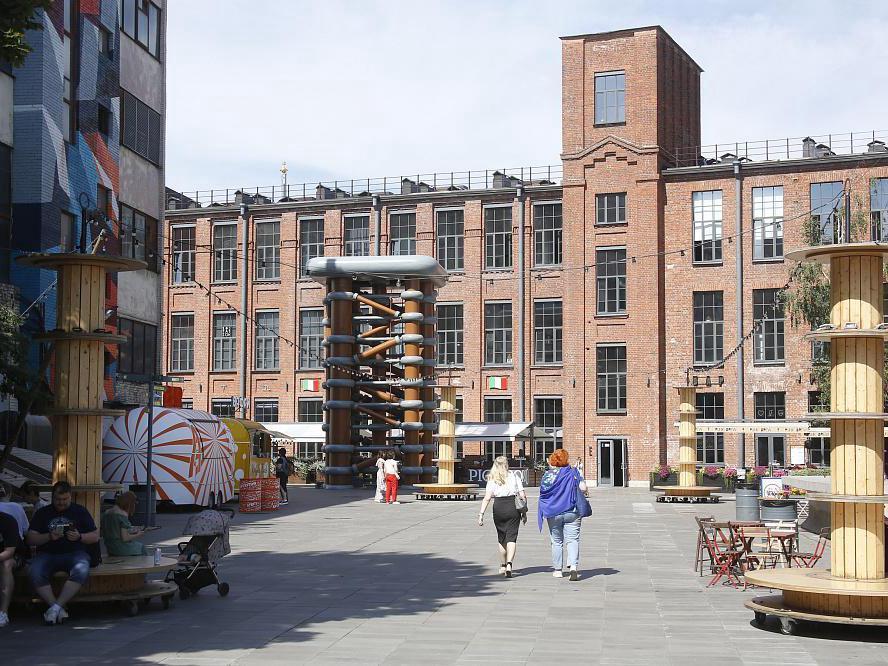
As an example of successful evolution, he cited Sevkabel Port, which has organically integrated into the urban fabric. Kartavkin also noted that requirements for spaces have qualitatively changed: if a few years ago people were surprised by garlands and benches made of pallets, today users expect a well-thought-out environment for different groups, including families and pet owners.
Ekaterina Sherstennikova, CEO of Zavod Razin, spoke about the development of the former brewery site. Several formats have changed here since 2013. Since the mid-2020s, the team began attracting creative projects to build recognition. In 2024, an annual multimedia project attracted nearly 50,000 visitors, proving interest in the area despite its perception as depressed.
Now the Zavod Razin cluster is developing in three directions: gastronomic production, contemporary art, and lifestyle projects. The project«s mission is to create a new attraction point and a comfortable environment for surrounding areas.
Denis Kazberov, director of the Skorokhod Loft project (Okhta Group LLC), noted that his team«s approach aligns with the city»s — people are always at the center. The developer«s task is to create an environment for different social groups. He gave examples of projects in new areas, such as Primorsky Kvartal, and projects in existing historical buildings, like Skorokhod Loft.
«We try to create an environment that people will come here specifically for, even from remote areas,» Kazberov said. He noted that even a small but interesting project can revitalize an entire microdistrict.
Natalia Travnikova, head of development at ABZ-1, spoke about the role of materials in creating a comfortable environment. This involves proper zoning, separation of flows, and creating areas for different groups. She mentioned colored asphalt concrete — a patented development of the enterprise that allows obtaining surfaces of various shades. According to a survey in one of the parks, 90% of respondents supported the use of bright surfaces.
«The use of such materials is not a decorative technique, but a response to modern requirements for the urban environment: it must be safe, environmentally friendly, and convenient,» Travnikova emphasized. According to her, St. Petersburg«s experience is being scaled across the country. The skate park under the Dunaysky overpass and the Bolshaya Nevka embankment were included in the Federal Register of Best Practices of the Ministry of Construction of the Russian Federation.
Pavel Melnikov, director of project development at Setl Group, noted that people increasingly view the living environment as a space for communication, work, and personal development. Therefore, multifunctionality and walkable access to infrastructure are becoming key. In response to demand for neighborly interaction, Setl Group is developing the SetlCommunity format — special spaces within residential complexes.
Developers in Trend
As Mikhail Kartavkin noted, public spaces should be more actively developed in residential construction. People want to get cultural and social experiences close to home. Therefore, in new projects, such spaces are becoming not an additional option but an integral part of the concept.
Pavel Melnikov explained that the inclusion of public spaces in the structure of residential complexes is driven by buyer demand for a favorable living environment. At the same time, developers are seeking a balance between integration into the urban environment and preserving privacy.
He gave examples of Setl Group projects: in the residential complex Bionika Zapovednaya, an all-season Zapovedny Park is being created on an area of 23,000 sq m, while the Astra Marine project emphasizes quiet relaxation with a waterfall, rock garden, and swing areas.
Maria Orlova, commercial director of GC A101 in St. Petersburg, noted that developers follow the philosophy of the 15-minute city, embedding infrastructure into residential areas. Community centers play a special role, becoming the «heart» of a district. Comfort is impossible without a comprehensive approach to safety, including modern video surveillance systems and well-designed lighting.
Sergey Sofronov noted that the format is determined by the initial conditions of the project. In the premium residential complex Severnaya Korona, besides closed infrastructure, there is an open courtyard (cour d«honneur) that the developer shared with residents. In the Galernaya Gavan project, internal infrastructure will remain private, while the open public part will be accessible to all.
City for People
Sergey Petrichenko, chairman of the Committee for Improvement of St. Petersburg, stated that the main task is to create a comfortable environment in all districts, not just the center. Public spaces should be suitable for living and recreation everywhere.
Embankments remain one of the key areas. Governor Alexander Beglov set the task of improving more than 70 km of waterfronts by 2030. Current projects include the embankments of the Karpovka, Okkervil River, and Bolshaya Nevka.
Special emphasis is placed on parks and squares of district significance. «For a family with children, a park near home is often more important than a garden in the city center,» Petrichenko said. New projects are introducing «smart» playgrounds with educational elements.
When working in the historic center, the emphasis is on preserving the city«s spirit, while for active youth, multifunctional spaces are created under bridges and overpasses. The design considers St. Petersburg»s climate, using durable materials and all-season solutions.
New Instead of Old
The redevelopment of historic areas is accompanied by restrictions. Denis Kazberov noted that the buildings of the former Skorokhod factory have protected status, which is both a bonus and a challenge. Historicism becomes the main asset, and the project should eventually turn into a «historic garden» open to citizens.
Ekaterina Sherstennikova noted that maintaining a single concept with multiple owners is a rare scenario. Zavod Razin does not sell anything to maintain the integrity of the project, but this requires time and resources.
Mikhail Kartavkin recalled that the closure of Sevkabel initially caused concerns, but over time it brought new jobs and revitalized the area. The requirements of KGIOP (Committee for State Control, Use and Protection of Historical and Cultural Monuments) remain the most difficult constraint, especially when combining modern standards with historical fabric.
Sergey Petrichenko emphasized that St. Petersburg bears the «burden of historical responsibility», and KGIOP fights to preserve authentic materials and technologies. All participants noted that dialogue with regulators has become more constructive.
Sergey Sofronov added that the complexity of approvals depends on the format of work with the object. If buildings are owned by the investor, it is easier to build a strategy than when renting.
More Space
The discussion participants agreed that the main vector of development is bringing urban life closer to the person, to their home and district.
Natalia Travnikova noted that densely populated areas lacking attraction points will become the next growth territory for public spaces.
Denis Kazberov believes that preferential lending for the restoration of monuments could give an impetus to redevelopment. In his opinion, the market is moving towards saturation, and in the future, exclusive, advanced functions will be in demand.
Pavel Melnikov emphasized the importance of dialogue between residents, developers, and administrations to create a truly lively environment. He also noted that spacious entrance lobbies with lounge areas are becoming the norm even in the comfort class.
Maria Orlova emphasized the systematic involvement of residents at all stages — from design to occupancy.
Ekaterina Sherstennikova believes that mechanical scaling of creative formats beyond the center is not always justified.
Sergey Sofronov is convinced that public spaces cannot be designed solely «on demand». The foundation should be conceptual thinking and understanding of the nature of the place.
Mikhail Kartavkin sees the main function of public spaces in socialization. In his opinion, local formats embedded in everyday life, such as neighborhood markets or small events, create connections between people.
Sergey Petrichenko reported that unprecedented funds will be directed to the development of courtyards and local spaces in the coming years. Municipalities will receive 6 billion rubles (approximately $67 million at current rates) for improvement in 2026.
Thus, the future of public spaces in St. Petersburg is shaped at the intersection of the interests of residents, developers, and the city, transforming from individual projects into an integral part of everyday life.