Omsk Doctor Explains How to Detect Opisthorchiasis


Omsk Region leads Russia in opisthorchiasis incidence, caused by parasites living in fish of the carp family
The causative agent of opisthorchiasis—the cat liver fluke—was first discovered in a cat«s liver. Unfortunately, this dangerous parasitic disease affects not only animals. Omsk Region leads in opisthorchiasis incidence among the population. Lyubov Alekseyevna Stepanova, an infectious disease specialist of the highest category, a doctor at the Euromed clinic with 15 years of experience, spoke about the symptoms, diagnostic methods, and treatment of the disease.
Long-term infection risks severe complications; treatment is strictly under doctor supervision in a hospital
— Lyubov Alekseyevna, what is opisthorchiasis?
— It is a natural-focal biohelminthiasis, mainly affecting the bile ducts, gallbladder, and pancreatic ducts. The causative agents of the disease are Opisthorchis felineus (cat liver fluke). These are flat hermaphroditic worms 8–14 mm long and 1–3.5 mm in diameter with two suckers. According to some researchers, opisthorchids live in the body for 10–20 years, while others believe they live for the entire life of the host.
— How widespread is opisthorchiasis?
— It is the most common biohelminthiasis in Russia. The largest endemic territory is in Western Siberia, where the largest Ob-Irtysh invasion focus is located. According to Rospotrebnadzor (the Federal Service for Surveillance on Consumer Rights Protection and Human Wellbeing) (in the report «On the State of Sanitary and Epidemiological Well-being of the Population in the Russian Federation in 2024»), Omsk Region ranks first among all regions in opisthorchiasis incidence, with the number of registered cases in 2024 being 1,774 people. Across all of Russia—13,757 cases.
— How does infection occur?
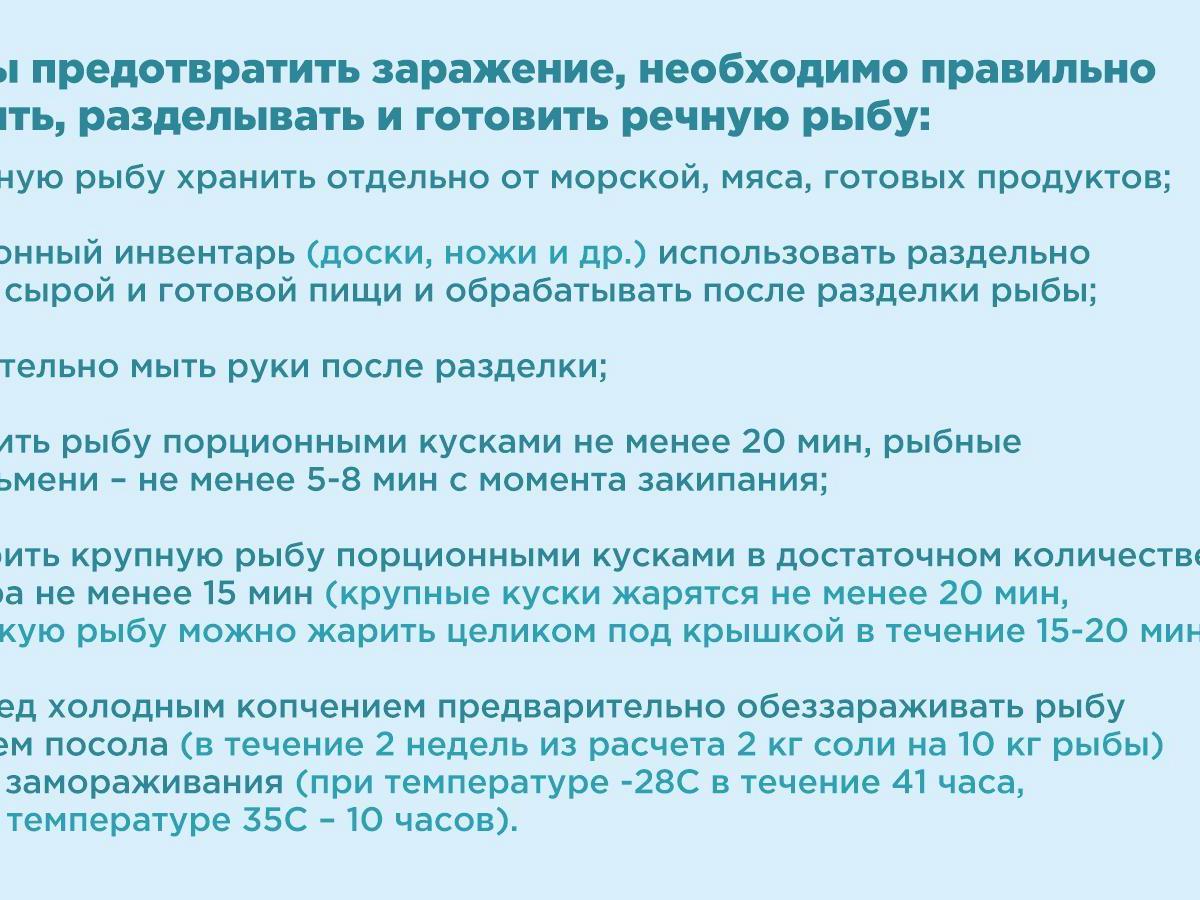
— The transmission mechanism is fecal-oral. In the life cycle of the pathogen, there are three links: two intermediate hosts and a final one. The first—mollusks of the genus Codiella, in whose bodies larvae form from eggs; the second—fish of the carp family, into whose muscles the larvae penetrate, becoming infectious after a few weeks. The final hosts are humans and animals (cats, dogs, foxes, squirrels) that become infected by eating fish. Human infection occurs only when consuming raw or undercooked and underfried fish (such as crucian carp, ide, vobla (Caspian roach), roach, chebak (Siberian roach), bream, and others) with viable parasites. It is impossible to get opisthorchiasis in other ways. After infected fish enters the stomach, the larvae are freed from their shells under the action of digestive juices. Within a few hours, they find their way to the bile ducts and liver, where they attach using suckers. Here, the larvae begin to feed and reproduce.
— How can a person understand that they have contracted opisthorchiasis?
— There are no specific symptoms. The acute form of opisthorchiasis is characterized by fever, weakness, sweating, loss of appetite, headache, muscle and joint pain. Rashes on the skin of the torso, arms, and legs are possible, which disappear without a trace after 3–10 days, as well as dull aching pain in the right hypochondrium or acute burning pain radiating under the shoulder blade.
In the chronic form, manifestations are similar to symptoms of other digestive system diseases. These include heaviness in the abdomen, pain in the right hypochondrium, belching, nausea, vomiting after severe dietary violations, bitterness in the mouth. Patients also note fatigue, decreased appetite, irritability, mild headaches, skin rash (sometimes itchy), and periodic slight fever.
And in the asymptomatic form, opisthorchiasis has no manifestations.
If the listed symptoms appear and there has been past consumption of fish from the carp family, it is essential to undergo examination to rule out opisthorchiasis invasion.
— How is opisthorchiasis diagnosed? How informative are the tests?
— In a clinical blood test, high eosinophilia may be observed in the acute period—up to 60x109/L (about 90% informative), moderate eosinophilia or normophilia in chronic forms, sometimes a decrease in hemoglobin and platelet levels and an increase in ESR. In a biochemical blood test—increased levels of ALT, AST, total bilirubin, alkaline phosphatase, GGT, and amylase in the acute period and their periodic moderate increase in the chronic phase. Immunoassay blood test for opisthorchiasis to detect antibodies in the acute process has high diagnostic value—up to 90% informative; in the chronic process, informativeness is no higher than 60%, and false-positive reactions often occur with other helminthiases and autoimmune diseases. The only means of confirming the diagnosis—detection of helminth eggs in stool analysis and/or duodenal contents (on the 4th–6th week after infection through coproovoscopy and microscopy of duodenal contents).
— There is an opinion that everyone is infected with parasites, and living with such neighbors is not dangerous. Is this true?
— No. Long-term presence of parasites in the body can lead to chronic inflammatory changes and damage to internal organs: toxic-allergic hepatitis, liver abscess, biliary peritonitis, acute myocarditis, pancreatic cancer, damage to the epithelium of the liver«s bile ducts.
— What does treatment involve?
— Deworming is prescribed only after diagnosis is confirmed: detection of eggs in chronic opisthorchiasis or detection of antibodies in acute. Treatment is prescribed by a doctor and conducted under observation in a 24-hour or day hospital setting. At Euromed, treatment can be undergone on referral from an infectious disease specialist or gastroenterologist in a day hospital (at the buildings on Syezdsovskaya and Lukashevich streets) and a 24-hour hospital (on Zeleny Island).
You can make an appointment with a specialist by phone: 8 (3812) 664-733.
Lyubov Alekseyevna Stepanova sees patients at the Euromed building at 15 Marx Street.