OSAGO Payouts Soar by Half in Three Years
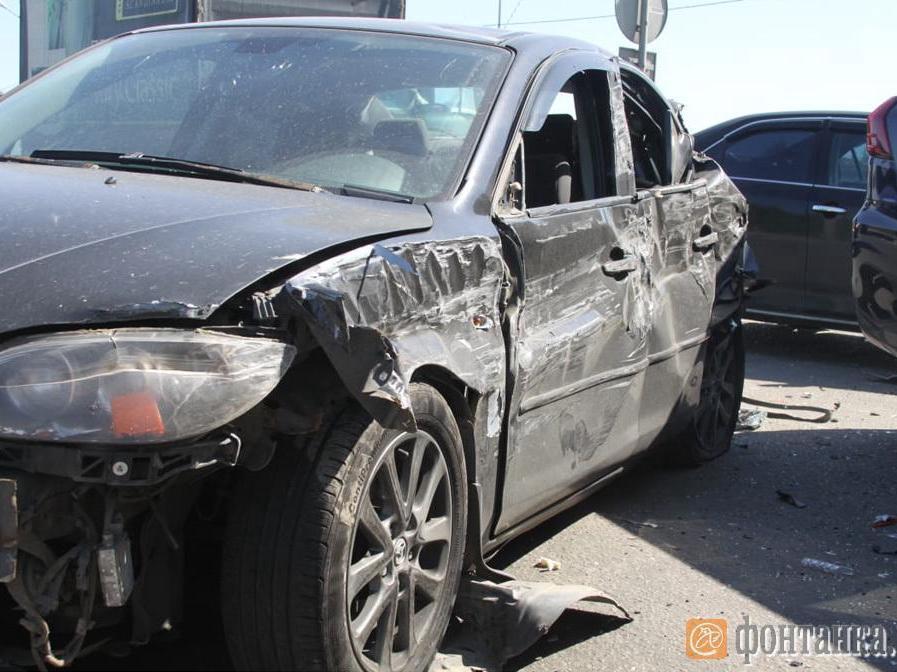

Over three years, the average OSAGO insurance payout for a car accident has grown by almost 1.5 times — from 72,000 rubles (approx. $800 at current rates) in 2022 to 101,000 rubles (approx. $1,100 at current rates). The cause is not only general inflation but also a deep crisis in the auto parts market, making it difficult to repair a car under insurance. Official calculations by insurance companies lag far behind real prices, parts deliveries are unpredictable, and the cost of original parts remains high. A bill allowing car owners to receive an additional payment if the payout is insufficient for repairs has still not advanced.
After the departure of Western automakers from the market, the situation with cars has more or less stabilized: some drivers have switched to Chinese brands, others have mastered parallel imports. However, the situation with parts is different. Even for Chinese cars that are actively sold in Russia, some parts have to be waited for up to three months.
«There are still some items for which deliveries have to be waited up to three months. Parts for «European,» and even «American,» cars are also being brought in, but the wait is 1–1.5 months,» said Alexey Podshchekoldin, president of ROAD (Russian Association of Motor Insurers), at a conference on the results of 2025. The expert did not comment on price changes, which is not surprising: there are still no established price tags on the market, nor verified suppliers. «Component manufacturers do not want to come to a low market,» Podshchekoldin explained.
Updates to Price Guides and Real Prices
Parts are imported mainly from China, and their quality varies greatly. Insurers use price guides with average market prices to calculate OSAGO payouts; these are regularly indexed but still far from reality. In 2025, the RSA (Russian Union of Auto Insurers) updated these guides twice: in September, prices rose by an average of 0.2%, and in December, by another 1% after a public audit.
The RSA noted that prices for parts for Nissan, Renault, and Chevrolet rose by 4.5–6.6%, for Toyota, Mercedes, and KIA — by no more than 1.4%. For Chinese brands, conversely, a decrease was recorded. «The record holder is the Geely brand — a decrease of more than 10%,» insurers reported. According to the association, average prices for parts for Chinese cars overall decreased by 2.4% in the second half of the year due to market saturation.
Specific Examples: Mercedes, Chery, Geely
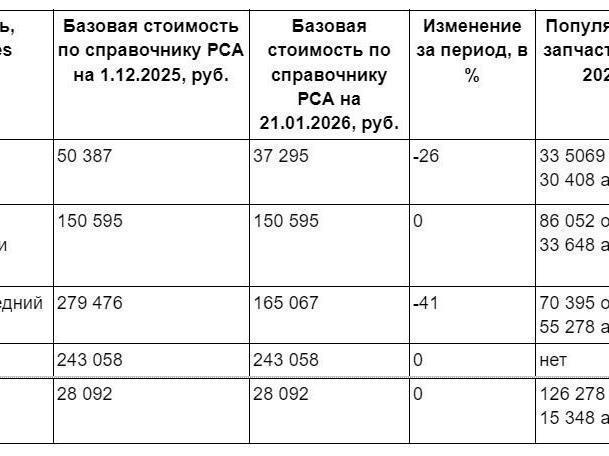
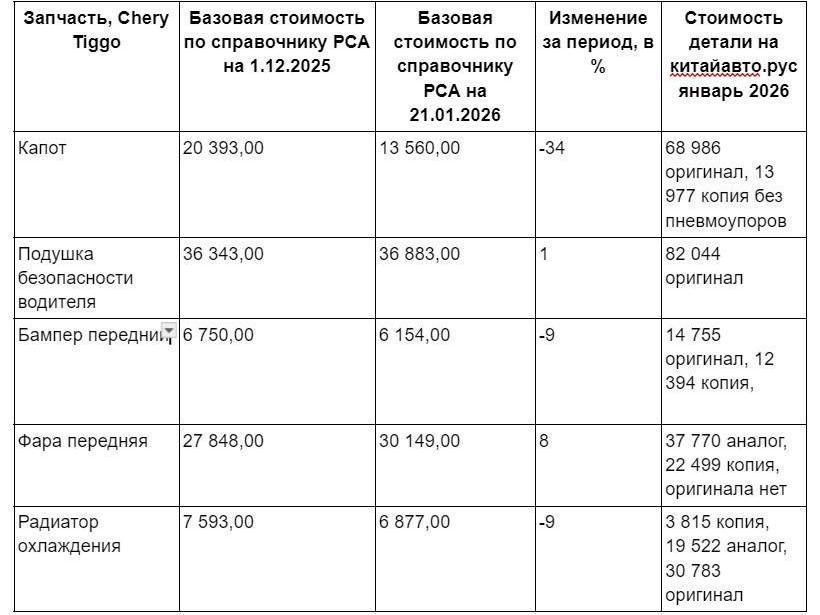
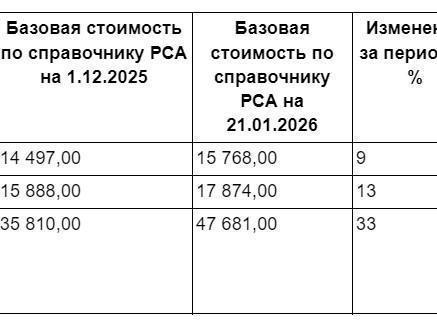
An analysis of base prices in the guides for typical parts (hood, bumper, airbag, headlight, radiator) shows an ambiguous picture:
- For Mercedes, hood and bumper prices in the guide decreased by 26% and 41% respectively, but the market cost of originals is still many times higher.
- For the Chery Tiggo, three items became cheaper (bumper and radiator — by 9%, hood — by 34%), but the airbag and headlight became more expensive by 1% and 8%. Original parts cost 2–4 times more than the base price.
- For Geely (and its Belarusian analogue Belgee), the guide recorded growth in base prices for the hood (9%), radiator (13%), and headlight (33%), which contradicts the stated overall decrease.
Meanwhile, real market prices for original parts continue to rise. For example, the hood and radiator for Mercedes have become more expensive by 170% and 31% respectively, and the airbag for the Chery Tiggo — by 251%.
Cash Payouts Instead of Repairs
Representatives of service stations link the price growth not only to the market but also to tax changes: the introduction of VAT for wholesalers and the transition to new tax regimes adds 7–9% to the cost. «The FAS (Federal Antimonopoly Service) announced that it is looking for those responsible for the price increase,» market players noted.
Aware of the gap between guide and real prices, insurers more often pay compensation in cash rather than direct to repairs. In the 11 months of 2025, 1.65 million cases were settled with cash (for 190.9 billion rubles, approx. $2.1 billion at current rates), and only 103.7 thousand cases with repairs (13.4 billion rubles, approx. $149 million at current rates). The average OSAGO payout for this period was 115.6 thousand rubles (approx. $1,300 at current rates), which is 1.5 times more than in 2022 (77.2 thousand rubles, approx. $858 at current rates).
Reform Plans for 2026
The RSA announced the preparation of a reform of the OSAGO compensation system, which is planned for 2026. The essence of the changes is to make in-kind repairs the priority, but flexibly. If the insurer finds a service station ready to do the work on time, the car will be sent there. If not, the car owner will receive a cash payout (minus depreciation), organize the repair themselves, and then, by confirming expenses, will be able to receive an additional payment from the insurer for the depreciation.
«This is the strategic topic that will affect OSAGO in 2026,» emphasized the RSA. «It will make the in-kind compensation system convenient for citizens and limit fraud, which is precisely linked to cash payouts.» According to the plan, funds saved on fighting fraud will be directed to compensating car owners. The success of the reform will depend on whether the parts market can provide stable prices and supplies.