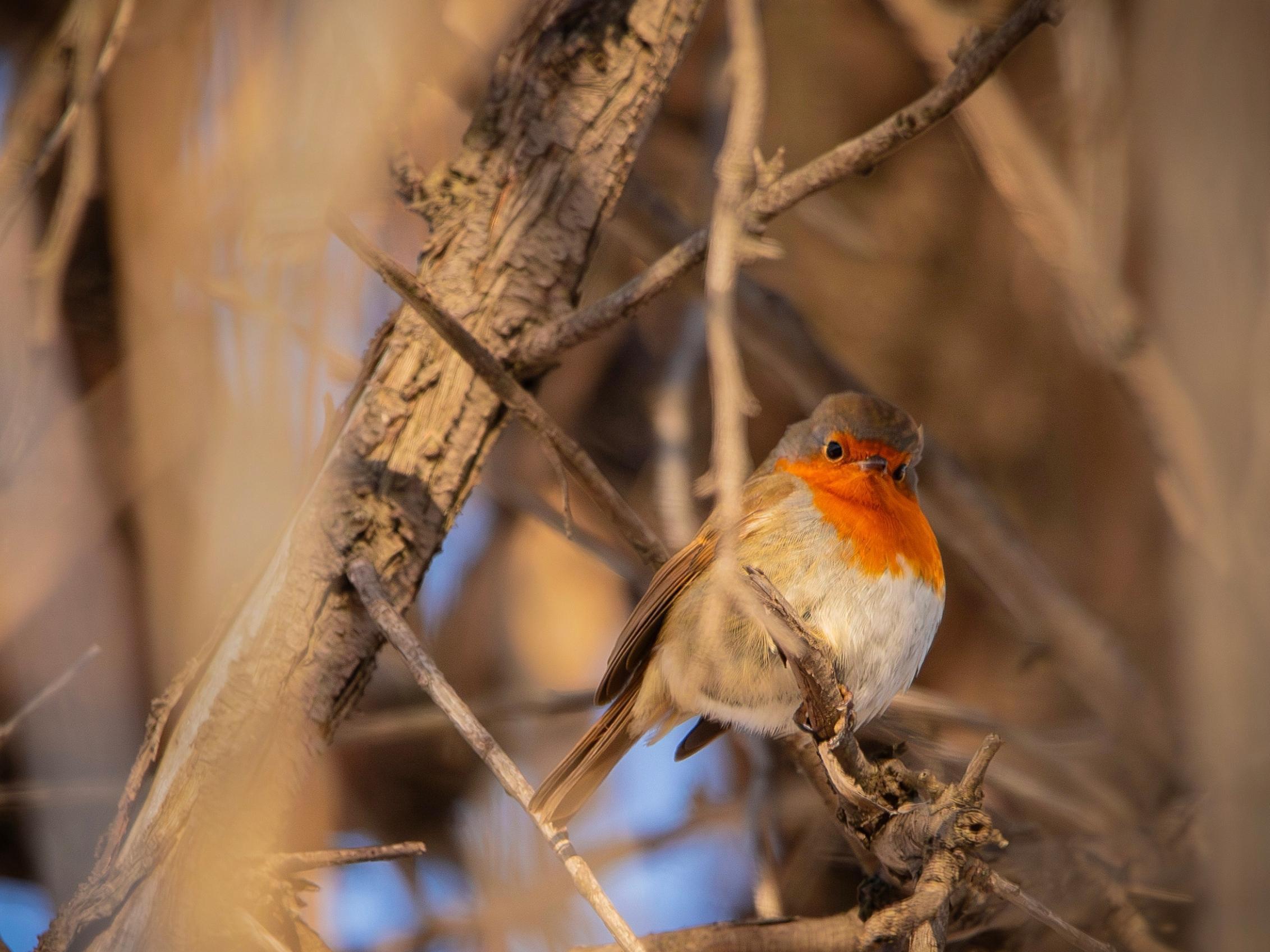
Robin with Bright Neck Spotted in Volgograd

Scaring off this proud bird is, unfortunately, quite easy.
A charming robin — a bird impossible to miss but very hard to encounter — came into the lens of Marina Yudina, a graphic artist and miniature painting master from Volgograd. Moreover, according to the photographer, it was quite timid, so capturing it in a photo was not easy.
“A tiny bird that I noticed thanks to its orange patch on its breast and face,” recounts Marina Yudina. “In the rays of the setting sun, flying through reeds and branches, it truly looked like a little flame. It perched on a tree branch at the top of a small but steep slope, while I was below. Because of its small size, my ‘telescope’ couldn’t see it well — I had to crawl on all fours to get the shots. Sliding and tumbling, climbing again and trying to find some foothold… While I was down there fumbling, it sat on the branch and seemed to look mockingly and haughtily at my attempts to reach the top. In the end, after several tries, one ‘shot’ was successful, but then a dog scared it off and it flew away.”
She managed to ‘capture’ the robin in the SNT Dubovaya Balka (a gardening community) in the Angarskoye settlement of the Dzerzhinsky district. The photographer admits she would like to take more pictures of this charming bird and its relatives, but the weather is not cooperating yet.
“I want to go ‘shoot’ them again — I’ve been bitten by the bug!” exclaims Marina Yudina. “But here in Volgograd, the weather is like a roller coaster — whoa… A nightmare: after frosts, a sharp warming, mud, slush, puddles and ice, and now another sharp cold snap and snow piled up, but the ice remains under the snow — dangerous… And scary. But no matter, I’ll get to her yet!”
Viktoria Faifer, assistant at the Department of Biology and Bioengineering of Volgograd State University (VolSU), confirmed that the bird in the photo is a robin. In Volgograd, they find a wintering spot due to the relatively mild climate.
“The robin, also known as the European robin. It is distributed across Europe up to Western Siberia. It is generally a migratory bird, but because winters in Volgograd are relatively mild, some robins stay for the winter. Their summer diet consists of insects, but when cold weather arrives, they can also eat berries and seeds. Interestingly, they can sing not only in the morning but also at night, and may start singing long before dawn. This is likely where its name comes from: a bird that sings at dawn, and the color of its breast also suggests that association.”
Earlier, Marina Yudina used her lens to capture waxwings and fieldfares that were all feasting on juniper berries in the same Angarskoye settlement. The photos are a delight to behold!