Why St. Petersburg and Leningrad Oblast Produce Little Butter

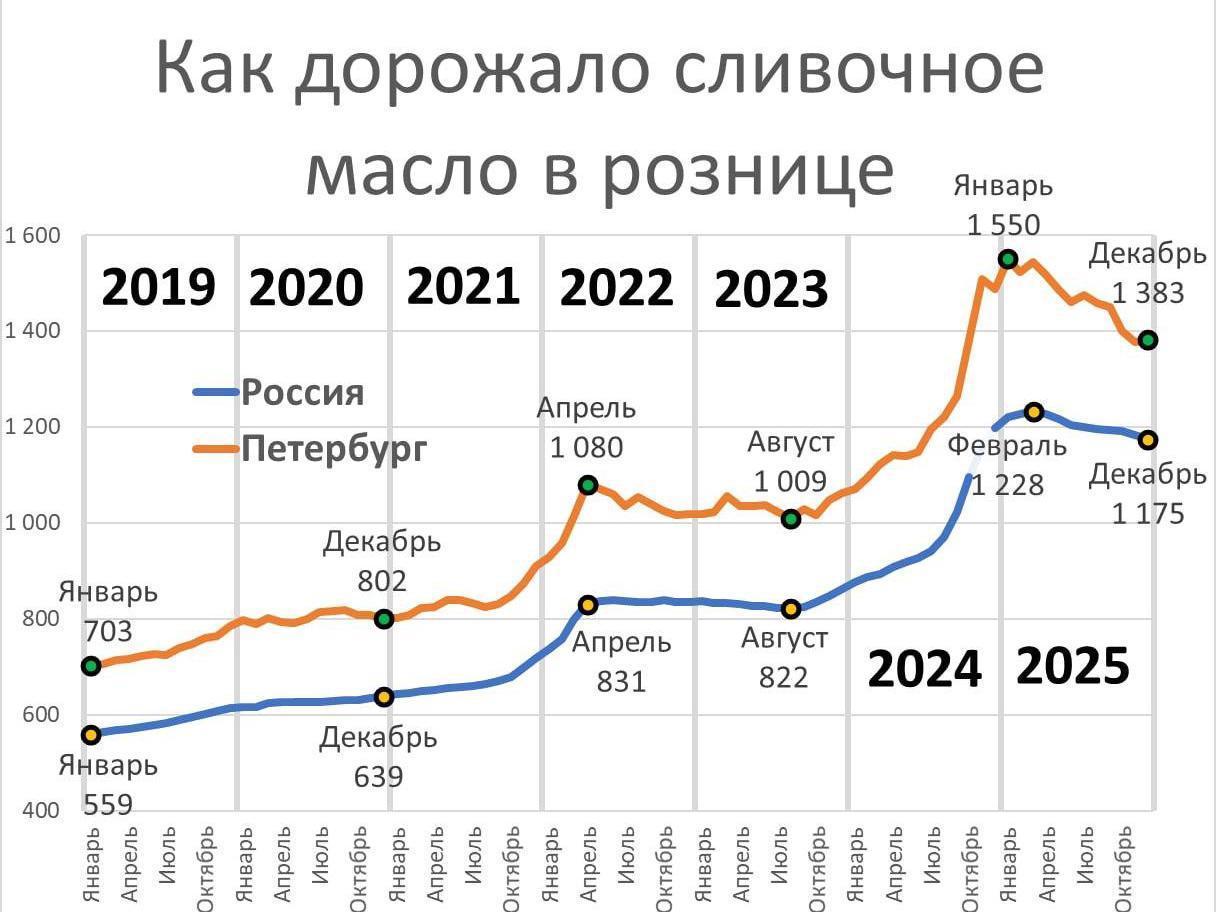
Over the past five years, the price of the simplest butter in St. Petersburg has doubled. This year, a kilogram of this product has already exceeded the threshold of 1,500 rubles (about $20 at current rates). The paradox of the situation is that Leningrad Oblast, being one of the leaders in milk production in the country, practically does not produce its own butter, but supplies consumers through deliveries from Vologda, Kazan, and Belarus.
Local dairy enterprises explain why even such high retail prices do not incentivize them to make large-scale investments in this direction.
Production Volumes
Last year, out of 670,000 tons of milk sold in Leningrad Oblast, only about 100 tons of butter were produced. This is less than 20 grams per year for each resident of St. Petersburg. For comparison, Vologda Oblast, whose climatic conditions are not significantly different, produces 100 times more butter with comparable milk volumes.
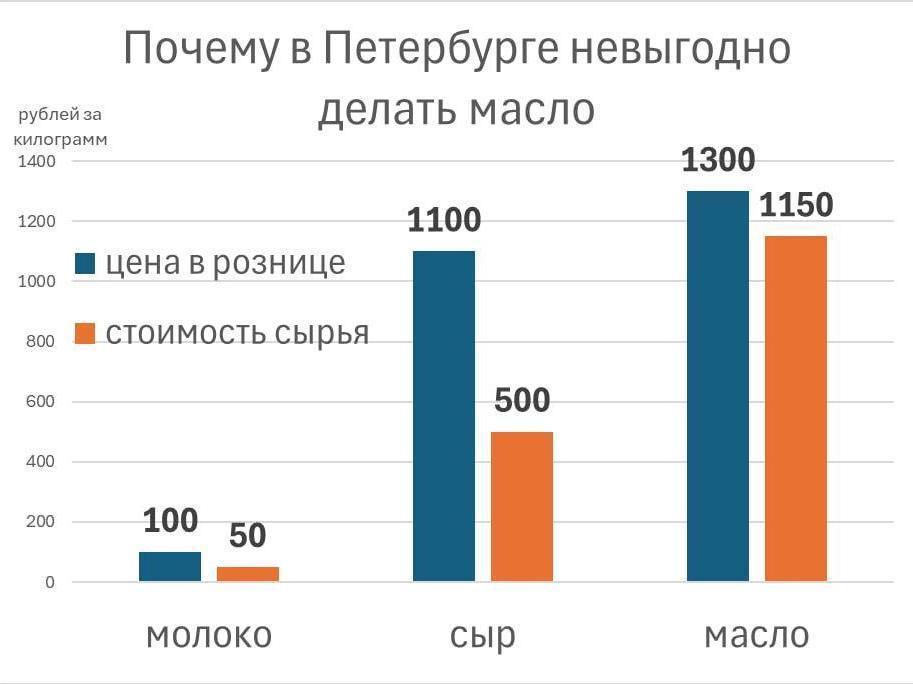
The reason lies in simple economics. To create one kilogram of butter, 22–23 liters of milk are required, while for a kilogram of cheese, only 10–12 liters. In St. Petersburg retail, a kilogram of cheese costs about 1,100 rubles (approximately $15), butter — 1,300 rubles (about $17), and a liter of milk — 100 rubles (about $1). With a wholesale price of raw milk at 45–50 rubles per liter (about $0.60-$0.67), it is extremely difficult to make a profit from butter production.
Residents of St. Petersburg and the oblast consume mainly imported butter, which at local enterprises is often only packaged. For example, the group of companies «Neva Milk» openly declares the packaging of cheeses and butter. Its revenue for 2024 exceeded 16 billion rubles (approximately $213 million) with a net profit of 230 million rubles (about $3.1 million).
A similar model is used by LLC «Versiya» (brand «Russkiye Traditsii»), which received revenue of 733 million rubles (about $9.8 million). The oldest market player — LLC «Rusexpoprom» — also engages in packaging butter purchased in Belarus and Tatarstan, with revenue of 334 million rubles (about $4.5 million) for 2024.
In 2024, the plant «Petmol» (holding «Logika Moloka», former Danone) announced its readiness to organize its own butter production. However, currently the company refuses to comment on whether this project was implemented. According to one market participant, production never materialized.
Comparison with Neighbors
In 2025, butter output in Leningrad Oblast grew by 28.9%, reaching 105.2 tons. However, this is a modest indicator compared to other regions of the Northwest. For example, Vologda Oblast in 2024 produced 10.3 thousand tons.
Experts see nothing surprising in the low volumes. «This is a milk-intensive product, and it makes sense to produce it in a region where there is a lot of milk and few consumers,» says Georgy Zhitmarev, deputy general director of the Piskarevsky Dairy Combine. In Leningrad Oblast, however, there is both plenty of raw materials and consumers, and raw milk is relatively expensive.
General Director of LLC «Agro-Trade» Dilsod Akhmedov confirms that raw materials in the region are about 10% more expensive than in a number of other oblasts, which is critical for butter and cheese production.
By-Product
For many local producers, butter is a by-product of the main whole-milk production. They do not plan to significantly increase its output.
«Our butter is known and taken, but there is no point in increasing its production volumes, it is not our main product,» notes Mukhazhir Etuev, general director of CJSC «Plemzavod Prinevskoye». The priority for the enterprise is whole-milk products and cheese.
An exception may be LLC «Agro-Trade», which is studying the possibility of creating butter production in Leningrad Oblast with investments from 30–36 million rubles (approximately $400,000-$480,000).
Influence of Raw Materials
There is a version that the low production volumes are linked to the prevalence of Holstein breed cows in the region, whose milk has lower fat content. However, most experts consider the main reason to be the high cost of raw materials.
«Butter can also be made from Holstein milk, it will require a bit more, but nevertheless it is a working story,» believes one market participant.
Market Situation
Retail sales of butter in Russia are declining. Over nine months of 2025, sales in physical terms fell by 12% compared to the same period last year. Production in 2024 decreased by 1.4%.
Price dynamics were volatile: in January 2024, a kilogram of butter in Russia cost about 830 rubles (approximately $11), by January 2025 — 1,200 rubles (about $16), and in St. Petersburg the price this month reached 1,500 rubles (about $20). By December 2025, a correction occurred: on average across the country — to 1,175 rubles (about $16), in St. Petersburg — to 1,380 rubles (about $18) per kilogram.
Belarusian producers have a significant influence on the Russian market, who, by setting export indicators, effectively dictate domestic prices. Their large stocks and plans for export, for example to India, make forecasting price dynamics a difficult task.