Big Smolensky Bridge Orthotropic Slab Installation Completed
In St. Petersburg, the installation of orthotropic slabs on all spans of the new drawbridge across the Neva River has been completed. Work continues, and traffic opening is planned for 2027.
Apr 25, 2026 0
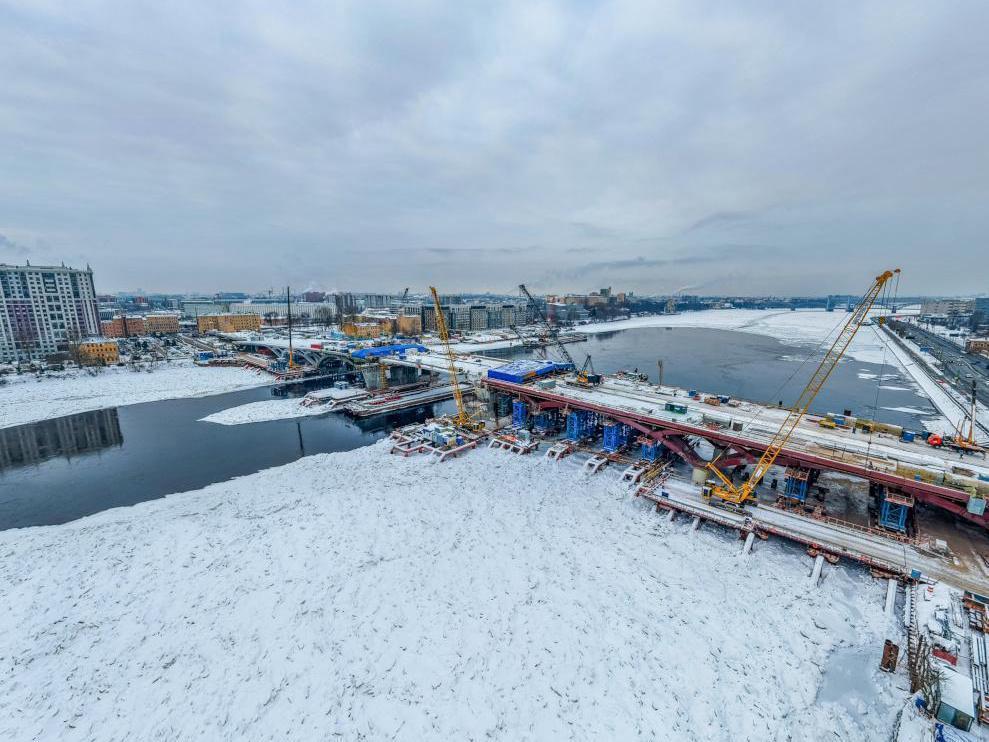

The Big Smolensky Bridge is the first drawbridge built in St. Petersburg in 40 years.
Source:
In St. Petersburg, an important technological stage has been completed on the Big Smolensky Bridge under construction across the Neva — the installation of orthotropic slabs on all spans. At the same time, work continues on installing metal structures and finishing the joints of the draw span with counterweights, the city administration reported on 4 February.
The orthotropic slabs, consisting of a steel deck and a system of longitudinal and transverse ribs, form a single metal sheet. It will later be covered with road pavement, tram tracks, and sidewalks. Currently, eight of the ten bridge supports have been built, and work on the fifth and sixth supports is nearing completion.
In the near future, builders will dismantle the temporary rigid connection of the bridge«s »wings« and begin commissioning of the hydraulic cylinders. »Soon the active phase of preparation for the 2026 navigation season will begin — this year the crossing will be able to pass ships. We plan to open working traffic on the bridge in 2027,« said St. Petersburg Governor Alexander Beglov.
The Big Smolensky Bridge is located between the Volodarsky Bridge and the Alexander Nevsky Bridge. It will become part of a new highway that bypasses the historic city center. Approaches to the bridge will be organized via interchanges at Obukhovskaya Oborona Avenue, Oktyabrskaya Embankment, and the intersection of Dalnevostochny Avenue with Kolontay Street. This structure will be the first drawbridge in St. Petersburg in four decades. Full completion of construction is expected in 2028, a year ahead of the original schedule.
The total length of the bridge will be 494 meters. When closed, the central part will be at a height of 15 meters above the water, and the width of the navigable span will reach 60 meters. The crossing will feature six lanes for cars, two central lines for trams, and separate paths for pedestrians and cyclists.
Read more