Polar Geological Expedition Closed Over 300 Million Ruble Debt
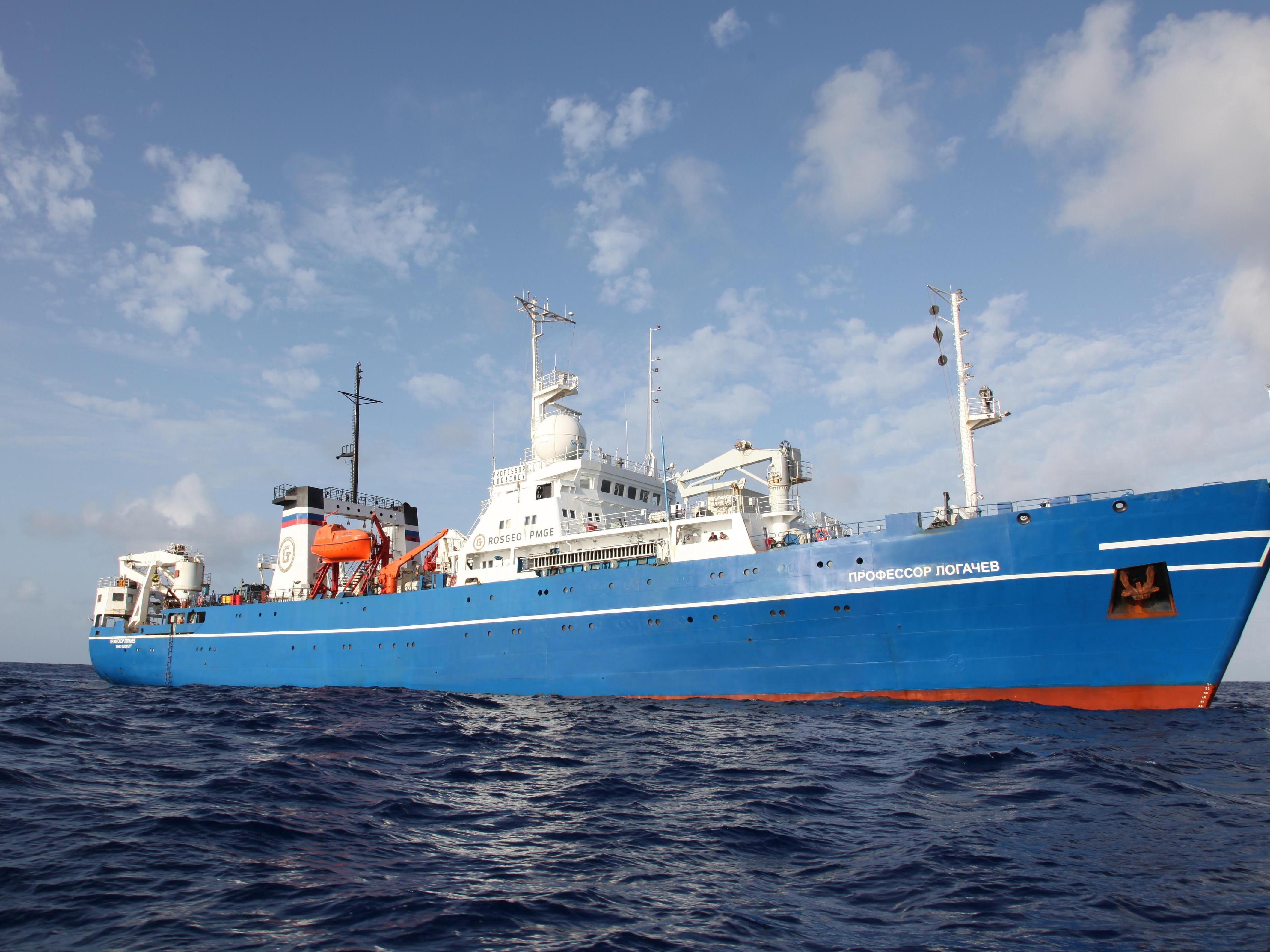

The Polar Marine Geological Exploration Expedition (PMGRE) is ending its long-standing activity. On February 12, a final point will be set in its history, and its building in Lomonosov (a town near St. Petersburg) will be put up for auction. The immediate reason for the closure was a debt of about 300 million rubles (approximately $3 million at current rates) for repairs to the research vessel Professor Logachev. A significant scientific mission in polar regions is ending not due to achievements but because of unprofitability.
A message about the expedition«s cessation, posted on the social network VKontakte, sparked a wave of outrage among residents of Lomonosov. In the comments, details of the collapse were discussed: the company is litigating with ship repairers over the vessel, and its museum exhibits have already been moved to the local local history museum. There, the opening of the exhibition is planned to coincide with Geologist»s Day in April.
«Because the expedition is closed,» briefly explained the administration of the municipal formation of the city of Lomonosov, refusing to provide details.
Staff of the Lomonosov Local History Museum confirmed that the Polar Expedition will cease operations precisely on February 12. After that, employees will be laid off, and its property and collection were transferred to the museum in coordination with Rosgeology. The museum could not give reasons for the closure, citing decisions of the parent organization.
Forge of Discoveries
Founded in 1962, PMGRE spent 63 years searching for minerals in the Arctic, Antarctica, and the ocean floor. Its achievements include:
- the discovery of the Pavlovsk polymetallic deposit on Novaya Zemlya;
- exploration of the unique Tomtor rare-earth metal deposit in Yakutia;
- the identification of gold-bearing areas on Severnaya Zemlya.
The expedition annually participated in the Russian Antarctic Expedition together with the All-Russian Research Institute of Oceanology (VNIIOkeangeologiya), maintaining three field bases in Antarctica. «VNIIOkeangeologiya has been and continues to carry out geological exploration work in Antarctica, including at present,» the institute«s press service reported.
PMGRE was also the executor of a 15-year contract with the International Seabed Authority to search for polymetallic sulfides in the Atlantic. Both the expedition and its parent company JSC Rosgeology are under U.S. sanctions. The company«s fleet consists of two research vessels: Akademik Alexander Karpinsky and Professor Logachev. It was the repair of the latter in 2016 at the Kanonersky Ship Repair Yard that led to a debt of nearly 277 million rubles (approximately $2.8 million at current rates).
Karpinsky at Sea, Logachev in Debt
In March 2025, the Kanonersky Ship Repair Yard filed a lawsuit with the Arbitration Court of St. Petersburg and Leningrad Region against PMGRE for 276.6 million rubles (approximately $2.8 million at current rates) for the repair of the Professor Logachev. Initially, the expedition acknowledged only part of the debt, but on appeal agreed to the full amount. The court noted the delay of the process and additionally recovered 803,000 rubles in legal costs from the company for abuse of procedural rights.
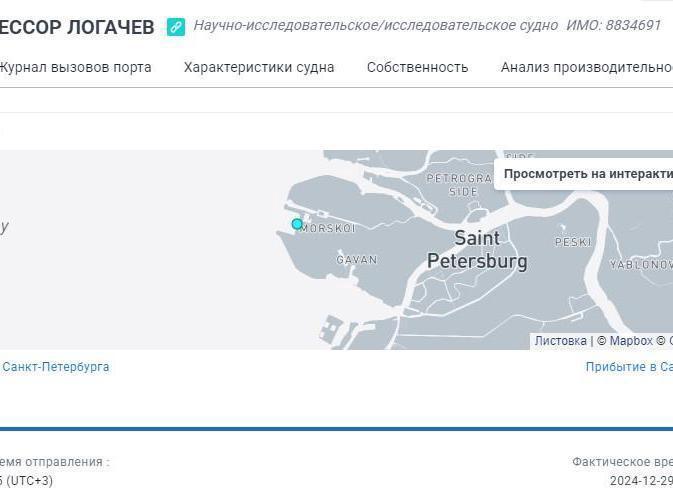
According to the online service MarineTraffic, as of February 2, 2026, the Professor Logachev is in the waters of the Passenger Port on Vasilyevsky Island in St. Petersburg. The other vessel, the Akademik Alexander Karpinsky, as of February 3, was in the Baltic Sea. In the current Antarctic season of 2025–2026, it has not been used, as in recent years.
Critical Balance
The expedition«s financial condition was precarious even before the lawsuits. According to its 2023 report:
- revenue amounted to 568 million rubles (approximately $5.7 million at current rates), 10% lower than the 2019 level;
- core operations incurred losses for four consecutive years;
- gross profit turned negative (negative 86 million rubles in 2023).
In addition to the debt to the Kanonersky plant, the expedition owes 22 million rubles (approximately $220,000 at current rates) to the St. Petersburg Diesel Parts Plant for engine repairs on the Professor Logachev. The sanctions regime may have complicated financial transactions, but even without it, the balance sheet was critical.
We«re Still Working
As of February 3, the expedition«s legal entity has not been officially liquidated, and the 10,000 sq. m building on Pobedy Street in Lomonosov remains in its ownership. At the expedition itself, in response to a journalist»s inquiry, they briefly replied: «We«re still working.»
Rosgeology did not immediately comment on the situation, but a source familiar with the situation explained: «An enterprise can work if it has orders and they are fulfilled. If there are no orders, the enterprise cannot work, even due to historical value.» Rosgeology«s financial condition is also alarming: for 2024, its revenue of 15.1 billion rubles (approximately $151 million at current rates) matched its net loss.
As early as 2021, the Accounts Chamber noted the critical wear and tear of Rosgeology«s fleet: the level of wear on research vessels reached 90–100%.
Future of Arctic Industry at Risk
Alexander Vorotnikov, coordinator of the expert council at the PORA Expert Center, emphasizes the expedition«s enormous role in Arctic and Antarctic research. «Studies have shown that the Lomonosov Ridge is a continuation of the Siberian continental platform. This scientific justification would allow Russia to claim inclusion of the ridge in its continental shelf,» he notes.
According to Vorotnikov, the loss of the expedition will derail plans to study new deposits and expand the base for the Northern Sea Route. «But this is the future of the Russian Arctic industry,» the expert believes. Also at risk is the further search for hydrocarbons and rare-earth metals on the Arctic Ocean shelf.
Interest Shifts to Land
Funding for offshore geological exploration has declined over the past decade: from 114 billion rubles (approximately $1.14 billion at current rates) in 2014 to 33 billion rubles in 2023. In recent years, the focus has shifted to onshore exploration, especially in Yakutia and new regions, because offshore projects are unprofitable at current oil prices.
Although the Ministry of Natural Resources and Rosnedra have developed a federal project «Continental Shelf» to study the shelf, it currently exists as a concept without approved funding. Another project, «Geology: Revival of a Legend,» will receive 41 billion rubles (approximately $410 million at current rates) for 2025–2027, but these funds are also spread over several years.