February 2026: Comet, Planetary Alignment, and Solar Eclipse
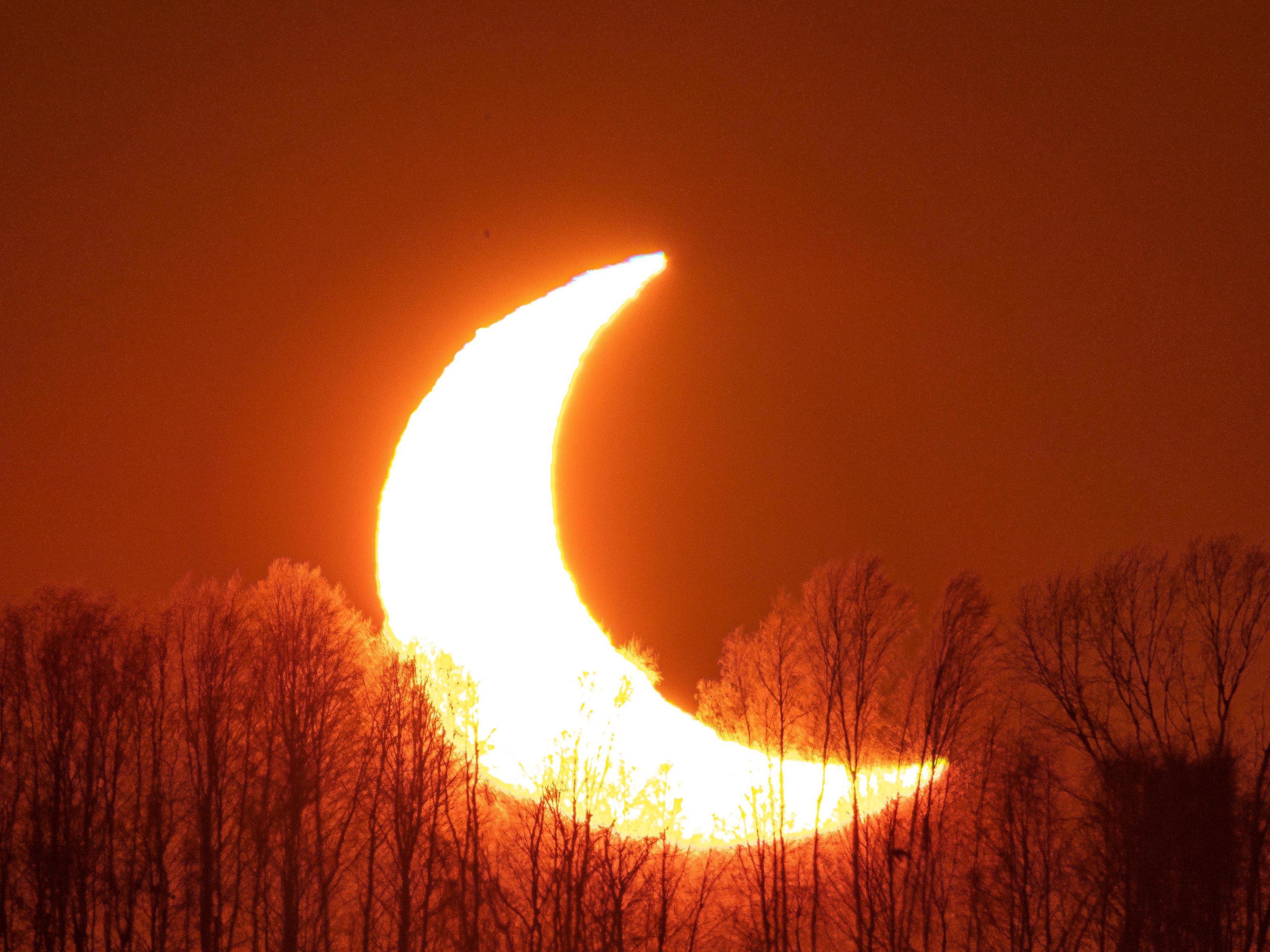

The solar eclipse on February 17 can only be observed in Antarctica and southern regions of Africa.
According to Nikolai Demin, head of the Gorky Park observatory in Rostov, February 2026 will not be rich in astronomical events, but several will be quite spectacular.
On February 1, the Moon will approach the star cluster M44 (the Beehive Cluster) at a distance of 1°26«. This phenomenon can be observed with the naked eye or binoculars in the constellation Cancer.
On February 17, comet C/2024 E1 (Wierzchos) will approach Earth at its closest distance and become visible in the Northern Hemisphere. Its brightness will be about magnitude 8. «The comet will be very low above the southwestern horizon about an hour after sunset. It can be observed with an amateur telescope or powerful field binoculars,» explained the astrophysicist.
On February 19, Mercury will be at greatest eastern elongation, i.e., at its maximum angular distance from the Sun. This will create the best conditions for observing the planet closest to the Sun.
On the evening of February 28, six planets will align in a line above the western horizon: Jupiter, Uranus, Saturn, Neptune, Venus, and Mercury. Four of them—Venus, Mercury, Saturn, and Jupiter—can be seen without optical instruments, while binoculars or a telescope will be needed to observe Uranus and Neptune.
The main event of the month—the solar eclipse on February 17—will remain inaccessible to residents of the Don region. «This phenomenon will only be noticeable in Antarctica and southern Africa,» added Nikolai Demin.