Cargo Held Hostage in Feud Between Stricken Transport Companies
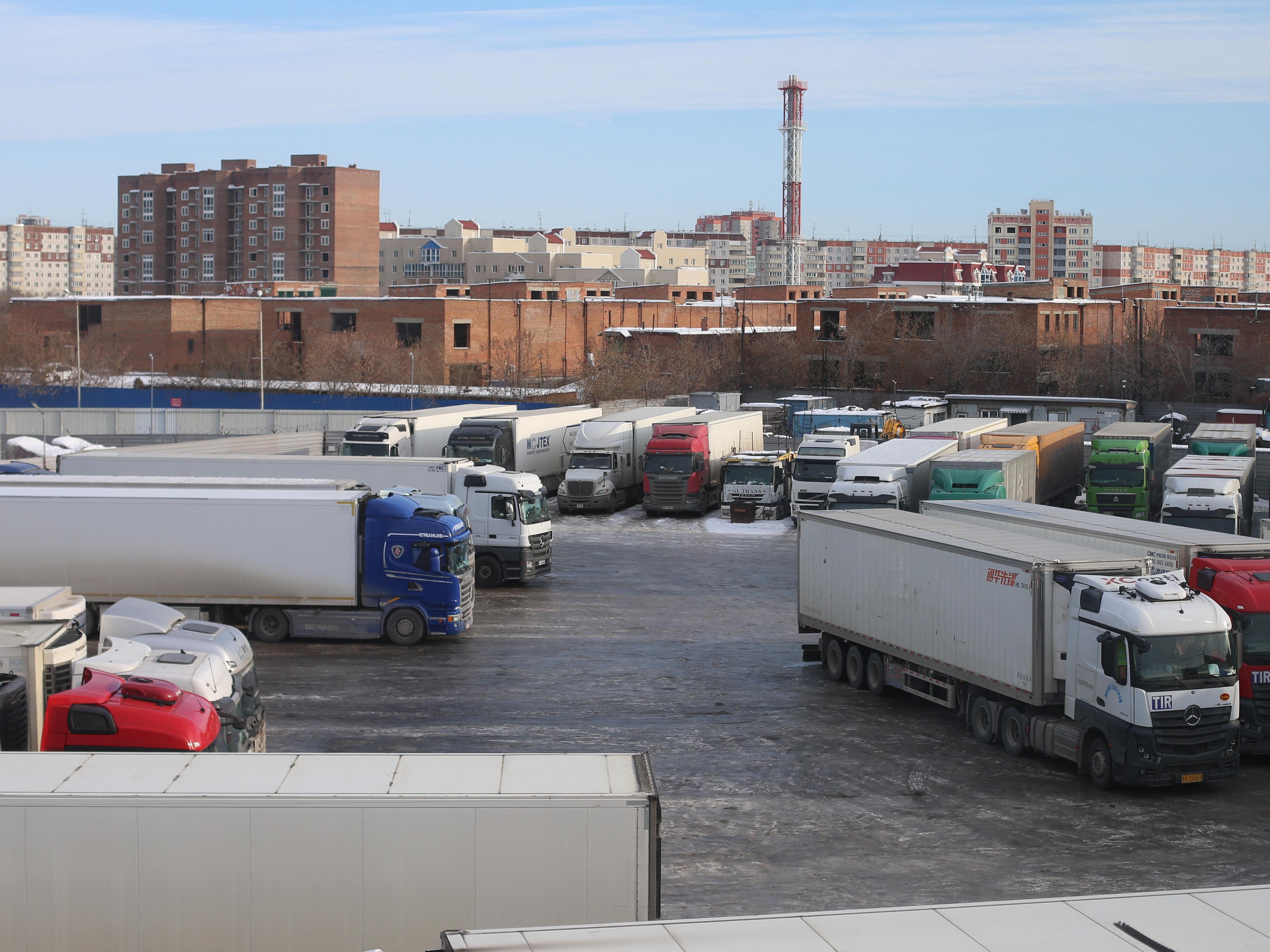

Even a contract for the transportation of goods is not always a guarantee that you will receive your cargo. A transport company can hire a third-party carrier and fail to pay them, and then that carrier will park the truck in their lot and wait for the money. The owners are then forced to go through the entire judicial ordeal, where they must prove that the property they purchased really belongs to them, preparing for inspections under a magnifying glass of every invoice and bill. This is exactly the situation Irkutsk entrepreneurs have found themselves in, left without money and without goods amid a financial dispute between two carriers.
Crisis in the market
The road freight market is in a deep crisis. Volumes are falling, freight rates are below cost, some players are engaging in dumping just to pay their leasing, and the leasing companies themselves are forced to repossess thousands of trucks for debt and already don«t know what to do with them.
Against this backdrop, of course, the risks for cargo owners have increased sharply. Anyone can now become a hostage in disputes between carriers. Even if you are far from the transport market, you can suddenly find yourself on the losing end of such disputes caused by a crisis of non-payments.
And the most unpleasant thing is that, in fact, the state does not guarantee any real protection for goods owners from such expropriation. No one will simply let you come and take your cargo: the law of the jungle is on the side of the carriers. And the state, in the form of the police, prefers not to intervene in such disputes and sends entrepreneurs to the courts, which drag on for months.
One such story happened to Irkutsk entrepreneurs who ordered the transport of goods in a truck from the Moscow-based transport company Transgarant from the capital to their home in Irkutsk. As a result, goods worth millions of rubles ended up in a parking lot in Tatarstan (a republic in Russia), and to get them back, they have to go to court and the police. For the carrier holding the cargo hostage, this could all result in charges for arbitrariness, and under certain conditions—for misappropriation of another«s property.
Your cargo will stay with us for now
In June 2025, Irkutsk companies—Kantslider, Hermes, Turkov Irkutsk, and about seventy other companies, unrelated to each other and working in different fields—ordered the transport of their goods from their regular Moscow partner—transport company (TC) Transgarant—from Moscow to Irkutsk. Representatives of these companies note that they had long worked with this carrier, had no problems with him before, and deliveries took a week and were on time. But this time everything went wrong—the cargo did not arrive.
In response to the entrepreneurs« questions about the location of the cargo, Transgarant first said the truck was delayed due to repairs, the driver was out of contact, and later admitted: the truck in Tatarstan was detained by a certain transport company Dio Logistics, which turned out to be a partner of Transgarant and from whom Transgarant had hired a vehicle and trailer to transport the Irkutsk cargo.
As it turned out, Transgarant owed Dio Logistics about 5 million rubles (about $55,600 at current rates) in mutual settlements, and because these two companies could not agree on the repayment of the debt, Dio Logistics simply detained the goods loaded by the Irkutsk clients into the “Transgarant vehicle,” which, as it turned out, was hired from Dio Logistics, to resolve the debt problem.
Irkutsk entrepreneurs note that they were unaware of the subcontractor«s existence and certainly have no relation to Transgarant»s debts. All invoices for the transport of their goods were paid by them on time.
What is known about this case at present:
The Tatarstan carrier Dio Logistics has detained goods that belong to third-party legal entities, not the debtor company;
The cargo has been held on the territory of Dio Logistics since mid-June;
It is unknown what condition the cargo is in, whether it is in the trailer, if the trailer is guarded, and if the cargo is even present;
Appeals to the police and the court have so far yielded no results. The cargo owners are not allowed to inspect their goods, the cargo is not being returned to the owners, and there is no precise information about its current location;
According to the Irkutsk companies, the trailer contains goods from more than 70 firms worth about 20 million rubles (about $222,200 at current rates).
A Transgarant representative, when asked for comment, requested a written inquiry. A Dio Logistics representative stated they were busy, would not communicate by phone, and suggested writing to the company«s email.
Lawyers specializing in transport disputes who were interviewed are unequivocal: this is illegal. In their opinion, this could constitute Article 330 of the Russian Criminal Code, “Arbitrariness.” This criminal article is a rather “mild” one, which is typically punishable by a fine. But if it turns out that some of the cargo is missing, that would be a full-fledged Article 158, “Theft.” Over 1 million rubles (about $11,100 at current rates) constitutes a particularly large scale, meaning up to 10 years of imprisonment.
A common story
Vladimir Matyagin, head of the national association of freight road transport GRUZAVTOTRANS and a member of the public council under Rostransnadzor (the Federal Service for Supervision of Transport), as a lobbyist specifically for truck owners, says he understands the Kazan-based carriers on a human level.
“The situation on the market is such that drivers are constantly being shortchanged—either not paid at all, or paid ‘sometime later,’ or they invent some ‘faults’ to reduce the payment,” states Vladimir Matyagin. “Essentially, their only trump card and any hope of getting money guaranteed is someone else«s cargo in their own truck.”
The Irkutsk entrepreneurs are outraged by Vladimir Matyagin«s comment. “How are we to understand this? Ignore the sacred property rights of cargo owners, ignore their interests, their obligations to their clients? And what guarantees does this give, what are they counting on?” says Natalya Seredina, General Director of Hermes.
Attempts by a carrier to take cargo hostage are common practice. Russian courts have seen dozens of such cases in recent years. Each such case is a story about a crisis of trust in the industry. Fleet owners increasingly distrust letters of guarantee from clients, let alone promises. Even a long history of trouble-free relations is no longer a guarantee that you won«t be ‘stiffed.’
Judicial practice includes dozens of similar cases across the country. As a rule, it confirms that cargo owners are not to blame in disputes between transport organizations, and if the cargo owners have no debts to either party, the property must be returned to them.
Perfect storm in the market
A decline in business activity (the Central Bank calls this an “economic cooling”) has led to a significant drop in demand for transport. The recipe is simple: expensive credit means a slowdown in investment projects, and therefore construction is postponed. There«s no need to deliver building materials to sites, nor raw materials to the factories that produce them. Or this: due to falling consumer demand, retail chains are reducing their product matrices, so fewer diverse goods need to be distributed to their stores. Accordingly, transport between factories, agricultural producers, and warehouses falls proportionally.
At the same time, the market has accumulated a huge number of transport market participants from the previous, post-coronavirus production and consumer boom. All of them, during the “high cycle,” took on leases for freight equipment and are now paying for it. But there are fewer and fewer orders, and so that the equipment doesn«t stand idle, owners agree to rates slightly lower than they had planned. As Vladimir Matyagin explains, rates on the market have been falling for over a year and by summer 2025 were around 60 rubles per kilometer.
To this problem, competitors have been added—drivers from Central Asia, the South Caucasus, and even China. Their vehicles are cheaper (they don«t have a recycling fee), they refuel with cheaper fuel at home, and many of them also bypass mandatory fees for Russians like the Platon toll system (a fee for heavy trucks on federal highways). As well as fines for overweight and other violations. Because of all this, “fly-in” long-haul truckers can push prices down even further.
The money received for trips—after paying the lease—Russian drivers immediately spend entirely on diesel and minimal repairs. There is practically no free cash in circulation.
And against this backdrop, Tatarstan«s Dio Logistics makes the decision to detain the cargo it is transporting from Moscow to Irkutsk on behalf of Transgarant and demand the return of nearly 5 million rubles (about $55,600 at current rates) already earned from previous orders, taking the cargo hostage.
Dispute between economic entities
After several attempts to negotiate with the Tatarstan carrier for the return of their cargo, the Irkutsk companies decided to go to court and the police.
The first was Hermes—their computer equipment, purchased to fulfill state contracts, was stuck in the ill-fated trailer. Proceedings regarding the seizure of the company«s property in Tatarstan began in late September—early October. The court denied Hermes»s request to inspect the trailer to verify the goods were indeed inside, hearings have been postponed several times and have been ongoing for 4 months, and there is no decision yet.
Hermes estimates the damage from the trailer«s detention at almost a million rubles (about $11,100 at current rates), not including loan interest taken to purchase the equipment, legal expenses, and damage to the company»s reputation: one equipment supply contract was terminated due to the delay.
Kantslider and Turkov filed lawsuits in November and December, with first hearings held on 19 January. As company representatives told, at these hearings the Tatar carrier Dio Logistics again confirmed that the trailer is with them, and also stated that they are confident this is the cargo of their Moscow partners, not the Irkutsk entrepreneurs, who must still prove their relation to it. Hearings on these cases have been postponed to February and March.
Hermes and Turkov filed reports with the Tatarstan police, believing the Tatarstan carrier«s actions could be considered arbitrariness or misappropriation of another»s property. In November, police confirmed to Hermes they had received the reports, but there have been no responses since, nor has a refusal to initiate a criminal case been issued. Turkov received a letter informing them of a refusal to initiate a criminal case. After this, the Irkutsk entrepreneurs filed a complaint with the republic«s prosecutor»s office but have yet to receive any response, although the deadlines have passed.
The company Kantslider filed a report with the Irkutsk Oblast police. The initiation of a criminal case was refused. The Ministry of Internal Affairs cited the fact that the dispute is of a property nature and should be considered in civil proceedings, and that there are no signs of a crime under articles on misappropriation of property or fraud in the actions of the carrier and its partner.
While the Irkutsk entrepreneurs are trying to prove in court that their property belongs to them, the Arbitration Court of Tatarstan, in the dispute between the Moscow and Kazan carriers over the return of almost 5 million rubles (about $55,600 at current rates), indicated that the creditor has the right to retain the debtor«s property until the debt is paid. Now the Irkutsk companies fear that the cargo belonging to them could be sold as part of enforcement proceedings. Hermes has filed an appeal against this decision.
Anyone can fall into the trap
Any Russian entrepreneur ordering the transport of their goods, even from the most reliable and trusted transport partner, can now find themselves in a similar situation. The current market situation is such that an attempt to save money can turn into much greater losses. Experts advise at a minimum to ensure that the transport company you sign a contract with actually owns its own fleet, and to be very attentive to legal formalities.
The problems with the Irkutsk cargo and the actions of Dio Logistics show that the issue is systemic and, at the federal level, could lead to numerous lawsuits, distrust of cargo carriers, multiple breaches of state contracts and other obligations of cargo owners, and the collapse and bankruptcy of freight carriers.
“Government bodies should pay attention to this and other examples of carriers« actions and regulate the market so that arbitrariness is unacceptable and strictly punished, and the interests of all market participants are fully respected within the legal framework,” believes Natalya Seredina, General Director of Hermes.