Everything Elongated Is Phallic Symbol: Psychologist on Dreams


The tradition of dream interpretation began millennia ago. People all over the world still try to decipher their night visions and look for some hidden meaning. But what images do we actually see when we sleep? Can we use them to predict the future, guess another person’s feelings, or diagnose illnesses? We discussed these questions with Tyumen psychologist Olesya Kondratyeva. She practices symbol drama (katathym-imaginative psychotherapy), emotionally-focused imaginal therapy, and art therapy.

Read our interview to find out what dreams can actually tell us and how they can be useful — at the end, the journalist even tried to analyze her own dream.

How and Why Dreams Appear in Our Heads

— What is a dream, and why do we see images at night?

— A dream is our behavioral and emotional patterns. That is, the behavior we copy. For example, what I see in life, I project in my dreams. These images come from our head, taking into account all the past experience we have lived through and how we imagine it in our dreams.

— What about prophetic dreams, which many believe in and which, oddly enough, come true?
— I’m not an esotericist. I rationalize everything. And about prophetic dreams, perhaps some folk healer would be better to tell. I am sure it’s just a coincidence, because we see many dreams a night, and some life events may simply coincide, like a déjà vu effect.
For example, if you dream of a blue horse. It is very unlikely that you will see it in life, but if it suddenly happens, you will say: “Wow, a prophetic dream!” In fact, it’s just some random event in a dream that no one will expect, it will simply be forgotten. An ordinary dream. But if a dream comes true, you immediately label it. Aha, so it was prophetic! Magical thinking kicks in, as if you endow yourself with some paranormal ability.
— So there is no intuition in dreams?
— Intuition can be there, of course. And it also happens that prophetic dreams are our unconscious. What we already feel, know something — and it happens. We just cannot actually perceive it due to our psychological defenses.
For example, a close relative dies: a grandmother or grandfather is ill for a long time, you already understand that the end is near, but you fear these thoughts and drive them away, don’t think about it. And then suddenly — the trouble happens. Or it also happens that there was some implicit sign (strange complexion or unusual cough) that you noticed in some unconscious, but your consciousness did not let these thoughts through. And then one day you dream about the death of loved ones. And it seems that it was a prophetic dream.
A real case. A loss happened in a family, a woman died, and the relatives forgot to put part of the clothes for the deceased, as they were in the acute phase of grief. In a state of shock, they did not notice this fact. And later that same day during a nap, a relative sees a dream where the deceased says she is without shoes, and waking up, the woman realizes that she did not put the shoes for the funeral service workers. The fact is that the consciousness recorded the mistake, but due to intense emotions, it did not pay attention, and the unconscious in the dream hinted when the person relaxed in sleep.
— So there is a conditional formula for dreams: it consists of three components: randomness, personal experience, and our fantasies?
— Yes. Freud also called for interpreting one’s own dreams independently. Analyzing dreams without delving into any sources and without shifting responsibility for one’s own dream and life experience.
— So how to analyze your dreams, what to pay attention to?
— A dream is always about our current state, our habits, characteristics of our personality. That is our intellect, life experience, emotions. Taking all these components into account, the basis of our dream is laid. We are all different, unique, so everyone’s dreams differ.
For example, a schoolchild will not dream of a theorem from university, because he doesn’t even know the word theorem. An anxious person will more often see anxious plots… A person who quit smoking will see himself smoking in a dream, and it will be emotionally intense, while a person who does not smoke is unlikely to see such a dream, or will accidentally see it and it will only surprise him.
In general, we have an interesting psyche. Freud spoke about associations: we dream of the most unpopular ones. For example, I say “doctor,” and you will name the 10 most common associations with that word: white coat, thermometer, first aid kit, and so on. But during sleep, our brain will choose the rarest ones, which you yourself might not even get to if you conducted a survey.
— Okay, we analyzed the dream, and what did it give us, why do we need it?
— When a person becomes interested in their dream, not just forgets it, it is curious. Why? Perhaps its plot was surreal, super bright, memorable. But most often, interest is in a dream where there was some emotional load besides the semantic one. And most likely, the person will be curious: why did I dream this?
By the way, usually people stop there, assuming for themselves what the dream meant.
What was there that caused feelings? And what were those feelings? Usually I remember such super scary dreams, some chases, pursuits. Because there is an emotional coloring. Erotic dreams, by the way, are also very emotional. Simple, fragmentary dreams are usually not brought to a psychologist. But they will bring some tricky one. And this is another way to delve into some current situation happening to the person.
Which Dreams Predict Pregnancy and Illnesses
— What do you say about dream symbolism? It is still believed that dreaming of fish means pregnancy, and losing teeth means the loss of a loved one? And there are many such examples.
— Such things arise from the collective unconscious. Among us, that is, Russians, ask anyone what a dream about fish means, and everyone will answer that it’s for pregnancy. And such coincidences do happen. Freud and a number of other scientists studied dreams related to health. In some cases, our psyche does send signals that something is happening in the body. And I, by the way, think that this dream about fish is probably also about that.
When a woman, without even taking pregnancy tests or seeing a doctor, already understands with her body, with her unconscious part, that something is happening inside, that pregnancy seems to have occurred. But the body can signal this to her through a dream, but why through the symbol of a fish?
That is, this is the same established association with pregnancy. The woman simply heard somewhere that fish means pregnancy. She has already absorbed this experience, internalized this attitude — and so she dreams of it.
Another popular example is dreaming about a toilet. It is commonly believed that this is for money. How does it work? For example, a huge number of people buy lottery tickets, each of them believes in their victory, they expect to win, think about it. And someone may start dreaming about something on a toilet theme.
And out of a thousand people, only one manages to win a million, and he just had a dream the night before that is commonly interpreted as a money dream. This is a common coincidence. Besides, there are also small winnings in lotteries — 100 rubles (about $1 at current rates). And this is also money, so in this case it will also be considered that the dream worked.
— About fish, toilet, and teeth is clear. These symbols and their meanings travel from generation to generation. What do such common dreams as a school exam, missing a train, or a fight say?
— This is all our emotional experience that we relive. If we gather 100 people who dreamed, for example, of a knowledge test at an exam, each of them will have their own interpretation, and it won’t necessarily even be related to a specific knowledge test. For some it will be trauma from school, from past experience, for some from university, for some it will be about how stupid and unsuccessful they consider themselves. And for some, a feeling of shame or disgrace will arise.
No one likes to miss buses, no one likes to miss trains. We all have fears, especially women. According to statistics, women most often dream that men attack them. And men more often have dreams related to aggression, where they act as aggressors.
Research shows that dreams about fears of knowledge testing are also more of a female dream. Women more often see situations related to school or exams. Women more often see themselves indoors, while men see themselves outdoors. Erotic dreams occur approximately equally in men and women.
— If dreams about knowledge tests or being late are more likely a reflection of our fears, what about erotic dreams? Are they some subconscious desires?
— According to Freud, it’s all about sexual desires. Sex dreams come not to people who have a lot of sex, but to those who think about it a lot.
These can be some forbidden, suppressed desires. For example, a woman is happily married, but she hasn’t had sex for a long time. She will dream of sex, and most likely, sex not with her husband, because not everything is okay in their relationship. Couples who have a good marriage will most often dream of sex with their partner.
There is an interesting statistic. Women see famous actors, friends, colleagues in erotic dreams. And men see strangers.
— So dreaming of sex not with your partner indicates problems in the relationship?
— Yes, it’s another reason to analyze the relationship with your partner. Because everything comes down to the fact that sex in our life is an important topic.
— If a person has the same dream over time, what does that mean?
— A recurring dream can indicate some conflict — intrapersonal or interpersonal. It can indicate a traumatic past experience…
Questions that can help get closer to the answer again relate to the sensory experience of the dream, the plot and its characters, the time period (present, past, or future), and many, many other things.
In general, you need to look at the context of the dream, that is, it will definitely mean something. The interpretation of the dream is individual for everyone.
How Psychologists “Decode” Dreams
— So any study of a dream begins with feelings. What next? Does the plot not matter at all?
— The best thing will be if a person immediately after waking up writes down their dream, creates a kind of protocol: what and how they dreamed. It is advisable to indicate what they felt at the time. People rarely delve into feelings, they usually say: “I dreamed this and that.” Often they don’t pay attention to it or have difficulty recognizing feelings.
You can try to answer the question: when have I experienced something similar in the past?
Look at how you felt when you observed the picture. For example, I stand, something is happening there, and you watch with some sensation: what do you feel and what thoughts come to you when you see it?
People with PTSD (post-traumatic stress disorder) often see repetitive anxious dreams and nightmares. And this is like a vicious circle: a person is afraid to fall asleep, sleep problems begin, and this further aggravates their condition.
But if we talk about troubles, problems, stress, and shocks that we experience daily, sleep and dreams help our psyche process and live through them…
— But suppose we are not talking about such a patient.
— The plot and symbols in a dream, of course, play a role. But there are completely different interpretations. I practice symbol drama (katathym-imaginative psychotherapy, a method of “waking dreams”), my first education was in emotionally-focused imaginal therapy, so also working with images. Therefore, when I communicate with a client and see that they pay attention to some details, I always stop there.
So, if according to superstitions a dream about lost teeth means loss, then for psychologists it’s about suppressed desire.
— Very interesting, what other symbols are “decoded” differently?
— It is believed that anything elongated is phallic. If you dream of swords, daggers, an elongated cane, then most likely a man is hidden behind this image.
A client dreamed he was walking with a cane, but in real life he is not lame, everything is fine. A specialist would tell him that this dream is not about leg pain, but about a certain person. Here it is important to figure out who he is. I would ask the client: “Who do you think it was? Is he helping you walk? Supporting? Did something hurt at that moment in the dream?”
And everything hollow in dreams: buckets, baskets, wells, caves, and so on — is feminine.
For example, a tunnel can mean the birth canal, so we can look at the relationship with the maternal figure. A labyrinth can be explored on the topic of whether the person has a hopeless situation. And a dark forest can mean fears of the past.
A house is the personality as a whole. Therefore, if you dream of unfamiliar rooms or rooms in which you no longer live, it is important to see how it was: which rooms you dreamed of. Was it a bedroom, or some basement, attic, toilet, kitchen, or living room?
Each room, each space in the house also has some meaning. For example, if you dream of a bedroom, it’s clear that something intimate, most likely about your relationship with your partner. If you dream of a kitchen, it’s about comfort, warmth, something family-related. Objects in the house, especially something unusual, memorable, out of place, can literally be parts of our personality.
Attics are all about our unconscious, secret thoughts, feelings, desires, past situations.
Basements are hidden resources.
It happens that you dream of yourself in some room, but you don’t know this house at all. You saw it for the first time. But in the dream you had the feeling that you lived there. Such absurdity. These are very interesting dreams, they differ from reality. Here you need to be especially attentive to your feelings. The same with people you know, but in the dream they look completely different, as if another person.
— So dreams about people with faces you don’t know are about you, about your feelings towards them?
— Yes, most likely. You need to look at your attitude. Why did the face change? What is your attitude towards this person? Do you know this person? If it’s a complete stranger, you really don’t know the face, you’ve never seen them in your life, then most likely there was some depersonalization.
For example, I recently had a similar dream. There was an unfamiliar man, but in the dream I knew for sure that it was my husband. And I think he appeared to me in that form because recently we had a situation where I didn’t listen to him and did everything my way. Although he asked not to interfere. My psyche depersonalized him because I treated him not as a husband, but as a stranger.
And in general, any strangeness, any image is another reason to think about what it’s about.
— How do psychologists interpret animals? In popular dream books, it is written, and everyone is already used to thinking, that dreams about dogs are about friendship. About cats — about enemies.
— Well, a dog is more related to a children’s theme. Even, you know, like any animal, especially if it’s a small creature (puppies, kittens, bunnies, something cute), it can have some children’s designation. Or there can also be something like monsters dreaming.
For example, some little devil dreams, even sometimes a dragon, maybe breathing fire. But actually, it is some internal, wounded part of your personality, most likely.
— Very interesting, what if a person doesn’t dream at all?
— According to statistics, there are not so many such people — 10–15% of the total. In fact, studies were conducted that examined the eye movements of a sleeping person. And it turned out that such people still dream something, but they just cannot reproduce it, remember it. Well, it also happens that a person simply says they don’t dream, although this may not be true. As if they rebel, try to be different from the majority.
— Are there people who say they see black-and-white dreams, not color? Does that also say something or not?
— Actually, all dreams are still in color. And black-and-white dreams were seen earlier because television was not color. At least, there is such a hypothesis.
If we talk about the modern world, black-and-white dreams are about the fear of death.
If This Happens to You at Night — See a Doctor Immediately
— Then what are nightmares about?
— In general, any dream can highlight our problems. And if there are dreams that constantly freak you out, in which you constantly experience discomfort, you need to pay attention to yourself.
But if a person has bad dreams every day, sleeps poorly, they need to contact specialists, possibly a psychiatrist.
— What are the most popular nightmares among people?
— I think it’s subjective. That is, for mothers, a real nightmare would be a dream where her little child runs around a corner somewhere. And I, for example, have no children. And if I see a dream where someone’s child ran away, it might be alarming, but overall — okay.
Some are afraid to see monsters, and some love them. So how to treat a nightmare? You need to look at the person again. That is, if a person comes and says, I was scared, I woke up sweating or in tears. And you listen, the plot is like… not like a nightmare. For example, a girl dreamed she was sitting at a table, and her sister takes away jam that she doesn’t even like. But in the dream she cried for some reason from this situation. So you need to see what was there that triggered her. And if this has become a system, it will be interesting to study the inner state of this girl. And this may not even be a problem in her relationship with her sister.
More severe dreams that are tiring, disturbing are better taken to specialists: psychiatrists, somnologists, clinical psychologists, to rule out more serious problems.
— Do psychologists work with sleep paralysis at all? Is there any explanation for its occurrence?
— Sleep paralysis is a state when a person hangs between sleep and reality. It occurs in healthy people, but systematically it happens in people with sleep disorders. This disease is called narcolepsy.
And in general, sleep paralysis is when part of your body and brain continue to sleep, while another part of your brain has already woken you up. And it turns out that you can already see the interiors of your bedroom, but they are superimposed on your dream. And since these momentary sensations are unpleasant, it seems that you are completely paralyzed. You can’t talk, open your mouth, move your arms or legs, because of complete muscle relaxation. And your dream can throw up some images. For example, someone is holding you in the room, some monster standing over you. And it has some power over you.
Sleep paralysis is always short. It does not last long. But if a person suffers from it often, they need to see a somnologist or psychiatrist. Because this can be a sign of narcolepsy, but they also have an additional symptom, cataplexy.
Cataplexy is the same muscle atony, only not during sleep, but during wakefulness and often in response to very strong emotional impulses. That is, for example, I laugh and suddenly my muscles go numb, and what do I do? I fall to the floor and literally for a minute or two I just lie there. I see what’s happening, that people are walking around, but I lie and can’t do anything with my muscles, they shut off.
Those who suffer from sleepwalking also need to see doctors. There have been tragic stories in life when such people harmed not only themselves but also those around them. It’s really scary.
— We seem to have dealt with dreams. But on the internet, besides dream books, there are many compatibility tests where couples are asked to pay attention to the position in which they fell asleep with their partner. And depending on the body position, some psychologists characterize the relationship between lovers. Is there any real justification for this?
— No. The position of bodies during sleep has nothing to do with the attitude towards each other. A person does not control themselves in sleep. It is exclusively a matter of habit. It is purely your own comfort, but if it bothers you, that is a psychological problem. For example, a girl nagged her husband why he always turns away from her? He probably doesn’t love me. And if these thoughts start to bother, it’s better to see a psychologist.
Experiment: Analyzing a Journalist’s Strange Dream
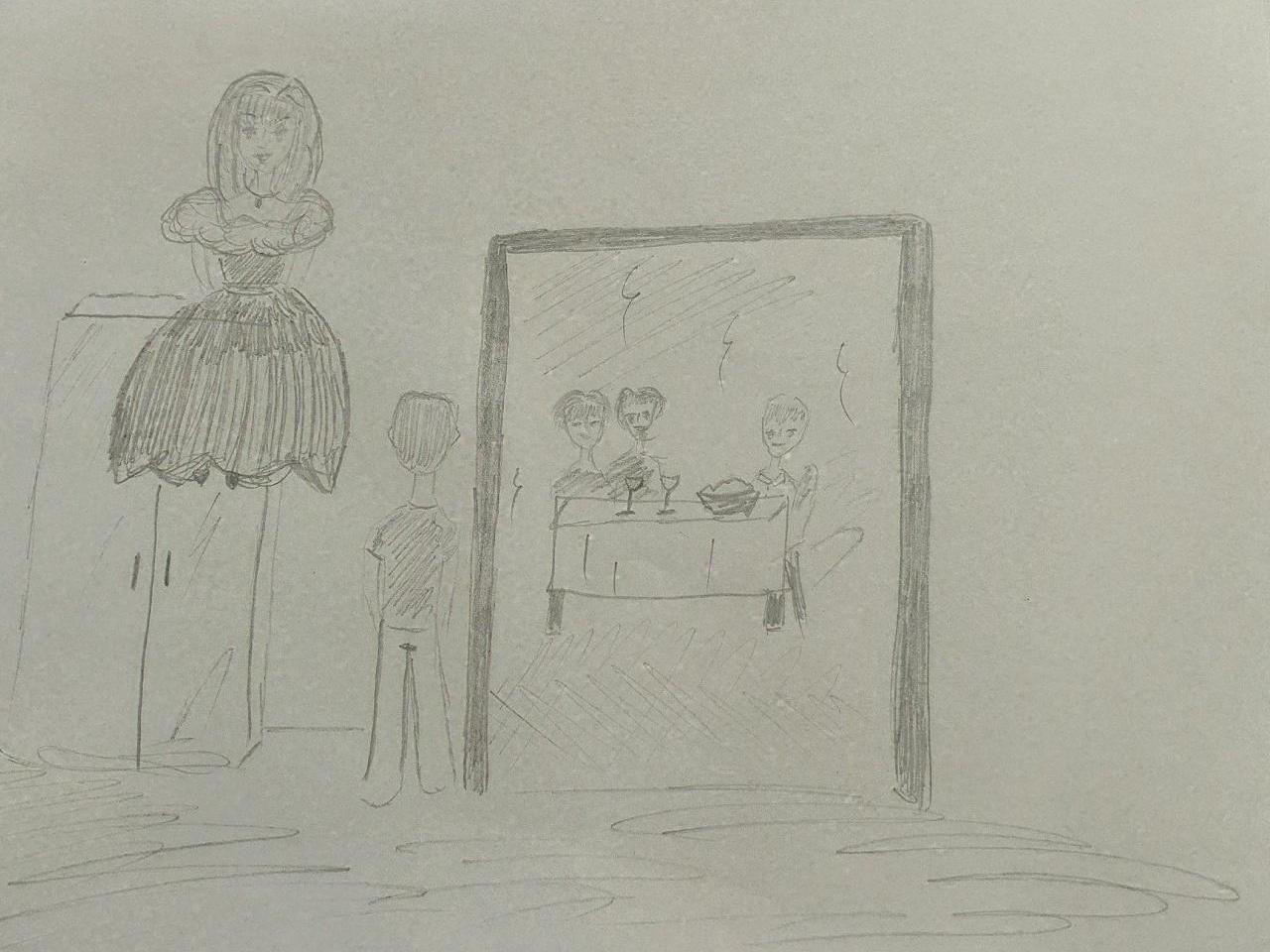
We decided to conduct a small experiment. Immediately after the interview, the psychologist gave me an assignment — to draw my dream. As luck would have it, after this meeting I didn’t see anything memorable at night. And a couple of days later this appeared (I attach the description I sent to the expert).
Some kind of holiday, it’s not entirely clear where, but it’s something between a spacious apartment and a community center (of that old, slightly rustic type). I feel like an invited guest, but for some reason I don’t dare enter the hall where my acquaintances are sitting, among whom, by the way, are former suitors (I don’t know anything about their fate and haven’t even thought about them). There is music, beauty, some confetti. For some reason, I end up sitting on a wardrobe (brown, lacquered, old) near the entrance. I’m having fun there too, and no one thinks I’m strange. I’m wearing a fluffy green dress. Some person came up to me (I don’t remember the face, but I feel that it’s someone close) and said that I would be welcome there. And asked me not to be shy. In the dream I make jokes, giggle, but agree to go inside. There I see familiar faces and for some reason try to please them… I only remember that the atmosphere was pleasant. We had a great time (laughs).
As it turned out, the psychologist needed more than just one drawing. She asked me to answer a series of questions. For example:
With what feeling did you draw the picture?
What thoughts came to mind?
What do you feel looking at the drawing? Do you like it or not? Does anything in it alarm or frighten you?
What would you say about this drawing if you imagined the author was unknown to you?
Which figure dominates the drawing, in your opinion? What might that mean?
Who or what do you think is the key figure in the drawing (what is important), and what is just background? Why did you choose this key figure? How does this relate to you?
Are there characters or things in the drawing that are emotionally charged for you? Why do you think?
What is different in the drawing from the dream or in me from the drawing? What is added/invented or accidentally forgotten/ignored? Analyze this difference — could it indicate something?
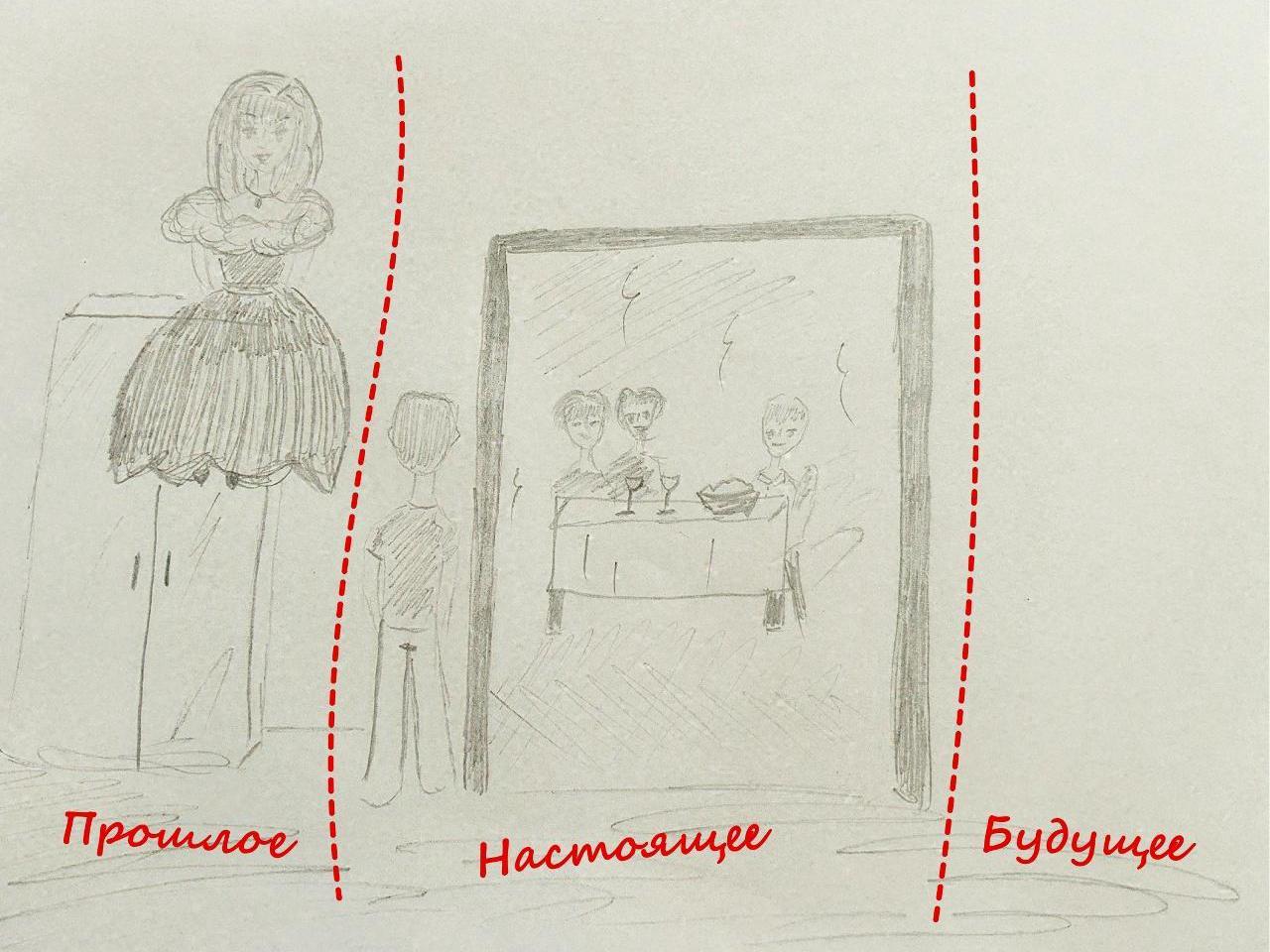
And here is the diagnosis, that is, the verdict of Olesya Kondratyeva, who analyzed the journalist’s dream. It turned out that not only the plot is important in the drawing, but also its placement.
— This is definitely a dream from the unconscious. Since it does not reflect your current life today. Think about when you “look strange” or behave strangely — is it a fear of not being accepted? And the opinion of men seems to be more important…
Climbing onto the wardrobe is some kind of metaphor, being higher, like on your parents’ shoulders. Perhaps you need some support from them?
The holiday is perhaps life that goes on, but which you perceive through the prism of anxiety about fitting into it.
In your “future” there is nothing — a white sheet. That is, no goal, no idea where to go. While the past and present are quite rich. Former suitors don’t necessarily symbolize themselves; the brain could have simply used them to denote some stage in life, an attitude towards something, or even other people from the past. This black frame in the center of the drawing just says that you have fenced yourself off from something or someone.
I especially want to analyze how you drew yourself. The hair is very voluminous, the hem of the dress is heavily shaded, the collar on the shoulders… That is, you see, it’s not even the dream that matters, but the drawing. Bright accents are what you need to pay attention to.
Your figure in the drawing is dominant. This may mean that you would like to rise above significant people and are trying to decorate yourself, become noticeable for that.
This voluminous element of the dress on the shoulders resembles either a lifebuoy or a yoke. Most often this means that you are carrying some heavy burden on your shoulders. The dress hid your legs, you are somewhere in the air, as if detached from the ground. Perhaps you are cut off from connection with your family. Your hands are also hidden — this is about your unwillingness to contact someone, possibly the people in your drawing.
Fluffy hair — many thoughts. And the necklace — about unexpressed anger (interesting, what about your unexpressed aggression?).
But all this is metaphorical, of course, it is important to analyze the drawing, the dream, and your feelings in a personal meeting with a psychologist.
What Else to Read on This Topic
If the topic of dreams doesn’t let you go, read our other materials. Sleep disturbance is one of the side effects of COVID-19. And sleepwalking is a sign that you need to see a doctor urgently, because it is one of the symptoms of a brain tumor. Read about what else your sleep can tell you in an interview with a Tyumen somnologist.
Another doctor explained that lack of sleep can lead to significant weight gain — read about the main mistakes.