Volgograd doctor warns of nasal drops’ danger


Nasal decongestant drops can cause dependency and severe complications requiring surgical treatment.
With the arrival of autumn and cold weather, swarms of dangerous bacteria and viruses descend on the city. Endless runny noses, congestion and terrible headaches — all are constant companions of residents in fall. Trying to save their noses from rhinitis and reclaim the freedom to breathe, residents of Volgograd liberally pour vasoconstrictive drops into their nasal passages, thereby exposing their health to even greater danger.
«I was pouring in drops every day, then they cut me with a scalpel and told me I got off easy»
Anastasia had suffered from a runny nose since childhood, depriving her of the ability to breathe. From a young age she got hooked on vasoconstrictive drops for nasal congestion and became dependent on them, like a true “drop addict”.

Adults often start children on decongestant drops, leaving them to endure harmful long-term effects.
«As a child, when I got sick, my nose was often stuffed up, — Anastasia says. — When I was about 10, my father suggested I try the vasoconstrictive drops he himself was very fond of. At first the drops were a real salvation for me. After them the congestion went away and I could breathe normally. I used the drops quite often, especially at night».
Over time, Anastasia noticed her nose was getting congested more often, and without the drops the blockage would not go away. She had to use them much more frequently.
«I already had to stream them into my nose — only then did they have any effect. Then even that stopped helping. Naturally, I had to see an ENT doctor, — the young woman recalls. — It turned out the drops had made me dependent and caused major problems with the nasal mucosa, which only made the rhinitis and congestion worse. There was swelling and inflammation of the mucosa along with unending rhinitis».
Doctors prescribed physiotherapy and massages, and issued various ointments and nasal sprays that were supposed to heal her nose and help her get off the drops. However, all the medicines and procedures had too weak an effect.
«At first I had ultrasonic disintegration of the inferior nasal turbinates. This operation is considered more sparing, but it didn’t help. A year later I had to undergo inferior turbinate conchotomy and have the overgrown tissue cut out with a scalpel, — she says in a nasal voice. — That was already a major, bloody operation. I lay there with my nose bandaged, but I knew that scraping with a scalpel inside me — that was a necessary measure. After the surgery I also had physiotherapy and treatment with other medications, and I finally started breathing normally. I was forbidden to use vasoconstrictive drops, and I haven’t used them since».
«The mucosa will overgrow — then you’ll have to cut it off with a scalpel»

Complications from chronic drop use may ultimately require intervention by an ENT surgeon.
Vasoconstrictive drops are a treacherous drug that promises relief from congestion while causing strong dependence. With prolonged, uncontrolled use, instead of benefit they bring serious problems and diseases. Just how awful the consequences of nasal decongestant drops can be was explained by Natalya Tarasova, head of the Department of Otorhinolaryngology at Volgograd State Medical University (VolgGMU), an expert with the project “FaktChek: Health Without Myths”.
— Vasoconstrictive drops cause habituation if you use them more than 3 times a day and for longer than 5 days. If such a drug is used for more than 3–5 days, it affects the structure of the epithelial lining of the nasal cavity, disrupting its regeneration. Ciliated epithelium turns into squamous — that is, epithelial metaplasia occurs: it is replaced by simpler types of epithelium, which disrupts the structure of the nasal cavity and leads to an atrophic process and nosebleeds. Drops can also lead to the opposite process — excessive division of ciliated epithelial cells and the development of connective tissue in the inferior nasal turbinates. This is called hypertrophic rhinitis.
The doctor notes that with prolonged use, drops can even provoke oncological diseases.

Dependence on nasal drops develops like addiction, leaving sufferers unable to breathe unaided.
— Use of drops for more than 5 days is not recommended, — says Dr. Natalya Tarasova. — To get rid of dependence on drops and stop using them, you just have to stop. The function of nasal breathing recovers within a day after quitting. This is the main method for combating the constant use of vasoconstrictive drops.
As the doctor says, conservative methods for treating overgrown mucosa are usually quite effective. Special sprays, ointments, massages and physiotherapy really do help many patients, but in a number of cases doctors resort to surgical interventions.
— Surgical interventions are performed to remove the nasal mucosa, widen the nasal passage and restore nasal breathing. There are several such procedures targeting the inferior nasal turbinates, — explains Natalya Tarasova. — The most sparing operation is ultrasonic disintegration of the mucosa; as a result, a connective-tissue scar forms at the site of the destroyed tissue, the lumen of the nasal passage widens and nasal breathing is restored. Sometimes this procedure does not help; then a more serious surgical intervention follows — inferior turbinate conchotomy, or mechanical conchotomy. Using a knife-like instrument, the surgeon excises the diseased turbinate and its mucosa, up to operating on the turbinate’s bony tissue.
«The more you drip, the worse your vision gets»
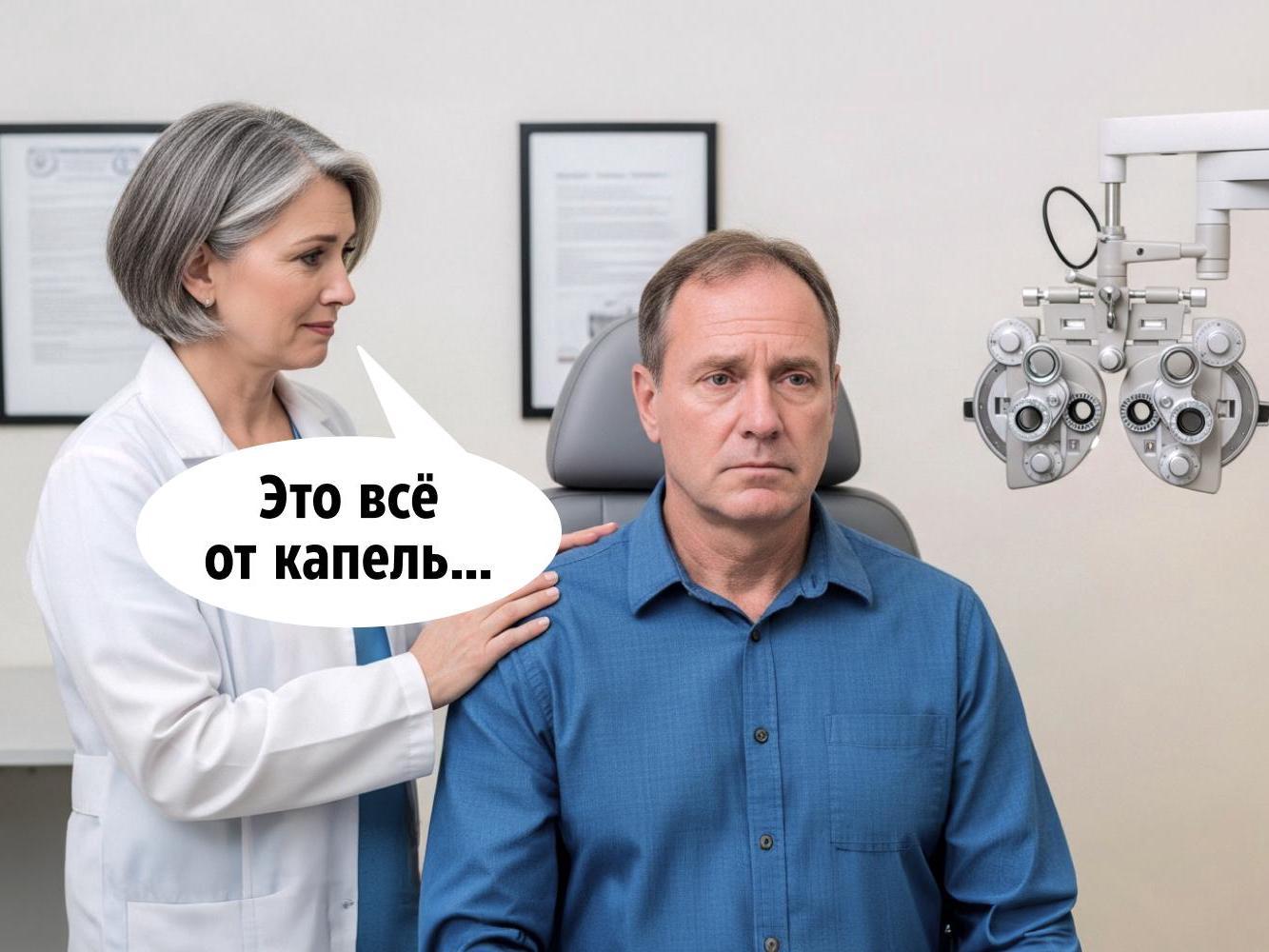
Prolonged use of nasal decongestants increases intraocular pressure and the risk of glaucoma.
A vasoconstrictive drug harms more than just the nose. As Dr. Natalya Tarasova warns, this dangerous remedy threatens the health of the whole body — first and foremost the eyes, which, due to their proximity to the nose, are in a special risk zone.
— The drops are absorbed in the nasal cavity and, together with the blood, travel through the eye into the cranial cavity. Thus they produce a vasoconstrictive effect in all the vessels into which they enter with the blood. And that is not only the nasal cavity — it is also the vessels of the eye, as well as the cranial cavity.
Prolonged use of the drug has been proven by doctors to lead to the development of many eye pathologies, including glaucoma.
— Vasoconstrictive drops stimulate secretion by the ciliary body, which synthesizes aqueous humor, — the doctor explains. — With its excessive secretion and insufficient outflow due to drainage dysfunction of the eye, intraocular pressure may rise. Ultimately this leads to glaucoma — a disease characterized by high intraocular pressure and, subsequently, atrophy of the optic disc, which results in vision loss. If a patient already has glaucoma, the use of vasoconstrictive drops is contraindicated.
«Heart rhythm disorders and vascular disease»
Treacherous nasal drops inflict colossal harm on the entire body. Experts warn that decongestant drops damage the heart and blood vessels. The longer a person drips them into the nose, the more problems they have with blood pressure and heart rhythm. Older adults are in a special risk group.
In addition, with overdose the drops spread to the heart and from the heart are ejected into the systemic circulation. The drug contained in the drops can cause constriction of the vessels of the cranial cavity, as well as a vasoconstrictive effect in the heart and kidneys.
— With long and frequent use of vasoconstrictive drops, systemic effects of these substances — sympathomimetics that affect all vessels in the body — may appear, leading to vascular spasms and elevated arterial pressure, — the doctor says. — Systemically this manifests as spasms of all vessels and an increase in arterial pressure and cerebrospinal fluid in the spinal cord and brain. As a result, headaches, dizziness, central nervous system dysfunction, and heart rhythm disturbances appear: extrasystole, tachycardia, arrhythmia. Systemic effects are particularly significant in elderly and senile patients. Therefore drops are far from a harmless medication.
As an alternative for patients suffering from nasal congestion, the otorhinolaryngologist recommends seawater-based preparations. They do not act on vascular receptors and at the same time have a beneficial effect on the structure of the mucosa, helping to combat the common cold.