Toyota crash on Okyabrsky bridge highlights road safety issues
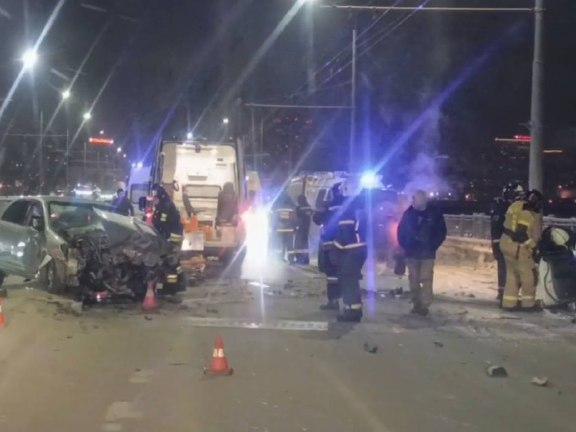

If traffic jams from snowfalls can still be explained—sometimes the Siberian winter is so fierce that road workers can«t keep up—then roads left uncleared in clear, frosty weather are, to put it mildly, surprising. Especially when accidents occur against the backdrop, or even because of, the state of these streets. Last Friday, January 23, just such an accident happened on the Okyabrsky bridge, and only a miracle prevented fatalities in the collision of several cars. NGS reviewed the footage with the head of the Novosibirsk office of the Federation of Car Owners of Russia (FAR) to determine who was at fault.
Friday evening, January 23, around 8:30 PM. Traffic on the Okyabrsky bridge was relatively light in both directions, but most drivers weren«t taking risks by speeding: they respected the traffic rules, and the bridge»s condition didn«t inspire universal confidence. Only the driver of a Toyota Corolla heading to the left bank decided to accelerate, and that was a big mistake.
“The driver lost control, entered the oncoming lane where he collided with an oncoming Subaru Forester and a UAZ Patriot,” the traffic police reported. “As a result of the accident, the 30-year-old Toyota driver, his passengers—a 29-year-old woman and a 2-year-old boy—and the Subaru Forester driver were injured.”
All the injured were taken to the hospital for thorough examination, and witnesses to the accident—both those who saw the terrifying crash firsthand and those who later watched the dashcam video posted in the AST-54 community on VKontakte—seriously pondered who was to blame. Clearly, the Toyota driver was going too fast. But did he have any chance of staying safe, given the bridge«s condition?
“When driving from the right bank, there«s a huge snowdrift that»s been there since New Year«s. On the turn, the third lane is missing; [all traffic] doesn»t fit. It«s always a hazardous situation. On the bridge itself, there are ruts and awful seams. Snow isn»t cleared from half a lane on the sides. From Gorskaya, snow cannons constantly create fog that settles as a glaze, making the asphalt quite slippery. There«s plenty of room for error there,” described the dismal state of the bridge Vitaliy D.
Experienced drivers were also troubled by the asphalt«s condition.
“Maybe there«s a rut, especially on the far right? I was driving no more than 60 km/h in an all-wheel-drive car, and when changing to the middle lane, I was thrown so hard that I crossed myself,” another subscriber, Alexander T., said.
“Besides the rut, there are also the span seams—in icy conditions, that«s enough to make the car skid,” agreed a user under the nickname Brundulyak Ivanovich.
Other commenters immediately countered: maybe the road isn«t the best, but who made the driver speed on it?
“They blame the ice, snow, frost. But they don«t see that [the speed limit] is 40 km/h,” lamented Evgeny Gennadyevich.
“If everyone just followed the speed limit in winter and didn«t mess around, there»d be less of this on the roads,” Ivan K. stated sadly.
The discussion ran in parallel under two posts and quickly devolved into an exchange of emojis depicting roosters and deer—reaching what might be called the ideal level of driver debate.
NGS posed the question of whether this was a straightforward accident with the Corolla driver solely at fault to Vyacheslav Ashurkov, head of the Novosibirsk representative office of the Federation of Car Owners of Russia (FAR). According to the expert, the Toyota driver was indeed the culprit in the multi-vehicle crash, but there«s a nuance.
“Clause 10.1 of the Traffic Rules states: ‘The driver must operate the vehicle at a speed that ensures safe movement, allows for stopping, and does not hinder other traffic participants,’” quoted Vyacheslav Ashurkov. “From this, we conclude: if you see a rut on the road, slow down and drive carefully. The fault definitely lies with the Corolla driver. But [there is another] factor that led to this accident.”
Vyacheslav Ashurkov knows all too well about the situation on the bridge on January 23, 2026: around the same time that day, he himself was in two potentially dangerous situations. First, the expert said, he took the right lane and got caught in a rut, from which he was almost ejected. The experienced driver lifted off the gas and, without braking, carefully extricated himself.
After switching to the left lane, Ashurkov recounted, he encountered a new obstacle—a square snow ridge left by snowplows in the middle of the road—and nearly slid sideways into oncoming traffic himself, which would have “adorned” the incident report with a similar crash at the other end of the bridge.
“My view is this: the Toyota driver is undoubtedly at fault. But when a serious accident happens, everything is considered, all road factors, including the road condition. And the bridge at that time was cleaned absolutely terribly,” the expert stated.
To learn how often the bridge is cleaned, when it was last done, and if ruts are present, NGS sent an inquiry to the Novosibirsk mayor«s office.
In November of last year, in Novosibirsk«s Kochenevsky district, a driver also veered into the oncoming lane and nearly killed people in an oncoming car. We investigated whether that collision could have been avoided.