Developers to Pay 100 Billion Rubles in Penalties

The Samolet Group«s request for 50 billion rubles ($550 million) in budget funds did not come as a surprise to the market. The company»s serious problems were known, and by the end of the year, similar difficulties may await about a dozen other major developers and their clients. In December, the moratorium on paying penalties for delayed delivery of homes expires, and preliminary estimates of required payments exceed 100 billion rubles ($1.1 billion). No sources for these funds have been found yet.
Samolet Group CEO Anna Akinshina wrote in a letter to Prime Minister Mikhail Mishustin: «Given the adjustment of the preferential mortgage program to prevent default on obligations to shared-equity holders and investors, we ask that the possibility of providing the company with a concessional loan or other stabilization instrument in the amount of 50 billion rubles for up to three years be considered as a support measure.» In exchange, she offered a blocking stake with a right of repurchase and the attraction of additional financing of 10 billion rubles ($110 million). The document does not specify what the state will do with the 25% stake if budget funds prove insufficient and the company goes bankrupt.
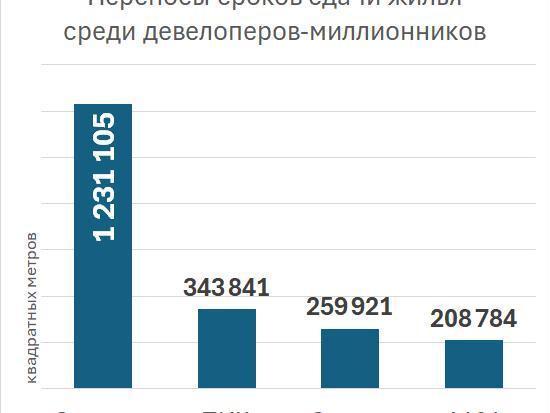
Market participants note that Samolet leads the industry in postponing project completion dates. The accumulated volume of apartments with delayed handover amounts to 1.2 million square meters. Until December 2025, this did not entail serious financial consequences, but from January, significant penalties began to accrue for each untimely transferred apartment, which the company cannot pay.
I Believe That«s Enough
The issue of extending the moratorium on calculating penalties for developers was raised by President Vladimir Putin in December 2025. Initially, this measure was introduced in 2020 as part of support for the construction industry during the pandemic. Unlike other sectors, such as shipbuilding or road construction, apartment buyers were unable to receive compensation for delays for several years. Putin said: «I believe that»s enough. And I ask the government not to extend these moratoriums.« He emphasized that keys should be handed over to new residents on time, and builders» difficulties should not be solved at their expense. «Overall, we need to establish systematic work related to developers fulfilling their obligations,» the president added.
How It Worked
The moratorium on accruing penalties was first introduced in April 2020 during the lockdown. Initially it was in effect until January 1, 2021, but was subsequently extended several times. In March 2024, the government established a moratorium until December 31, 2025, with the possibility of extension until the end of 2026. When calculating penalties, periods of the moratorium were not to be considered: from April 2020 to summer 2023 and from March 2024 to December 2025. Even court-awarded payments did not have to be made by developers until the end of 2025. A fixed rate of 7.5% was used to calculate fines, although it is usually tied to the key rate of the Central Bank of Russia (CBR).
Massive Payments
The construction lobby managed only to delay payment of the accumulated amounts until the end of 2026. However, all court decisions made after January 1, 2026, are subject to immediate enforcement. In addition, the fixed rate of 7.5% was canceled, and now the amount of penalties is again tied to the key rate, making delays more costly. Thousands of lawsuits from shared-equity holders have already been satisfied in courts, and as many are pending. The amounts include penalties, fines, compensation for moral harm, and legal costs. Courts often reduce the amount of payments, considering them disproportionate, but the total amount of awarded funds, according to estimates, reaches 100 billion rubles ($1.1 billion). This figure was announced at a meeting in the Ministry of Construction (Minstroy) with the participation of heads of leading developers. Since lawsuits continue to be filed, the final amount may increase.
Developers argue that immediate payments will lead to mass bankruptcies of special-purpose developers — subsidiaries on whose permissions and accounts the projects are registered. This, in turn, will provoke an increase in unfinished construction, rather than accelerate the handover of homes.
Leaders in Delays
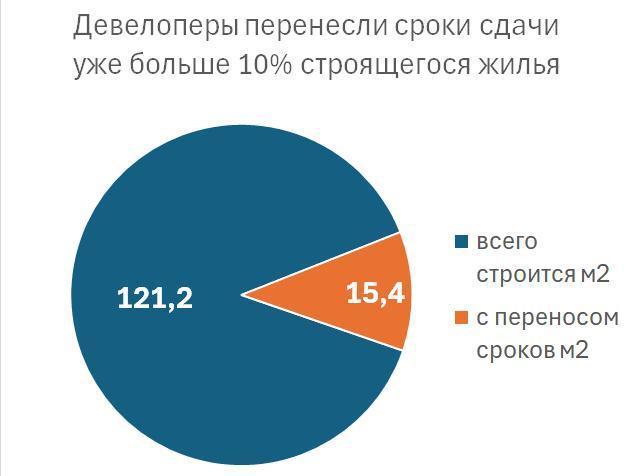
According to the Unified Developer Registry (Yediny Resurs Zastroyshchikov, ERZ), as of February 1, out of 121 million sq. m of housing under construction nationwide, delays were noted on 15.4 million sq. m. With an average apartment area of 48.8 sq. m, this means about 315,652 buyers have faced postponements. Developers often use legal tricks, such as persuading shared-equity holders to sign additional agreements to change dates, threatening bankruptcy. Those who do not agree are offered to terminate the contract and return the money, which is particularly disadvantageous for mortgage holders who have already paid interest.
Why There Is Not Enough Money
Despite the project financing system and escrow accounts, which are supposed to provide construction with funds, developers sometimes postpone applying for tranches to reduce interest costs. The loan rate depends on the degree of filling of the escrow account, i.e., the volume of sales. Therefore, some companies wait for sales to grow, which leads to pauses in construction and delays in handover.
There Are Reasons
Among the 14 largest companies with construction volume over 1 million sq. m, only four have no delays:
- LSR Group (St. Petersburg)
- Setl Group (St. Petersburg)
- SSK (Krasnodar)
- YugStroyInvest (Stavropol)
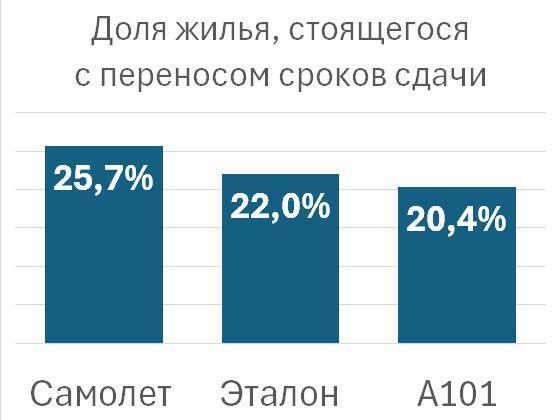
For Brusnika from Yekaterinburg, delays affect only 1.26% of area. For PIK Group — 8.3%. The anti-leaders are Samolet, A101, and Etalon.
Samolet Group, Russia«s largest developer, has a total debt of 952 billion rubles ($10.6 billion) against revenue of 339 billion rubles ($3.8 billion) and net profit of 8.1 billion rubles ($90 million) for the first half of 2025. The company has faced a series of crises, including the death of its main owner and the seizure of a project in favor of the state. In response to a request about the reasons for delays, Samolet did not provide comments, but a top manager stated a strategy aimed at stabilization and cost optimization.
A representative of the A101 Group explained the delays by a shortage of labor, rising material prices, a high key rate, and a reduction in preferential mortgage programs. He noted that the personnel shortage will remain relevant in 2026, and to solve the problem, it is necessary to increase the prestige of construction professions. He also emphasized that minor postponements in current conditions are a working situation, especially if the developer informs shared-equity holders in a timely manner and demonstrates an intention to solve problems. The company has high credit ratings from Expert RA and ACRA.
In Etalon, they indicated that the share of projects with delays is about 20%, which is lower than other developers of comparable scale. Among the reasons are tighter regulatory requirements, especially in the Moscow region, the need to replace imported materials and systems, a shortage of qualified personnel, and unforeseen geological conditions. The company emphasized that postponements are often a conscious choice in favor of quality and reliability of projects.
Thus, adjustments to timelines for large projects are due to working in difficult conditions and changing standards. For buyers, choosing such a developer means investing in a project where quality is placed above formal deadlines.