Perm fires and flickering lights: grid overload?
We spoke with EMERCOM, Rosseti Ural, and a Perm Polytechnic scientist about a series of major fires and power outages in Perm.
Apr 25, 2026 0
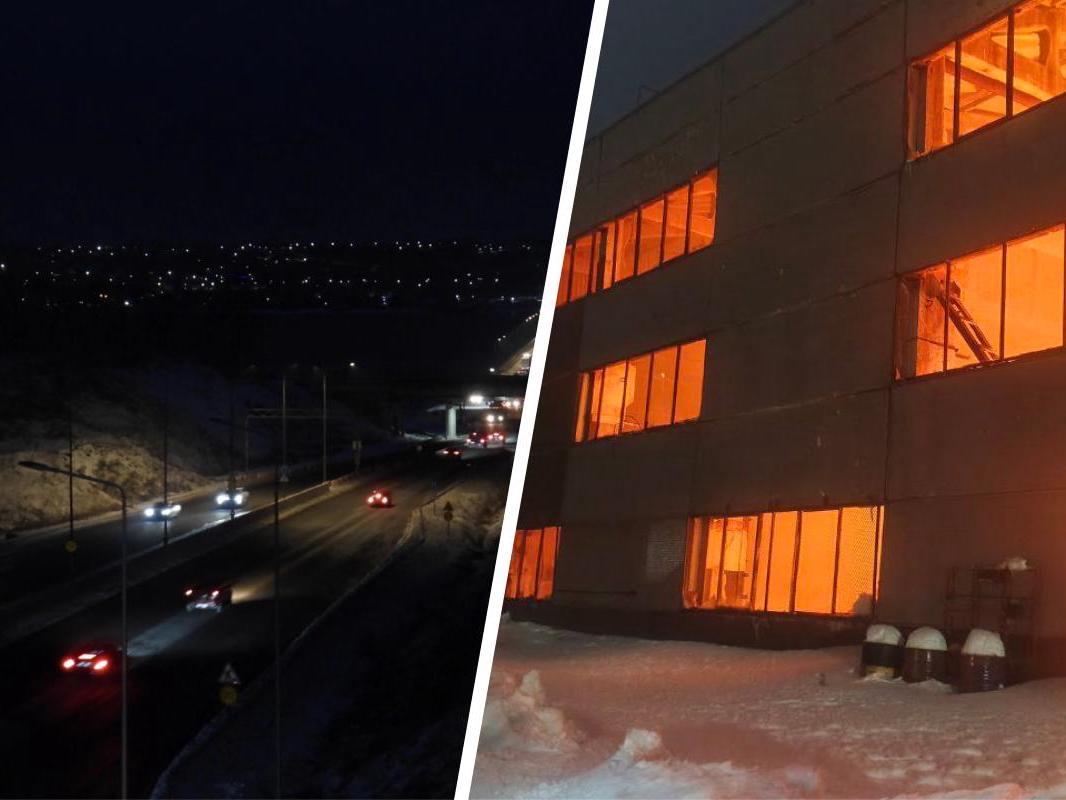

Recently, Perm has seen high-profile fires and frequent power outages — potentially linked to grid issues.
Source:
Over the past couple of weeks, Perm has experienced several major and notable fires: garages, an auto repair shop, a warehouse once belonging to a factory, and even a kiosk in an ice town on the esplanade caught fire. In the latter case, the cause was a short circuit, and on top of that, Permians constantly complain about power outages or accidents on the grid, leaving several houses without electricity at once.
The Chusovskoy Bridge in Perm had no lighting for a period in late 2025.
Source:
The 59.RU editorial team investigated whether these major fires are linked to problems in the power grid and whether prolonged frosts affect the voltage. We discussed this with EMERCOM for the Kama Region, PJSC Rosseti Ural, and a scientist from Perm Polytechnic.
Even the newest equipment can fail under excessive loads during peak usage.
Source:
Several fires in a row
Lights can flicker for reasons other than short circuits.
Source:
The next day, 27 January, a building with auto repair shops near the «TETs-6» stop caught fire (link). Video footage circulating on social media showed flames engulfing the second floor, which was later confirmed by EMERCOM. Various companies operated there, including a pre-trip inspection center and an auto glass repair center.
On 28 January at 06:15, a 15-meter one-story warehouse—an annex to a four-story office building at 59 Dzerzhinsky Street—caught fire (link). EMERCOM for the Kama Region reported that the fire covered 1,000 square meters, and traffic was closed on Dzerzhinsky Street, causing major traffic jams (link). Firefighters worked on site all day; the fire was extinguished only around 8 PM, with 94 EMERCOM personnel and 26 units of equipment deployed.
Sources from the city rescue service told 59.RU what burned and how the fire was fought. Cardboard boxes and wooden pallets caught fire, but what was in the boxes was unknown. The flames quickly heated the load-bearing structures, and the metal beams softened under the enormous heat and could have bent—there was a threat of the entire building collapsing.
«Its peculiarity is that a concrete roof weighing several tons lies on these structures,» a source shared with 59.RU. «The roof could have collapsed along with the melted beams. The fire turned the premises into a blast furnace, with enormous temperatures at the epicenter.»
Also, several 59.RU sources noted that the fire occurred in a former workshop of the Dzerzhinsky Plant (ZID). Fortunately, no one was injured in any of these incidents. However, the causes of three out of four incidents had not been previously disclosed.
What EMERCOM says
EMERCOM told 59.RU that procedural checks are underway for all fires, and the exact causes will be known only after expert examination. However, the version of electrical equipment malfunction is considered one of the most likely.
Flickering lights across Perm
In addition, since January, Permians have complained about power outages: lights flickering in homes and appliances turning off and on by themselves. For example, mass reports of flickering lights appeared on social media on 22 January. We conducted a poll in our Telegram channel confirming that electricity was cut off in different districts of the city. Readers mentioned Gaiva, Molodezhny, Parkovy, Nagorny, Zagarye, and the Krokhaleva microdistrict.
At that time, Rosseti Ural clarified to us that on that evening there was an emergency shutdown on a 110-kilovolt power line. Electricity was automatically restored almost immediately without the involvement of specialists.
Recently, there have been more frequent outages and accidents on the grid—such as prolonged blackouts affecting several houses in different districts at once. On 29 January, a technical disruption occurred in a 6-kilovolt distribution network in the Razgulyai microdistrict, leaving houses on Gorky, Klimenko, and Dostoevsky streets without power for a while. On 30 January, a disruption in a 6-kilovolt network also occurred in the Leninsky district—several houses on Monastyrskaya, Gazety Zvezda, and Sovetskaya streets were left without electricity. Power was restored after about two hours.
What Rosseti says
In response to 59.RU«s inquiry about the reasons for the outages and whether prolonged frosts affect the grid, Rosseti said that power supply quality issues often arise in non-gasified developing populated areas, but »energy workers are trying to improve the reliability and quality of power supply.« The company also notes that due to heavy loads during frost periods, when Permians» energy consumption increases and exceeds technical standards, even the newest equipment cannot withstand it.
«Thus, preferential technological connection up to 15 kilowatts under the third reliability category is designed for household electricity consumption without using it as the main source of heating,» Rosseti«s press service explains. »There are cases of applications for 5-10 kilowatts, while actual energy consumption, when using electric boilers for heating residential houses, is recorded at up to 35 kilowatts per house, which is several times higher than the calculated standard load on electrical networks. This is not about isolated cases, but about a massive exceeding of consumed electrical power.«
Preferential technological connection is the right of individuals to connect an object to the power grid at a reduced rate. Connecting 15 kW at a reduced cost is allowed only once every 3 years within the same region of the Russian Federation. The connection must be at a voltage level of 0.4 kilovolts.
Moreover, the company adds that by law, the supply organization does not have the right to demand project documentation of residential buildings from the applicant to calculate the need for electrical power or to design a power reserve beyond the standard. Also, the company does not have the right to require residents of non-gasified areas to submit applications for technological connection.
«It should be especially noted that in conditions of chaotic individual development of these populated areas, reconstruction of the electric grid economy is only a point measure that can temporarily solve the existing problem of power quality,» says Rosseti Ural. «Moreover, the construction of new residential buildings will only exacerbate the problem for existing ones.»
«You definitely shouldn’t turn on many electric heaters at the same time»
We also spoke about flickering lights and the danger of grid overload with Anatoly Perminov, head of the General Physics Department at Perm National Research Polytechnic University (PNRPU), Doctor of Physical and Mathematical Sciences. The scientist notes that flickering lights may not be related to short circuits.
«How does a short circuit occur?» says our interlocutor. «Two wires come to a socket and suddenly for some reason they connect—there is a sharp heating of the wires. A discharge may occur and there is indeed a risk of fire. If we are talking about flickering, it may be due to a malfunction of the lamp itself or the wiring in the house.»
Nevertheless, interruptions may also be related to more global issues—something happened on the power supply organization«s networks. Anatoly Perminov notes that local problems in an apartment, for example, can be identified by a characteristic smell and crackling, like when two wires touch. If none of this is present, the problem may be more global.
Also, the scientist notes that frosts can greatly affect the operation of power grids. For example, due to temperature changes, wires or poles may become icy—our interlocutor recalls a recent case in Murmansk Region where four power lines were damaged and fell due to frost. Or, wires or poles may be covered with snow, and under its weight, equipment may also be damaged.
«The massive use of electric heaters also loads the power grid,» says the scientist. «Therefore, you need to ensure that the power stated on the electric appliance or heater does not exceed the power that can pass through the fuses. An excessive number of electric heaters turned on inside an apartment can lead to overheating of the wiring. And this can lead to bad consequences, including fires. Especially if we are talking about some fairly old houses like Stalin-era or Khrushchev-era buildings. Simply put, you definitely shouldn’t turn on many electric heaters at the same time.»
Earlier, together with a Perm electrician, we analyzed why it is dangerous to hold a charging phone and a heating radiator (link).
Read more