Natural Selection: 6 Details of Theo Jansen’s Kinetic Sculptures
Dutch artist Theo Jansen has been creating wind-propelled 'beach beasts' that learn from nature and evolve through a process akin to natural selection for over three decades.
Apr 20, 2026 0
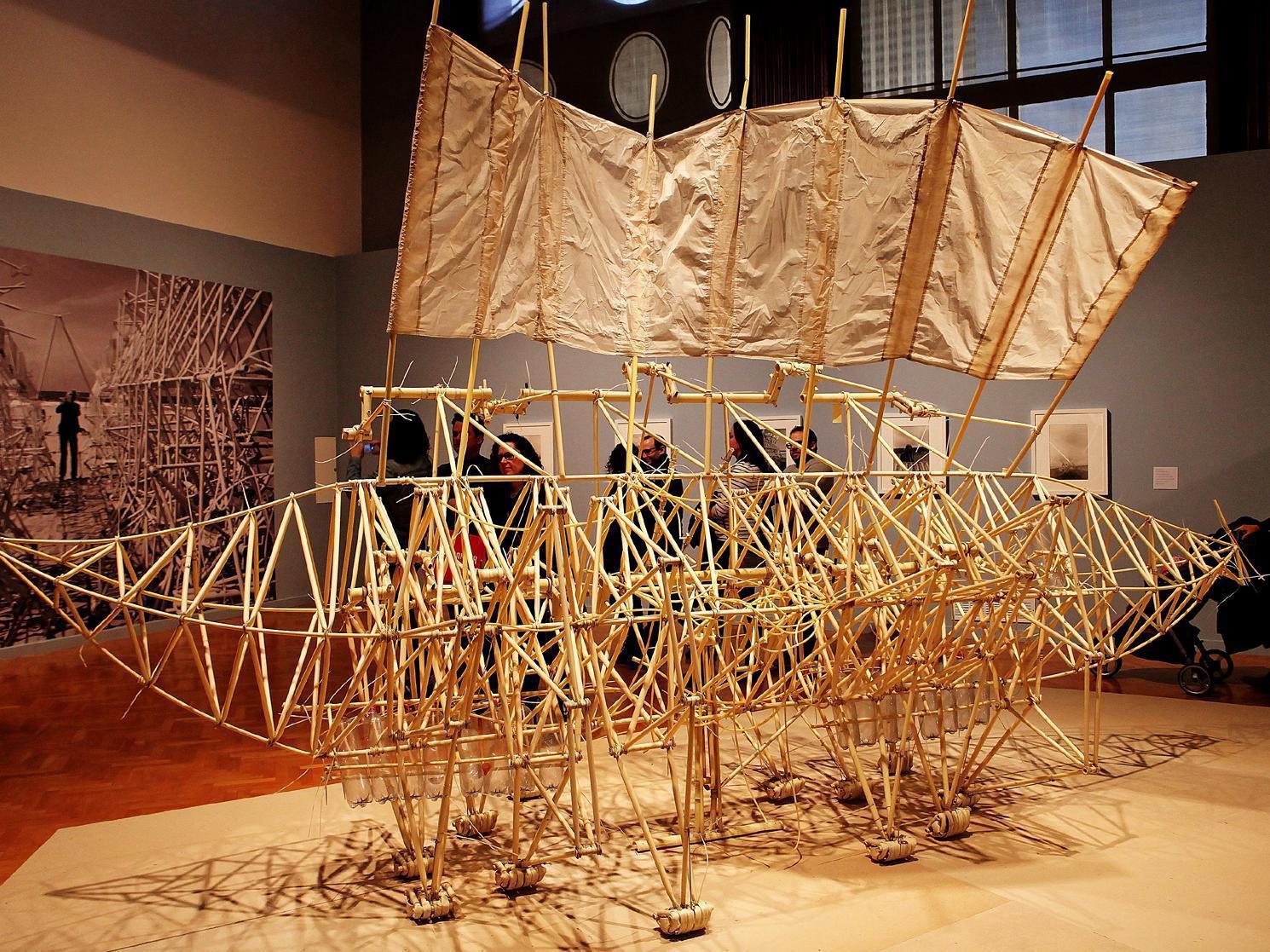

The kinetic sculpture «Animaris Adulari» (2012) by Theo Jansen is one of his iconic beach beasts that moves with the wind.
Source:
«They allowed me to create myself,» says the Dutch artist about his amazing creations known as Strandbeesten, or «beach beasts.» The project was born from a newspaper column in which Jansen, discussing the threat of rising sea levels, proposed building mechanical animals to reinforce coastal dunes. The idea captivated him and grew into a multi-year experiment that has lasted for more than three decades.
Each year, the artist constructs new creatures and releases them on the North Sea coast, observing which designs survive in the winds and sands. Jansen compares this process to natural selection, and names his creations in analogy with biological nomenclature, marking key stages of their «evolution.»
One such «species» is Animaris Adulari, created in 2012. This kinetic sculpture, made of PVC tubes and measuring about 3.2×5×2 meters, can not only walk under the influence of wind but also «sweat,» washing sand from its «vessels.» The name is composed of the English animal, the Latin mare (sea), and adulare (to flatter). According to Jansen, a flock of these creatures on the beach resembles playful dogs.
1. Material. If the basis of life is proteins, then for the «beach beasts» the building material became ordinary plastic tubes for electrical wiring. They can be bought in any hardware store in the Netherlands — as the artist himself once did.
2. «Legs.» The walking mechanism is the heart of each sculpture. Jansen calculated the optimal proportions of 11 articulated parts using a computer program. The principle that converts rotation into a step goes back to the walking machine of the 19th-century Russian mathematician Pafnuty Chebyshev.
3. «Wings.» Sails that resemble wings or fins catch the wind — this is the main source of energy for the creatures. Without them, they would not be able to travel across the vast beaches.
4. «Stomachs.» Plastic bottles work as air reservoirs. The air accumulated in these «stomachs» helps the sculptures move even in calm conditions, providing a reserve of energy.
5. «Muscles.» Air is pumped through a system of tubes inserted one into another — these are simple but effective «muscles.» As Jansen explains, in his creations «muscle and bone form a single whole,» making the structure light and strong.
6. «Feelers.» Movable tubes on the nose of the sculpture act as sensory organs. They detect when the creature comes too close to the water and make it turn around to avoid danger.
Jansen«s project lives on today. His »beach beasts« continue to evolve, gaining new abilities, and thanks to 3D printing, their reduced copies »multiply« around the world. The artist»s works travel to museums, reminding us that engineering can learn from nature — not as a temple, but as a great workshop.
Read more