Yekaterinburg Woman Debunks Abkhazia Myths, Shares Costs


A Yekaterinburg traveler gave an honest account of her recent trip to Abkhazia.
Abkhazia is one of the most picturesque and unique places in the Caucasus, where Russians need neither a foreign passport nor a visa. In recent years, this republic has been gaining popularity among tourists, attracting them with its nature, clean sea, wine, and affordable prices. And since July 1, direct flights from Yekaterinburg to Sukhum have appeared, operated by Ural Airlines.

A comfortable outdoor lounge was created for passengers at Sukhum airport.
E1.RU journalist Daria Kostomina tested the new destination: she gave a detailed account of prices and also debunked many stereotypes about this country.

The spacious and beautiful waiting area at the new airport terminal is inviting.
Before this trip, I was told: «It’s beautiful there, but the locals see you as a walking wallet»; «There’s nothing but ruin and no service»; «It’s all crime»… I listened to the horror stories and didn’t bring any cash (the official currency in Abkhazia is the Russian ruble). That decision was my biggest mistake, because for the rest of the trip I had to pay by transfers. As luck would have it, I didn’t even have a suitable bank card (they only accept Mir and Mastercard).

The hotel where the traveler stayed has a large pool and includes meals.
But such a trifle couldn’t spoil my trip. I started it at Sukhum Airport named after V. G. Ardzinba, which only opened in 2025. After the Abkhaz–Georgian war, it had been abandoned for more than 30 years. The new building, though small, is very comfortable — there is a cafe and an outdoor area.

The hotel rooms are equipped with all necessary amenities for a comfortable stay.
A bit about the flight: the journey from Yekaterinburg to Sukhum takes about 3 hours 40 minutes. During the season, a direct one-way ticket costs around 20,000 rubles ($220 at current rates).

The beach is pebbly, without sandy stretches, but clean and modest.
We stayed at a hotel called «Adunei», literally a two-minute walk from the sea and a 20-minute drive from Sukhum. A standard room per night here costs 6,000 rubles ($67 at current rates). Included in this pleasant price are breakfasts, dinners, and a pool.

Sunbeds can be rented for the entire day for a symbolic fee.
The beach is outside the city, so you won’t find a comfortable promenade or recreation area. The situation can be described in three words — modest but clean. If you don’t want to sunbathe on the pebbles, you can rent a sunbed for the whole day for a symbolic 300 rubles ($3). Also nearby there is a cafe and a shop where you can find local beer for 100 rubles ($1). After that, the question immediately comes to mind: «Why would you need Sochi?»

Taxi fares in Abkhazia are inexpensive, especially compared to Yekaterinburg.
The weather that day wasn’t particularly kind to us; there were strong waves on the sea, so we decided to head to Sukhum — the capital of Abkhazia. You can get to the ancient city, which is over 2,500 years old, by taxi. Locals use a separate app, but if for some reason you can’t download it, you can ask at any hotel or cafe to call a car for you.

Monument to the Abkhaz muhajirs who were forced to resettle in the Ottoman Empire.
The trip to Sukhum cost us 500 rubles ($6). A small city with a population of just 60–70 thousand people can be explored in one evening.

The Makhadzhirov Embankment is lush with greenery and lined with architectural monuments.
One of the beautiful and favorite spots is the Makhadzhirov Embankment, which is literally immersed in greenery. It is surrounded by architectural monuments, fountains, and various establishments.

Restaurant prices in central Sukhum are reasonable for a full meal.
Prices in the very heart of Sukhum, by the way, are very pleasant, but be prepared that local restaurants are not about impeccable service and oyster presentation. They can again be described in three words: modest but tasty. The average check per person is 1,500 rubles ($17).

The main drama theater of Abkhazia is located on the embankment.
And in this beautiful building is the main drama theater of Abkhazia. They only perform plays in the Abkhaz language. Nearby is the famous cascade fountain with 12 figures of bronze griffins and lighting.

The cascade fountain with twelve bronze griffin statues is beautifully lit.
Abkhazia is a country that has experienced terrible economic crises. Today, the main industry on which the local population earns is tourism, but that wasn’t always the case. For example, during Soviet times, the republic was famous for its tea plantations — they were known throughout the country. After the collapse of the Soviet Union and a devastating war, these plantings were destroyed.

Tea plantations, once destroyed, are now being restored in Abkhazia.
Now the republic is reviving what was once destroyed. One of the few tea production facilities is located in the village of Kutol. The owners tell the story of tea and the stages of its production, and also hold tastings for their guests. Tourists can pick leaves themselves on the plantations and then take them away as a tasty and healthy souvenir. The excursion costs 1,500 rubles per person ($17).

Tourists can pick tea leaves themselves during a tour of the plantation.
Next stop is the ghost town of Akarmara, which clearly reflects the consequences of the Abkhaz–Georgian war. It was built by German builders in the 1940s–1950s. During the political conflict of 1992–1993, the village endured 413 days of blockade.

Incredible views of the scenery are visible from the tea plantation.
Once there was bombing, hunger, and death, but now it is a popular tourist location often visited for its post-apocalyptic atmosphere. Many buildings are overgrown with jungle, and bullet holes can still be seen on the walls.

The excursion includes an explanation of the history and process of tea production.
There are also legends that the ghosts of Akarmara wander the village — restless souls that stayed here forever. However, according to our guide, no paranormal phenomena have been observed here (and we didn’t see any either).

Akarmara is a ghost town that reflects the aftermath of the Abkhaz-Georgian war.
Abkhazia is a republic of contrasts, and here we are already near the Holy Waterfall, 38 meters (125 ft) high. It can be found in the same Tkvarcheli district.

The sight of the abandoned buildings with bullet holes gives goosebumps.
What I truly love about the Caucasus is its hospitality. In the village of Gup lives a positive and friendly beekeeper named Tengiz Khvedelidze, who has been producing honey since 2004. But our tour does not start with history or tasting, but with a real Abkhaz feast. According to local customs, guests must first be well fed and watered. Tengiz’s wife is a true hostess: she prepared homemade cheese, pancakes, flatbreads, and sliced vegetables and fruits.

This location was once a paradise but now shows the scars of conflict.
No feast in Abkhazia is complete without toasts — they are said in a certain order: for the Almighty, for the departed, for Abkhazia, for parents, for grandparents, for brothers and sisters.

Beautiful photographs can be taken near the Holy Waterfall in the Tkvarcheli district.
This soulful location can only be visited as part of a guided tour. Some guides have Tengiz’s number; they contact him in advance and report the number of people.

Tengiz Khvedelidze has been producing honey in the village of Gup since 2004.
We devoted the last day to the «golden ring» of Abkhazia. Everyone who comes to this republic at least once goes to Lake Ritsa. This heavenly spot is located in the Gudauta district, at an altitude of 950 meters (3,117 ft) above sea level.

An Abkhaz feast involves a ritual of toasts in a specific order.
Swimming in Ritsa is strictly prohibited because of the icy water and dangerous currents. If you don’t follow the rules, you can either drown or pay a fine of 5,000 rubles ($56).

The main guide on the tour is a man nicknamed Ryzhiy (Ginger).
For those who want to swim safely, you can rent catamarans. The cost per person is 500 rubles ($6). Eating here will cost significantly more than in Sukhum. For example, the price of a Russian salad (Olivier salad) is 500 rubles ($6).

High-mountain honey is available for purchase at the beekeeper«s apiary.
In popular tourist spots, locals can be persistent and offer various services. Conscientious guides immediately warn about scam schemes and advise not to engage in conversation. According to our guide, one of his tourists lost 16,000 rubles ($178) because of photos taken on his own phone.

Lake Ritsa, located at a high altitude, is an incredibly beautiful natural site.
Another place that deserves special attention is the New Athos Monastery. It comprises six churches, a bell tower, and cells.

Swimming is strictly prohibited in the lake due to dangerous currents and cold water.
It is important to say that at almost all cultural sites in Abkhazia, you can only find paid toilets. This is another good reason to stock up on cash.

At some tourist spots, only paid photo opportunities are available.
The last location is the New Athos Waterfall, also called the «man-made» waterfall. It was built by Orthodox monks at the end of the 19th century.

The New Athos Monastery complex includes several churches and a bell tower.
To see Abkhazia, three days is certainly not enough, and I wanted to stay longer. As a souvenir, many tourists want to bring home wine and mead, which the republic is also famous for, but transporting alcoholic beverages in plastic bottles is strictly prohibited (honey and spices are allowed).

Paid toilets are the only option at almost all cultural sites in Abkhazia.
If you are also planning a trip to Abkhazia, note that direct flights to Sukhum from Yekaterinburg operate on Wednesdays and Sundays.
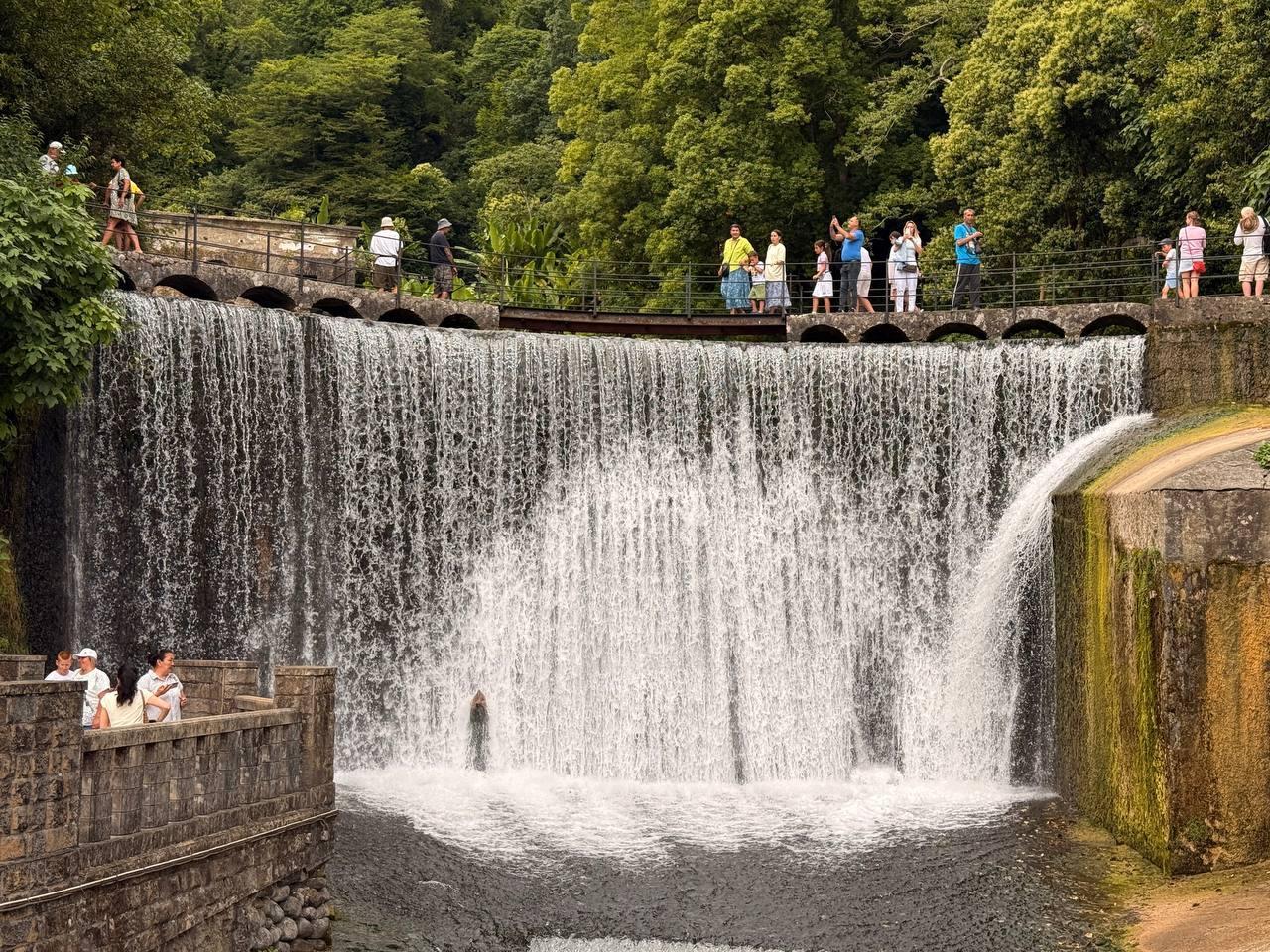
The scenery in Abkhazia is incredibly beautiful, especially around the waterfalls.
And if you’re still undecided whether it’s worth it — just look at a few more photos!
Earlier, a Yekaterinburg woman told how much she spent in the most Russian city in China. Read why it’s worth flying there.
We wrote that prices in Yekaterinburg have plummeted for tours abroad. Before your vacation, be sure to study how scammers cheat tourists when buying tours.