Remote Siberian Village of Four Battles Bears and Isolation


The entire village can be walked in less than ten minutes.
In Ust-Chernaya, Sretensky District, there is only one street where just four people live. On one side lies the river, on the other the taiga. The taiga is home to bears, wolves, and wild boars, while Ust-Chernaya is home to the Bakshayevs. They raise livestock, tend to their homestead, and keep the entire village in working order.

About a dozen houses remain, and all but two are abandoned.
Each year, the forest presses in closer, and the wildlife creeps nearer. The village is extremely hard to reach, with no cell service, no internet, and no shops. Residents spoke of how they have lived as a foursome for years, putting out fires themselves, driving off drug users, and coping with loneliness.

Many houses in the village are already half-ruined.
Ust-Chernaya lies in the Sretensky District of Zabaykalsky Krai, on the banks of the Shilka River. The village was founded in 1785.

Sergei, Marina, Olga, and Pavel Bakshayev.
A Haunting Place

Marina and Olga Bakshayev.
I managed to visit as part of an expedition during a religious procession through the villages of Sretensky District. For four days we rafted down the Shilka River in boats, retracing the path of Saint Innocent, carrying the Orthodox faith to the people.
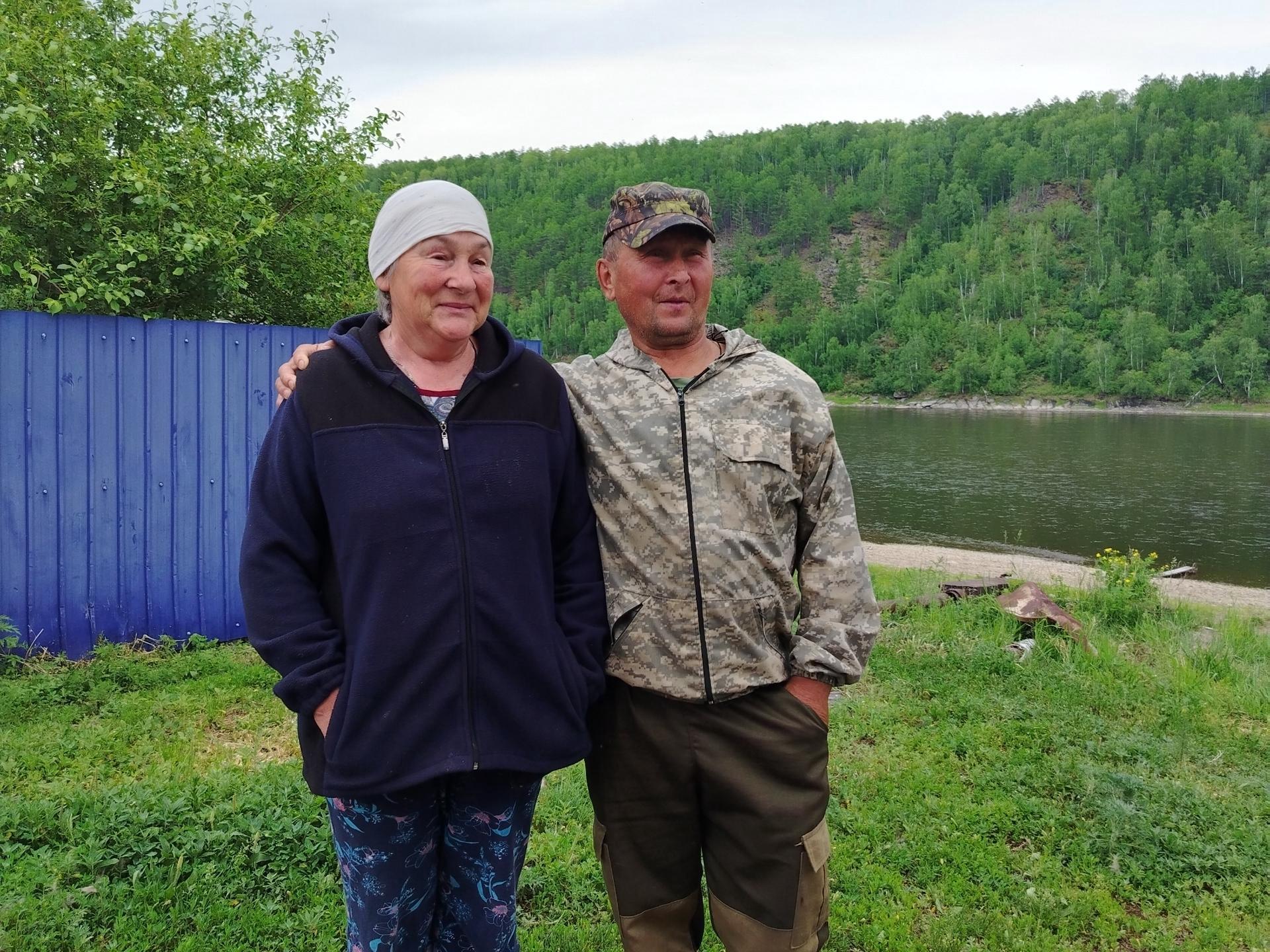
Marina and Sergei Bakshayev.
When we landed on the shore, I realized the overnight stay would be a true adventure. At first, the place seemed eerie: abandoned houses, a nearly empty street, and the taiga where wild animals could emerge. Overcast skies and a light drizzle darkened the mood. The whole scene felt like something out of a horror movie.

The house where we slept was cluttered with junk: old clothes, piles of empty plastic bottles, and garbage. The refrigerator was packed with food long past its prime. I imagined what insects might lurk there and felt uneasy. I looked at the beds and sofas, then chose to throw my sleeping bag on the floor.

The store has been closed for five years.
The Bakshayevs arrived — two retired couples, Marina and Sergei, and Olga and Pavel. Until they showed up that evening, the only source of cheer was a friendly dog named Bim. As we later learned, he belonged to Pavel and Olga. During dinner on the Shilka«s banks, we gladly shared our food with him.

The Shilka River bank in Ust-Chernaya.
— “We’ve been feeding your dog for two hours now, and it still can’t get enough,” said Bishop Makary, who led our expedition.

A card payphone.
— “That’s a village dog; it has no sense of satiety. If Bim wanted, he’d eat everything here and eat you too,” joked Olga, his owner.

In the morning, after a heartfelt conversation with the Bakshayev family, Ust-Chernaya transformed from a frightening, intimidating village into a charming, cozy hamlet. I was genuinely impressed by how deeply the residents love their native land and are ready to face all hardships while staying positive. I sat there thinking, “What wonderful people they are.”

All Four Residents Are One Family

For years, the village has rested on the shoulders of one family, the Bakshayevs. There used to be more people, but now the elderly have passed away and the young have left. Occasionally, a watchman from Mogocha appears in the village, coming to fish.

Sergei and Marina Bakshayev.
Olga and Marina have been friends since third grade. They sat at the same desk and have been together daily ever since. They used to live in the neighboring village of Nizhniye Kularki and took the bus to school in Verkhniye Kularki. The distance between the two villages is about four kilometers (2.5 miles).
— “All sorts of things happened; we even walked. I remember trudging along, and my hands and feet would freeze. Then we’d gather straw, which was plentiful in the fields, pile it on the road, and set it alight. We’d stand warming ourselves and then hurry home,” Marina recounts.
The women have been friends for 53 years. Marina describes their daily morning exchange:
— “I go out and call to Olya: ‘Old woman, hi! How are you, still alive?’ She answers: ‘And you, old woman, haven’t croaked yet?’ I say: ‘No, you won’t see that day.’ We run to each other’s houses.”
Olga married Pavel Bakshayev 43 years ago and moved to Ust-Chernaya. Their first son was born here. Marina was studying at a technical college at the time and came on break to congratulate her friend. In this village, she met Pavel’s younger brother, Sergei.
— “And that was it, friendship blossomed, and in February 1985 we got married. We moved here, and by November our first son was born,” Marina recalls.
Interestingly, Olga’s brother and Marina’s sister also married each other.
Just like the women, their mothers were friends once. They lived across a ditch, almost facing each other. When one mother baked something tasty, she always called her friend over.
— “When our mothers quarreled, they’d sit on a bench or stool, each by her own house, and silently smoke across from each other. But then a conversation would inevitably start, and they’d go off together to someone’s home for tea,” Olga tells.
“We Raised the Kids”
Olga and Pavel have three children; Marina and Sergei have six. The village once had a school building, and when children began to arrive, residents wanted to restore it. They never managed to open a school, but they did set up a medical station and a club.
— “We raised the kids. They weren’t spoiled: they lived in a boarding school, where there’s no room to run around — strict schedule. They came home on Saturdays. We baked treats, fed them, washed clothes, ironed. On Sunday, the bus came and took the kids back to Verkhniye Kularki,” Olga recounts.
The children got an education, hold good jobs, and help their parents. One now works as a narcologist; another works in the governor’s administration. When possible, they visit the village for holidays, but for the past couple of years, the residents have rung in the New Year just as a foursome.
On festive nights, the locals usually string up lights, open champagne, watch TV, and always set off fireworks. The celebrations are short, as the next day dawns early with chores to do.
January temperatures drop below -50°C (-58°F).
— “It’s fine; we’re not afraid of the cold. In winter, we actually feel better than in summer,” say the locals.
Adapting Without Stores
Now all residents are pensioners. They farm, keeping cows, calves, horses, chickens, and other animals. There’s no other work in the village, and commuting daily to other settlements is impossible: the trip to the nearest inhabited point consumes about 10 liters of gasoline.
The village once had a store, but it closed in 2021. At that time, according to official data, 16 people lived here. Now there is not a single shop.
— “It’s not needed anymore; there’s no one to sell to. I worked at the store when it was still open. Goods came from Ust-Karsk, people walked in, and business was good. But then the old folks gradually passed away, and our kids grew up and left,” Olga recounts.
Ust-Karsk is a settlement roughly 35–40 kilometers (22–25 miles) from Ust-Chernaya along the Shilka River. About a thousand people live there. There’s no year-round road access, as the taiga and river separate the settlements. In winter, you can drive over ice; in summer, only by boat or motorboat.
The Bakshayevs buy groceries in the neighboring village of Verkhniye Kularki, about 10 kilometers (6 miles) from Ust-Chernaya. They go twice a month, after receiving their pensions. Otherwise, they have everything they need: cows provide milk, and they bake their own bread.
— “This time we went to the store — it was a laugh. We stocked up, got home, and discovered no one had matches. What to do? Driving all that way for matches is silly. Luckily, the men searched and found some. But I was already telling Marina: ‘You and I are like characters in a movie, going for matches,’” Olga laughs.
Drinking water comes from a communal pump. When it starts to turn yellow, they drive to the Simonka River. The mountain water there leaves a lot of scale. Sometimes they pump or haul water from the Shilka by hand.
Once a visitor told the residents he wouldn’t drink such water. Marina replied, “We don’t have pockets full of money to buy bottled water.”
Previously, the villagers had a source of good, clean water. But now, due to gold mining everywhere, the water is dirty. It sometimes appears yellow or even soapy.
“Dead Zone”
Midshipmen (as residents call the crews of passing ships) call this place the Dead Zone because there’s no cell service. Locals bought signal boosters and installed them, but they proved useless.
Residents communicate with the outside world through two card phones — prepaid card payphones installed in homes by the government under a program for remote villages. The devices run on satellite antennas.
— “There used to be cards, but now it’s free. But it started acting up. I called the village council several times to explain it wasn’t working. Finally, a guy came and fixed it a bit. It crackles, but I can talk to my kids. Though not for long, because the payphone is in another house that isn’t heated, and it’s freezing there in winter,” Marina recounts.
She calls her children every other day, when they finish work and can answer. If she talked to each of her six children daily, no one would tend to household chores: in winter, the family would freeze; in summer, the garden would be overgrown.
— “Today I chat with one, tomorrow with another. I want to know how everyone’s doing. Sometimes I have a scary dream, then I sit five minutes with one, five with another: ‘What’s up? How is it?’ That calms my heart. There’s no other way,” Marina shared.
Payphones were also installed in neighboring villages, but they didn’t catch on because those places have cell coverage. “They broke and stayed broken,” Olga says.
The village has electricity, though breakdowns occur. Once, wires fell into the river, and power was out for four months. The Bakshayev children eventually got it restored through the prosecutor’s office.
Now Pavel and Sergei handle the wiring themselves. Electricity is vital for the villagers.
— “It would be a shame if the milk and meat in the freezers went bad.”
“Boars, Wolves, and Bears Come Around. We’re Not Afraid of Anyone”
Residents often spot wild animals near the village, and each year they come closer. The Bakshayev children initially didn’t believe that animals could be seen so close to the village.
— “My eldest son came and said, ‘What are you talking about, Mom? What bears? That can’t be.’ Then he went to pick up his brother and saw a bear at the river mouth. He came back and said, ‘Mom, I heard your friend there’— and chuckled at us,” Marina recounts.
— “Yes, we have boars, wolves, and bears roaming around. It’s all fine; we’re not afraid of anyone,” Olga says.
Last year, she heard a roar but couldn’t identify it at first. Then she grabbed binoculars and saw a mother bear swimming down the river with her cubs. Marina also heard a bear two weeks ago.
— “I went at five in the morning to round up the cows: I’m standing there luring them when I hear a roar. At first, I thought it was the old man messing around. I looked around — he wasn’t there. The roar came again, and the cows stopped, ears pricked, all staring toward the sound. My hair stood on end. ‘Maybe it’s a bull?’ I thought. But the cows backed away, and I realized it was a bear. So, with my aching legs, I ran to the old man on the Shilka bank. I sat with him, waiting for the bear to leave,” Marina recounts.
Besides bears, wolves, and boars, one used to see ten to twelve roe deer near the village. Now they’re harder to spot. Locals link this to a ferocious wind that struck three or four years ago. It blew like a funnel, tearing up trees in strips along the hills. After that, the roe deer stopped coming.
No Doctor in the Village
When the village was larger, they had a feldsher (a medical assistant). Now there is no one. Olga is trained as a veterinarian, and having worked as an orderly, she can give injections to both cows and people. But that doesn’t always help when urgent medical care is needed.
— “All kinds of things happen. Last year, the old man’s blood pressure spiked. I did what I could to lower it. Beyond that, I couldn’t do anything, and there was nowhere to get pills. Meanwhile, the roads were impassable. Olga and I chiseled about six meters of ice to the Shilka with crowbars to haul the boat — a Kazanka (a popular Soviet lightweight aluminum motorboat. — Ed.) — to the river, and Pasha managed to squeeze through with a heavy motor on a UAZ. He took Sergei to the neighboring village. Luckily, the payphone there worked, so I called Kolya, my younger brother, in Kularki. He came and broke the ice. We got to Ust-Kara, where they gave the old man injections and sent him home. At first, he was fine, but then he got worse. So I called the kids, Pasha again took Seryozha, and they picked him up from there,” Marina recounts.
Ran Toward Smoke, Found Drug Users
The village survives solely on its residents, who call themselves its keepers. The Bakshayevs tend the cemetery, clearing graves; watch the ice on the Shilka to prevent flooding; and scan for any spark that could start a fire.
Two years ago, a house caught fire. Outsiders had been there fishing, and either a dropped cigarette or an unattended campfire ignited the dry grass. The fire spread between strips and reached the parents’ house of Pavel and Sergei. Flames erupted and, carried by grass, advanced toward the village.
— “First, we ran there with brooms, then Seryozha brought water on a tractor, and he and Pasha started dousing the house. Nearby, the ground was already burning. I ran home, grabbed watering cans, and raced back. I gave one to Olya and used the other myself,” Marina recounts.
Together, the four locals put out the fire themselves, then joked about the burn holes in their jackets. A helicopter arrived, saw no flames, and turned back. The residents tried to call Kularki for firefighters, but by the time they arrived, the fire was out. The firefighters then cleared small hotspots.
— “It was still terrifying. We thought about grabbing documents and running to the boat, but we managed to put it out,” the Bakshayevs say.
Sadly, this wasn’t the only time they had to battle fire alone. About eight years ago, another fire broke out in the village.
That day it rained, with a thunderstorm. Marina went to close a window and saw a blue-green dome over the transformer. It turned out a ball of lightning had hit the device. Pavel was on duty at the store, and Sergei wasn’t home, so the woman hurried to Olga’s.
— “If anyone had seen us, we looked like ghosts: running to Pasha in our nightgowns with umbrellas. It’s funny now, but terrifying then. In the end, the wires in the transformer burned off and fell,” the women recall.
Incidents like these mean residents can never let down their guard. One day, Olga smelled smoke, ran to investigate, and found drug users who had come, likely from neighboring villages, to local hemp.
— “I was furious: there was dry grass all around, and they’d built a fire. I grabbed one by the collar, dragged him into the field: ‘See that grass? Do you realize what you’re doing? There’s wind here! If the fire reaches the field, nothing will be left fast. Run and put it out!’” the woman recalls.
Olga says that as she yelled at them, she feared what they might do. Four men, after all. Pavel and Sergei came to help after it was all over.
— “But I had really lost it and gave those junkies an earful: frying pans flew one way, pots another,” she says.
The residents of Ust-Chernaya also protect themselves from floods. The village has endured several: once the entire potato crop was flooded, another time a house was inundated. After floods, helicopters arrived and experts assessed the damage.
The Bakshayevs face threats with resolve: “We’ve survived. Let all the bad stay in the past.”
The Village Has Outlived Its Time
Asked whether they get bored, the Bakshayevs reply that they have no time for boredom.
— “We get up at six in the morning, milk the cows, wash everything, tidy up, run to the garden. Then lunch, a rest, and off we go again. At four we have tea, get up, and do this and that. Of course, at our age, it gets a bit dull sometimes. We drive to other villages and recharge from people,” they explain.
However, the Bakshayevs can’t stay away for long. They worry that something might happen in the village while they’re gone. So they don’t attend any concerts or events. Even when they go shopping, they try not to linger.
— “This time, artists from Mogocha came to Kularki, but we couldn’t go. In Ust-Kara, there was a boxer whom the old man knows since he loves boxing, but we couldn’t make it,” Marina shares.
For the residents, a joy is seeing passing ships. When they sound their horns, they’re overjoyed. Sometimes the river is quiet, with no one around. Then the Bakshayevs think, “Lord, if only someone would float by.”
— “Everything is falling apart. We remember how it all looked when we arrived in this village, and how it is now. We’re aging, and the houses are aging. Fences are collapsing. We walk around, looking at what needs patching, what needs tying,” the residents say.
They admit the village has outlived its time. No stores, no hospital. Berries and mushrooms have become far scarcer. They attribute this to excavations carried out by archaeologists near the village. They found an ancient Russian settlement and dug up dugouts and bones. After that, mushrooms and berries almost stopped growing in the forest.
— “The forest is encroaching from all sides, squeezing us. Five or six years ago, there were still fields here; now it’s all forest. And the animals are advancing, coming closer,” the Bakshayevs tell.
Soon, Only Two Will Remain
In autumn, Olga and Pavel will move to Ust-Karsk. Their son built a house there and said, “Come,” and he got married. Marina and Sergei will remain in the village alone.
— “I’d like to leave too, but my old man doesn’t want to. I don’t know how we’ll manage here just the two of us this winter. They’ll probably cut off our power; no one will service a single house,” Marina shares.
She also worries that if her husband suddenly falls ill, she won’t be able to break the ice on her own to take him to the hospital. Sergei, for his part, reassures her that everything will be fine and his blood pressure won’t rise again.
— “I’ve gotten used to this place, and as long as I have my health, I want to live here. Of course, I understand my wife will miss her friend Olya. At least friends visit me sometimes. Our daughter invites us to Chita, but we won’t move there. Maybe later to somewhere nearby, like Ust-Kara.”