Who Earns Billions Selling Gas in Voronezh?


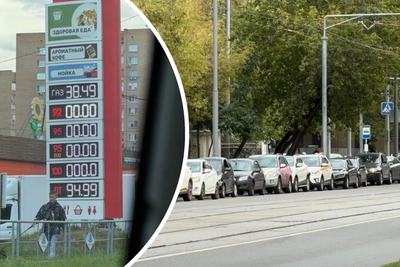
Kilometer-long queues at gas stations, prices shooting up like mushrooms. It’s a holiday for those selling gasoline, panic for those buying it, and a stupor in government offices. The Russian folk wisdom about “war” and “mother” took on new meaning. Voronezh1.ru tells the story of those who profit from fuel sales in the region. The first part is about the federal workhorses of the gas pumps.

Rosneft

The subsidiary of the federal giant with state participation in Voronezh Oblast is JSC Voronezhnefteprodukt. Judging by the map on its official website, it has at least 78 gas stations in the region. The company has been on the market for 30 years — it was registered on 19 July 1996. According to the counterparty verification service Kontur Focus, for the last 13 years it has been headed by various managers — all former Rosneft (RN) employees, whom the company periodically shuffles between its enterprises. Since 4 March 2025, Voronezh’s subsidiary of Rosneft has been headed by Igor Perelygin. Before his appointment to the capital of the Black Earth region, he was CEO of the Irkutsk subsidiary (JSC Irkutsknefteprodukt), and even earlier — in Lipetsk and Tambov. The last two have already been liquidated, but their story is noteworthy.

JSC Lipetsknefteprodukt ceased to exist on 1 March 2023, merging into the Tambov entity. Only on 20 November 2024 did it close as well — joining its Voronezh sibling. Both companies were the largest fuel players in their regions; Rosneft did not explain the reasons for their closures. As a result, the Voronezh enterprise became a kind of gasoline giant of the Black Earth region. On the Rosneft website, the enterprise is listed among the company’s 11 training centers.

***

Since 2021, Voronezhnefteprodukt has not disclosed its financial results: there is no accounting report on the FNS website. Complex matters, but no violations. The federal parent — Rosneft — regularly publishes its financial statements on its official website. For the first quarter of 2025, compared to the last quarter of 2025, growth across all items. Revenue from sales and income from associated organizations and joint ventures — including Voronezh — increased by 4.3% and exceeded 2 trillion rubles (over $22 billion at current rates). For the full year 2025 — even with a decline of 18.8% — that revenue exceeded 8 trillion rubles (over $88 billion at current rates).

For Voronezhnefteprodukt, the latest publicly available data is for 2020. Revenue then was 27 billion rubles ($300 million at current rates) for the local market. For comparison: for 2025, among Voronezh’s retail motor fuel sellers, the leader is a certain LLC Khimstroymontazh with revenue of 7.2 billion rubles ($80 million at current rates). And by the way — remember this name: it will soon appear at an unexpected turn.

Voronezhnefteprodukt pays its taxes diligently — it is not listed as a debtor in the FNS database. For 2021, the last year the company publicly reported, it contributed 422.9 million rubles ($4.7 million at current rates) to the treasury — 1.4 times more than in 2020. Of that, 384.3 million rubles ($4.3 million at current rates) was VAT, also 1.4 times more than in 2020. What does that indicate? Value-added tax on goods is actually paid by the buyer — the company merely transfers it to the state. More VAT collected means more sales. And/or higher prices.

***

In past years, Voronezhnefteprodukt often made headlines in the regional FAS for violating antimonopoly legislation. For example, here:
In the 2000s, when events unfolded in the antimonopoly reports, two businessmen stood out among the heads of Voronezhnefteprodukt who later ended up in city hall positions. Since 2004 — Gennady Shvanov: first he was territorial manager, then CEO, until in April 2008 he became acting vice-mayor for municipal property. Now Shvanov is associated with another fuel company — the local Yukon.
From December 2009, the local subsidiary of Rosneft was headed by Gennady Koldashov, who in March 2010 also became a deputy of the City Duma. However, in November 2012, Koldashov gave up his elected position to become a bureaucrat — to head the city’s housing relations department. Now, according to counterparty verification services, he is listed as the liquidator of Moscow JSC KFS-Trans, which deals in rental and leasing of railway transport and equipment. In short, everyone’s life has worked out.
***
Voronezhnefteprodukt was once called the dominant player in the region’s fuel market by the FAS. In the second half of 2014, it was among the sellers whose gasoline prices rose the most. On average, prices in the region rose by 4.4%, but at its stations, 92-octane gasoline rose by 5.9%. But inflation at the time was 6.6%, so no punishment was imposed. Since then, the company has not been publicly reprimanded by the FAS. The last mention of it on the agency’s website is from spring 2021: a dry table in the fuel price monitoring for March. Incidentally, in April of that year, bad news on gasoline issues on the agency’s website inexplicably ends.
Meanwhile, in the Unified Register of Inspections of the Prosecutor General’s Office, from 2015 — when it started — until 2021, the Voronezh subsidiary of Rosneft had repeated violations in fire safety. In May 2021, inspectors from the State Labor Inspectorate found violations of labor law during the investigation of an accident involving a pump attendant — a note that the guilty were brought to administrative responsibility. In June of the same year, inspectors from the Upper Don Directorate of Rostekhnadzor found 10 violations of industrial safety requirements at the oil depot for storage and transshipment of oil and oil products in Liskinsky District (Voronezh Oblast): they issued orders to fix everything, and it went to court under the Administrative Code.
What happened next is unknown to the public: since July 2021, information about violations in the prosecutor’s register has been closed.
But let’s turn to recent days. In early July — amid the gasoline frenzy — Voronezhnefteprodukt became the subject of a mundane court battle. A resident of Borisoglebsk (Voronezh Oblast) — coincidentally, a local communist deputy Alexander Sukhinin — filed a lawsuit against the company for refusing, in his version, to sell him 20 liters of paid gasoline in a can. He says he suffered moral damage — he is asking for 50,000 rubles ($555 at current rates).
By the way, at Rosneft-branded gas stations in Voronezh, queues have been the longest in recent weeks. Because prices there are the lowest, in line with official statistics.
Lukoil
Another federal gasoline player on Voronezh’s roads. PJSC Lukoil is Russia’s largest private oil company, which made hereditary oilman Vagit Alekperov a dollar billionaire. In 2025, according to Rusprofile.ru, it posted revenue of 3.5 trillion rubles ($38.9 billion at current rates), up 13%. By the way, for those who don’t know — Teboil is also Lukoil: the Finnish oil company has belonged to the Russian magnate since 2005.
Lukoil gas stations in Voronezh Oblast were managed by various subsidiaries over the years. In the 2000s, it was Lukoil-Nizhnevolzhsknefteprodukt. During its time, the owner himself visited Voronezh: on 18 November 2009, Vagit Alekperov and then-Governor Alexey Gordeev signed a cooperation agreement between the company and the regional government.
“In accordance with the document, Lukoil, considering the capabilities of its subsidiaries (…) will supply enterprises, institutions, and the population of Voronezh Oblast with oil and gas processing products, as well as petrochemical products,” boasted the company’s press service.
The Voronezh government, for its part, promised to facilitate the construction and reconstruction of facilities for transportation, storage, and sale of petroleum products, and the expansion of the gas station network (then numbering 17) — including those working with non-cash payments via Lukoil fuel cards. Of course, while strictly observing antimonopoly legislation. However, shortly before the epochal event — in February 2009 — Lukoil-Nizhnevolzhsknefteprodukt faced an administrative charge from the Voronezh FAS and was fined 11.9 million rubles ($132,000 at current rates) for abusing its dominant market position.
If you recall, at the same time and for the same thing, Voronezhnefteprodukt was fined 6.8 million rubles ($75,500 at current rates) — both companies were market dominants and sometimes misbehaved together.
***
The agreement was supposed to run until 31 December 2014. Even if it wasn’t extended, Lukoil feels quite comfortable on Voronezh’s expanses — according to open sources, the company now has about 40 gas stations in the region. After Nizhnevolzhsknefteprodukt, in the 2010s, they were managed by Lukoil-Chernozemieneftprodukt. Both companies were liquidated in November 2018, and since then control has passed to Lukoil-Yugnefteprodukt, based in Krasnodar Krai.
***
LLC Lukoil-Yugnefteprodukt is a 100% subsidiary of PJSC Lukoil, registered in March 1998. Its area of responsibility, besides Voronezh Oblast, includes 13 other regions — its home region of Kuban, as well as Stavropol Krai, Adygea, Kabardino-Balkaria, Karachay-Cherkessia, Kalmykia, Volgograd, Saratov, Penza, Astrakhan, Kursk, Belgorod, and Rostov Oblasts. In total, more than 580 Lukoil gas stations operate on their roads. Plus, the company manages 13 oil depots and four oil and gas separators.
Since 8 November 2024, the CEO of the enterprise has been Andrey Gavrilets. Before that, he headed other Lukoil subsidiaries — a 100% insider, like his predecessors. Revenue has been steadily growing despite economic storms: in 2025 — 227 billion rubles ($2.5 billion at current rates). Among other Krasnodar companies retailing motor fuel, it is a Stakhanovite: the second-place company earned 20.6 times less.
Lukoil-Yugnefteprodukt has no tax debts, and there is no publicly available data on its fiscal contributions. It has not received public reprimands from the Voronezh FAS — at least not when the antimonopoly agency published its fuel front reports. In the Prosecutor General’s Office inspection register, there are several fire safety violations at Voronezh gas stations in 2021.
Meanwhile, Voronezh residents themselves periodically file complaints against the federal oil companies. In June 2019, a driver won 4,800 rubles ($53 at current rates) from the company because at a Lukoil gas station he was shortchanged: he paid for 45 liters, but was filled with only 7.4. In October 2024, another driver won 236,300 rubles ($2,626 at current rates) — for his damaged Audi: the car was damaged when it hit a pothole while leaving a Lukoil station. And here is a very recent case: on 29 June, the Voronezh public organization “Consumer Protection” filed a lawsuit against Lukoil-Yugnefteprodukt. What exactly they were trying to protect and from what is not specified on the court’s website; the application was rejected — they filed with the wrong court, it said.
***
Lukoil gas stations that work with the company’s fuel cards are managed by Moscow LLC Likard, also a subsidiary of the federal boss. Its finances are also in good shape. Last year, revenue skyrocketed 1.86 times — to 856 billion rubles ($9.5 billion at current rates).
Gazprom Neft
Another federal player. The company was registered in 1995 in St. Petersburg. From May 2015 to July 2021, its founder was the Government of Russia. Now the main shareholder is Gazprom, which is more than half controlled by the state.
In the Voronezh gasoline market, Gazprom Neft is perhaps one of the newest characters. Although it was awaited. At least, the antimonopoly authorities certainly did. In July 2014, acting head of the regional FAS Vladimir Rokhmistrov dreamed that if the “gas men” federal players came to our region, there would be competitive idyll. In February 2020, it became known that Gazprom Neft and the Voronezh government had signed a cooperation agreement.
On 29 December 2021, the company announced on its official website the “expansion of presence in Voronezh” — a new gas station opened at Kholmistaya Street, 66. Which number it was is unknown, but by September 2022, the number of stations reached 10. After that, there were two more announcements about gas station openings in Voronezh Oblast: in December 2022 — in the Khutor Batovka in Bogucharsky District, a year later — at the 574th km of the M-4 highway in Kashirsky District. And now — attention.
***
Gazprom Neft gas stations in the region are actually operated by local gasoline landlords. The legal entity behind most of them is the already familiar LLC Khimstroymontazh, which last year outperformed its competitors in revenue. And behind this LLC — in the role of owners — is the company of founders of the well-known Voronezh Fuel Company (VFC) in full: Pavel and Sergey Parinov, Evgeny Ilyinsky, Viktor Dobychin, and Yuri Zemlyansky. In June, a certain Andrey Pashkov was appointed general director, and before that, one of the founders, Sergey Parinov, was in charge. On the Gazprom Neft website, however, it is emphasized that the fuel at its Voronezh gas stations is not locally produced, but from its own refineries. Drivers can only hope and trust.
Khimstroymontazh was registered back in 2002. Over the last eight years, its revenue has grown phenomenally: from 3 million rubles in 2017 to 7.2 billion rubles in 2025 ($80 million at current rates), and the confident takeoff began in 2020 — when Gazprom Neft shook hands with the Voronezh government. It is not on the tax authorities’ blacklists. Last year, it paid 288.4 million rubles ($3.2 million at current rates) in state taxes, of which 145.6 million ($1.62 million) was VAT and 142.5 million ($1.58 million) was income tax. Compared to 2024, both amounts have grown significantly: they were 112.3 and 97.8 million respectively. That means money is pouring into the company’s coffers.
By the way, Gazprom Neft’s own revenue for 2025 was 3.6 trillion rubles ($40 billion at current rates), down 12.2% compared to 2024. But that year was a record for the company: revenue jumped 16.5% to 4.1 trillion. So, it is more of an adjustment to realities than a loss.
***
With inspections of Khimstroymontazh, it’s a puzzle. It is not mentioned on the FAS website: Gazprom Neft entered Voronezh just as the gasoline topic in antimonopoly news was fading. However, it was awaited for complete harmony — evidently, that is what happened. And in the Prosecutor General’s Office inspection register, the first entry about LLC Khimstroymontazh is somehow only from March 2022, when the state had already decided that too much knowledge was harmful to the public.
But courts are still open, and there is interesting information there. For example, from a decision of the Sovetsky District Court of Voronezh on 10 June 2025, it turns out that the Gazprom Neft gas stations belonging to the Voronezh company — a relative of VFC — also exist in Lipetsk Oblast. At least one: in the village of Utkino in Zadonsky District (Lipetsk Oblast), at 2 Donskaya Street. And local sanitary doctors found unlabeled water for sale there. A representative of Khimstroymontazh confessed in the hearing — saying we are doing everything to get on the path of correction. And Themis’s decision boiled down to acknowledging the illegality of the company’s actions, which sold drivers who knows what under the guise of water. However, Rospotrebnadzor had asked for that. There is no information that it fined the gas station operators 50,000–300,000 rubles ($555–$3,333 at current rates) with confiscation under Article 15.12 of the Administrative Code for unlabeled goods. In the prosecutor’s inspection register, only that they were “warned” twice. That happens.
In spring 2025, a disabled Voronezh resident filed a lawsuit against Gas Station No. 29 of Gazprom Neft, which belongs to LLC Khimstroymontazh. He complained that from May to November 2024, he worked five shifts at this station, but they never signed an employment contract with him (“the signing was constantly postponed”) and did not pay the promised 3,600 rubles ($40 at current rates) per day. The Voronezh deputies of Gazprom Neft did not resist: they settled.
***
And finally. The registration address of the Gazprom Neft gas station in the Khutor Batovka in Bogucharsky District (Voronezh Oblast) — at 17 Sadovaya Street — exactly matches the registration address of a certain LLC Yukon-Plus. One of the founders of the company is the Voronezh gasoline LLC Yukon, behind which stands a former city hall official. And it turns out that at least this Gazprom Neft station is not controlled by VFC in the form of Khimstroymontazh, but by another local character. Perhaps that is why prices at supposedly federal stations — even despite ostensibly close ties with the state — are closer not to the semi-state Rosneft and official statistics, but to private Lukoil. Yet still lower than at stations of native Voronezh companies like Yukon, VFC, and Kalina Oil — for which there seem to be no limits. And we will tell about them in the next part.