HPV vaccination may join Russia's free immunization schedule

January 2026 brought two significant pieces of news: Russian women gained access to human papillomavirus (HPV) DNA testing under the state health insurance system (OMS). It was included in the first stage of reproductive health check-ups for women aged 21 to 49. And in 2027, the HPV vaccine is planned to become free — it is expected to be added to the national immunization schedule. NGS.RU journalist Maria Tishchenko asked doctors why these steps are so important, whether they will help prevent cancer, and how often all this needs to be done.
What is HPV and who gets it

Human papillomavirus (HPV) is a group of viruses comprising more than 200 strains. They can be transmitted through sexual intercourse, skin-to-skin contact, household means, and from mother to child.
Marina Katsun, an obstetrician-gynecologist and ultrasound specialist at Invitro, noted that these viruses can live quietly in the human body for years and then cause complications: from papillomas and warts to oncological processes (cervical, vaginal, anal, penile cancer, and so on). Both women and men can be carriers and transmitters of the virus. Strains 16, 18, 30, 31, 33, 39, 40, 42, 43, 52, 55, 57–59, 61, 62, 67–70 are considered the most dangerous.
Marina Katsun emphasized that the first HPV test (oncocytology) should be taken three years after the onset of sexual activity or at age 21 — whichever comes first. Then the test should be repeated every three years, and if the result is positive, an extended test should be done: a PCR test for HPV. After age 30, everyone is recommended to have a PCR test every five years.
Including the HPV test in the OMS program is significant, according to Marina Katsun: it will increase people«s awareness of their health status and, very importantly, will help expand early diagnosis and prevention of diseases caused by HPV.
«Including HPV testing in OMS and the HPV vaccine in the immunization schedule could potentially have a positive impact on preventing the incidence of certain types of cancer,» the doctor believes.
She added that the experience of Australia is indicative in this regard: there, the incidence of cervical cancer has been reduced to almost zero because HPV testing and vaccination are widely available.
What vaccines exist
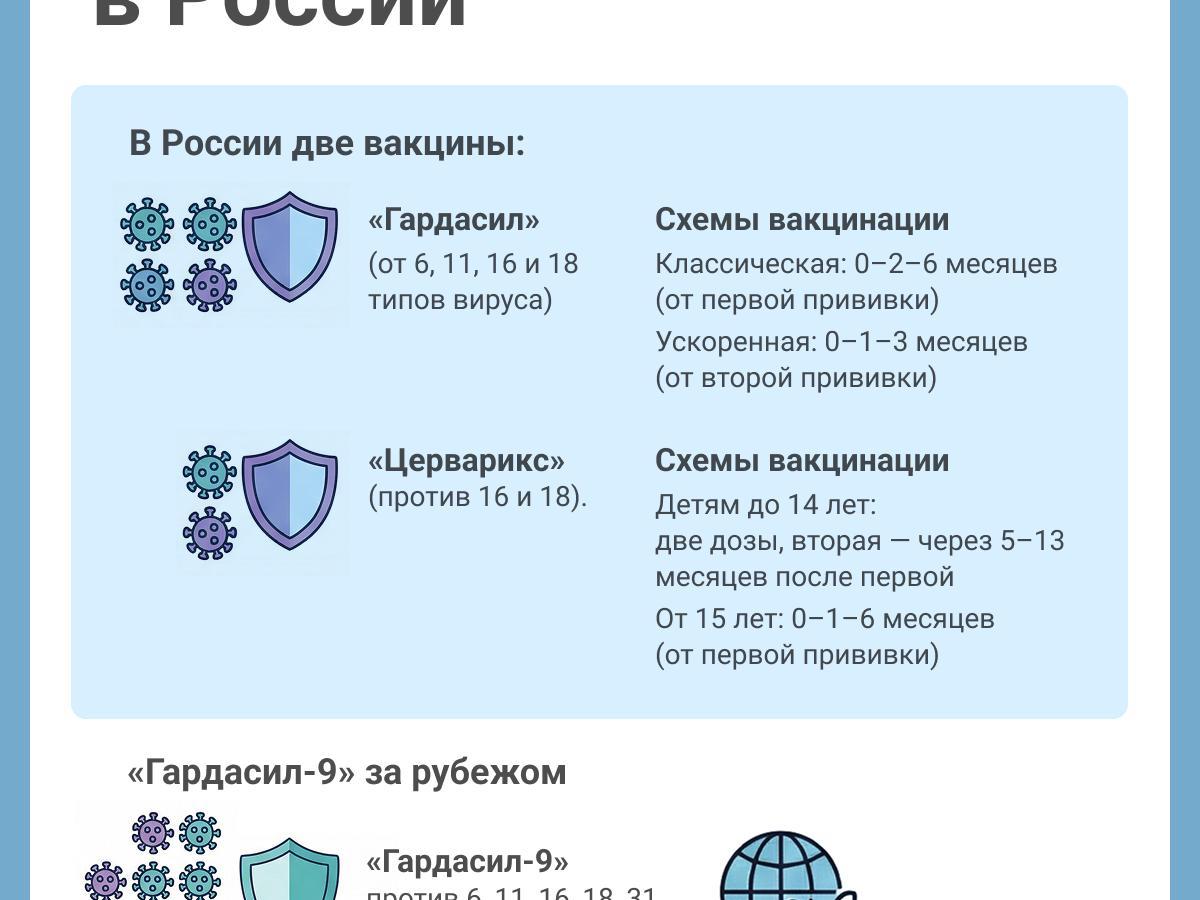
Vaccination is effective for women up to age 45, and for men — up to age 26. Two vaccines are available in Russia: Gardasil (protects against virus types 6, 11, 16, and 18) and Cervarix (against types 16 and 18). Abroad, the Gardasil-9 vaccine against HPV types 6, 11, 16, 18, 31, 33, 45, 52, 58 is also available.
There are two Gardasil vaccination schedules: the classic one — 0–2–6 months (from the first shot) and the accelerated one — 0–1–3 months (from the second shot). Gardasil can be administered up to age 45.
Cervarix is administered according to different schedules depending on age: for adolescents under 14 — two doses (the second is given 5–13 months after the first), for people over 15 — 0–1–6 months (from the first shot). Cervarix is given up to age 25.
On average, prices for Gardasil start from 10,000 rubles (about $100 at current rates) (a course of three doses can cost patients from 30,000 to 60,000 rubles, or about $300 to $600), and for Cervarix — from 6,000 rubles (about $60).
What HPV tests are available
According to Olesya Kholodova, a gynecologist at the Zdrava network of family medicine centers, until age 30, routine analysis for HPV DNA detection by PCR is not prescribed: 100% of the planet«s population is affected by the virus, the route of transmission is sexual in 90% of cases, and sometimes a single sexual contact is enough for infection.
«The peculiarity of the virus is that in most cases, after entering the body, it eliminates on its own, meaning it leaves the body within one to two years, and a woman may not even know she was infected. Elimination depends on many factors and primarily on the status of the immune system,» the gynecologist explained.
For an oncological process to develop, at least 10 years must pass from the moment of infection to the verification of a tumor, which is why screening starts at age 30. And even if HPV is detected before age 30, independent drug treatment to «treat» it is not prescribed.
«There is no cure for HPV — complete drug elimination of the virus is impossible. Prescribing a very narrow range of drugs is justified and considered only in the case of destructive operations on the cervix,» Olesya Kholodova emphasized.
According to her, screening for all women from 30 to 65 years old is co-testing (cytology / liquid-based cytology and HPV test) every five years. Depending on the presence of changes according to co-testing data, the tactics for timing and determining the doctor«s further actions change.
Also, all women of any age with the onset of sexual activity must have a cytological examination of smears (traditionally a Pap test) or liquid-based cytology and a gynecological examination once a year.
Is it realistic to include the vaccine in the schedule
«The topic is, of course, relevant. One aspect is the oncological disease itself, cervical cancer, which in 90% [of cases] is caused by the HPV virus, mostly types 16 and 18,» explained oncologist and candidate of medical sciences Evgeny Cheremushkin. «The second aspect is childbirth in the country, which is being fought for on all fronts. Everything related to vaccination can only be welcomed.»
Olesya Kholodova said that the issue of including HPV vaccination in the national immunization schedule has been considered for many years, but the deadlines are postponed each time. In particular, it was planned for 2026, but so far, HPV vaccination is not included in the national schedule of preventive vaccinations in Russia. The decision must be made at the legislative level.
«In 2027, the HPV vaccine may be added to the national immunization schedule and made free for the population, but this is not a final decision. »May« does not mean they will definitely add it in 2027, as [it requires] a certain budget. It is possible that the deadlines may be shifted again,» Olesya Kholodova believes.
Currently, it is possible to get vaccinated against HPV only privately and for a fee. Under OMS, this is possible only within the framework of regional programs.
According to Olesya Kholodova, such a program is currently in effect in Moscow and Moscow Region. In Moscow, since 2021, HPV vaccination has been included in the regional immunization schedule and is provided free of charge for girls aged 12–13 in children«s clinics at their place of attachment or in schools.
The doctor recalled that in Novosibirsk such a program existed many years ago, and even the vaccine was purchased for it.
«But due to the ignorance of most doctors on this issue, it was not prescribed to girls and was disposed of after the expiration date. Doctors at that time, and this persists, unfortunately, now, under pressure from big pharma, preferred to prescribe non-existent treatments and drugs that do not even have data on HPV in their indications,» noted Olesya Kholodova.
She emphasized that, according to WHO, Russian, and international experts, one of the most effective ways to prevent HPV infection is primary prevention, namely vaccination. Therefore, the doctor considers its inclusion in the national immunization schedule necessary.