Novoalexandrovka: Ufa's Pripyat 40 Years On
Only packs of aggressive dogs remain in Novoalexandrovka, a once-thriving settlement in Ufa evacuated after a phenol disaster 40 years ago.
Jul 27, 2026 0


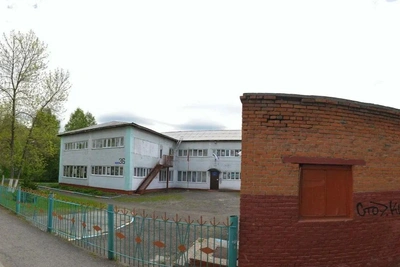
A typical residential building in the evacuated settlement of Novoalexandrovka.
Source:
The Novoaaleksandrovka microdistrict is often called «Ufa»s Pripyat« because just a few years ago everything there was abandoned. Now the district is not what it used to be — neither when people lived there nor when they were evacuated. Yet this place can be called the scariest in Ufa: if during the day it»s still tolerable, finding yourself there at night is real horror. UFA1.RU went to Novoaaleksandrovka to see a different life and the reality of this settlement.

A road sign provides motivation to return to the city quickly.
The road to Novoaaleksandrovka runs along the Birsky Highway. Approaching the district, we smell various odors: some like petroleum products, others like some kind of chemicals. Amidst this madness, cyclists race by.

These abandoned houses were likely built by prisoners of war.
The entire road is one continuous industrial zone — huge, endless. We pass the Ufa Electric Lamp Plant — the famous «Lamp». Then some other enterprises. Then buildings along the highway, cafes — we have arrived in Novoaaleksandrovka.

Empty and abandoned buildings remain in Novoalexandrovka today.
Once life here was bustling: prisoners and POWs arrived to build new territories for Ufa. The work lasted several years. In total, Soviet troops captured about 2–3 million soldiers and officers, many of whom worked on restoring the economy. In Ufa, according to some data, there were about 13,000 of them. In the 1950s, they were allowed to return home.

An online advertisement offers a building for sale at 16.3 million rubles ($171,600).
By the 1970s, the former camp area had turned into a residential quarter where about 40,000 people lived compactly. Ufa residents recall: the apartments were small, but at least they existed. They were allocated by enterprises. For entertainment, there was a cinema and a bathhouse. Televisions appeared late, and not everyone had one. They say people would crowd around the box to see this miracle. No wonder.

The street named Krashennikova echoes a surname more widely recognized.
However, they didn«t live here long: locals say that resettlement began as early as the 1970s, continued in the 80s, and after the phenol disaster, eviction accelerated. People were moved to different districts, but mostly within the city.

The abandoned houses slowly collapse due to lack of maintenance.
Nowadays it«s fashionable to send people from the center to Shaksha or, even worse (location-wise), to Vetochnikovo. But back then they were taken to Sipailovo, Chernikovka, Zelenaya Roshcha (consider it almost the center).

A pack of wild dogs runs through the abandoned settlement.
After the resettlement, everything became desolate. Then at some point life began again — various companies started occupying former houses. Some set up auto repair shops, others deal with petrochemicals, still others even opened cafes.

Dog tracks were frequently seen, and we avoided following them.
We go further and approach Zelinsky Street — named after the Soviet chemist who invented activated carbon. He also invented a carbon-based gas mask. In some places here, it would come in handy.

One of the dogs appeared surprisingly friendly during the walk.
Let«s be honest: there is almost nothing to see in Novoaaleksandrovka now. However, traces of former civilization can be found — and that is very interesting. But first, you need to reach these places that still remind us that people once lived here, not just stayed temporarily.

A broken balcony makes stepping out onto it unappealing.
Approaching one of the buildings, we saw open gates. We didn«t intend to enter, just wanted to see what was there, but dogs caught our interest. Yes, there are many of them here.

The roads in the settlement are in extremely poor condition.
The dogs we encountered were unfriendly. They were probably not very hungry, but the presence of uninvited guests irritated them. The tailed ones ran out to bark at us, but it was clear that in fact they wouldn«t hurt a fly — they are wild, afraid of sudden movements and noise. However, the pack effect might kick in: if there are many, the chances of being bitten increase.

The only task left is to clear away the trash from the area.
During our walk, we encountered dogs many times, but often the meeting was unpleasant. A couple of times we picked up a stick — just in case, to defend ourselves. Fortunately, we didn«t need it, as the dogs always backed off, but sometimes they would try to follow us, pretending to still be nearby.

A mysterious building with a bull«s head embedded in the wall.
Many of the buildings here were apparently residential. This is evidenced by balconies — now someone has an office with the opportunity to step out for fresh air. If the wind blows from the river, breathing here seems easier than in the city: few cars, and after rains all the sand is pressed to the ground and doesn«t cause a dust storm.

According to locals, there was a bathhouse in the area once.
Returning to the buildings: some owners (tenants) leave them as is, without changing much, others seem to rethink the space around, clearing excess overgrowth.

The roof of an old building is slowly caving in.
In the area of Lisa Chaikina Street (a WWII partisan), we were looking for abandoned objects, such as a clinic, but we encountered a building with a bull«s head in the wall.

The structure does not resemble a residential house at all.
It«s unclear what this building is, but judging by the entrance (bricked up), it looks very much like a bathhouse.

We hope Krashennikov was not in Novoalexandrovka, which already existed.
Then we found another abandoned building that looked like a former residential house. We went through the gates, watching our feet, as we had already seen dog paw prints many times. In the end, instead of dogs, there was something like an auto repair shop in the yard.

A large puddle resembles the famous Lake Aslykul in the area.
The worst street in the district is Krashennikova.

Illegal dumps were found in several locations in the settlement.
It is named after Nikolai Krashennikov, a native of Sol-Iletsk — a writer and playwright who wrote about «Waning Bashkiria». It is a fairly well-known book, published in 1907, which also earned some praise from critics. To be fair, in 1941 the writer wanted to write about the flourishing of autonomy, but died a couple of months after arriving in Ufa (well, well).

On either side of the phrase stood a boy and a girl with pipes, apparently pioneers.
If anywhere, it is here in Novoaaleksandrovka that this waning is visible: there are no normal roads. After the rain, everything was muddy, but still passable.

Sickle, ears of grain, and book are reliable Soviet symbols.
Another thing is that the passage to Miftakhov Street, named after playwright Sagit Miftakhov, was flooded. There was a puddle the size of Aslykul Lake, and unlike the lake, it had no plans to dry up, neatly positioned in the shade.

A school building collapsed over time due to neglect.
Miftakhov, by the way, wrote an opera named after the winged horse Akbuzat. It seems that this flying stallion would come in handy here. On this street, by the way, there was a road — old asphalt, very old, but intact. Cars regularly drive here — to one enterprise or another, sometimes fuel trucks and other heavy vehicles.

The structure has collapsed almost completely, leaving only debris.
Thus we found an abandoned two-story Soviet-era building. At first we thought it was that hospital, but it turned out to be a school. On the facade we saw the phrase «Learn, learn, learn» — a phrase once mentioned by Lenin in his works and later adopted by the people.

The building appears to have been built with low-quality materials.
Coming closer, it was clear that people had been here often: the grass was trampled, tall plants slightly flattened, and graffiti artists had painted on the building.

There is a staircase to the first floor, but not to the second.
What happened to this school is not very clear: from the outside, the walls are more or less intact, but there is no roof or any flooring between the two floors. Inside, we didn«t notice any slabs, only a large number of bricks that had fallen from the walls.

Everything that could be taken from the school was stolen.
One can also notice how nature has taken over — over the past decades, bushes and entire trees have grown here. In some places, even worse things that are not edible.

The raven«s wingspan is 50 centimeters (20 inches) larger than a gray crow»s.
If you look closely, it is noticeable in places that some of the floors were made of wood.

Some abandoned buildings are easier to demolish than to repair.
And in some places, a staircase remains, but another one collapsed long ago.

The building had no floor, but dogs were inside, so we left.
We examine the walls: no traces of soot — meaning the building did not collapse due to fire. Why it collapsed is unclear. At the same time, one cannot say that since there is no roof, nothing will fall on your head. Some part of the building remains. Anything could happen.

Most such abandoned facilities are guarded by feral dogs.
While we were inside, we heard a strange sound: not like a bird, not like a dog, not a person, not a car. We were about to look for wire to catch ghosts with it, but soon found the one who broke the silence. It was a raven — big and black. He and his kin accompanied us all the way around this school.
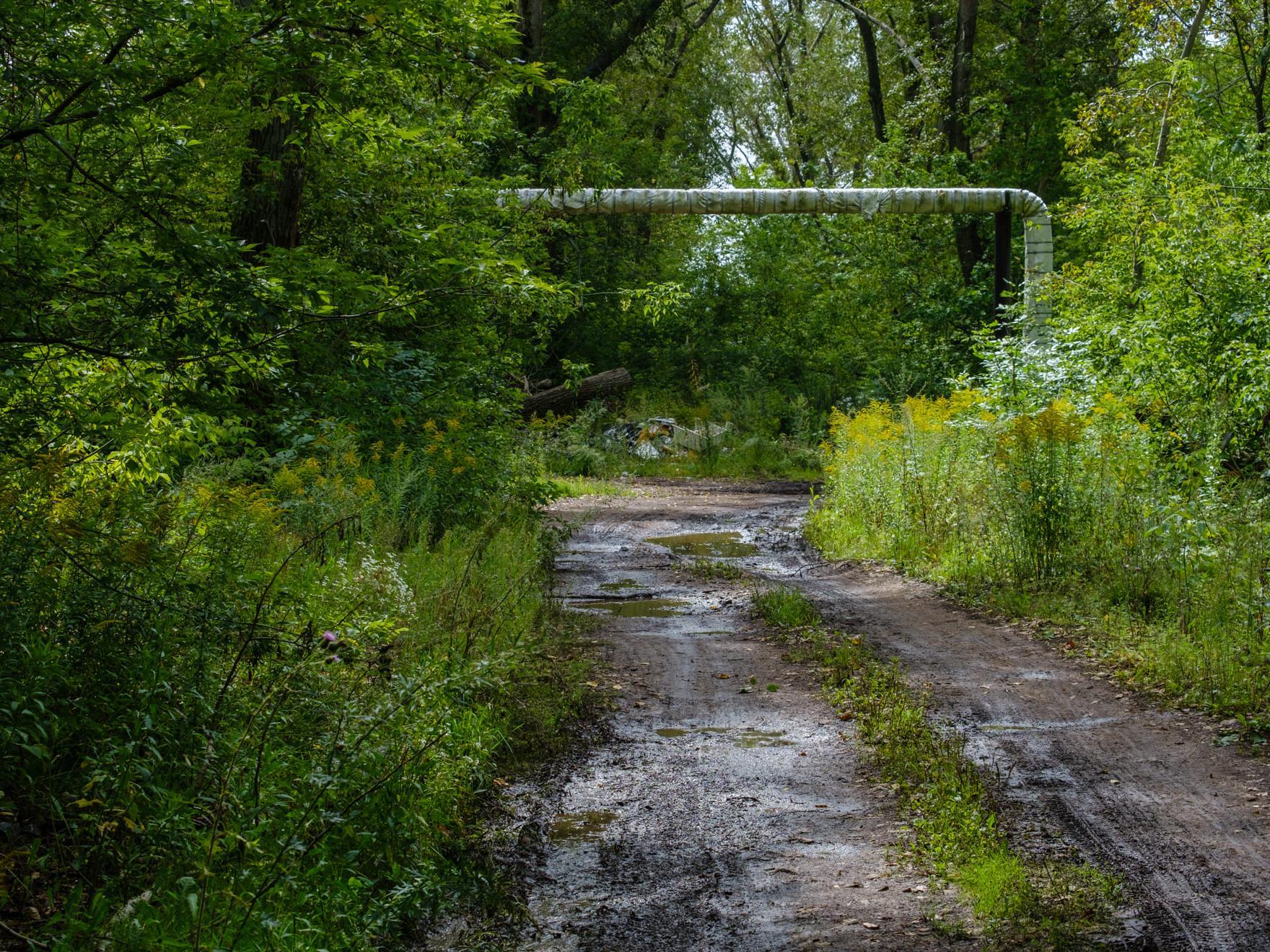
Walking through Novoalexandrovka, one can easily get lost.
Continuing through Novoaaleksandrovka, we repeatedly encountered abandoned buildings. Some were impossible to enter because they were heavily overgrown, not only with bushes but also trees. Sometimes the height of some plants reached about two meters.

To be fair, sometimes we met friendly dogs that completely ignored us.
Moreover, it was impossible to get into some buildings because they were already ruined, like the one in the photo below.

This building appears to have been a hospital or clinic.
Also, there was a constant noise, like an airplane flying or a factory working. It turned out to be sounds from a research and production enterprise that manufactures polymer and plastic products. They mainly supply their products for construction or maintenance of oil and gas pipelines.

A nail pierced through the structure from one side to the other.
In its job advertisement, the company says it provides transport to Novoaaleksandrovka and supplies employees with protective equipment. At the base in the settlement, there is an opportunity to eat and take a shower. For a standard 40-hour work week, a chemical technologist was offered 50,000 rubles ($526 at current exchange rates).
We also found a technopark of a company that sells chemicals for cars (and not only — also for cleaning weapons). For example, various lubricants, oils, and aerosols. Representatives of the organization assure that most of their products are made as import substitution.
Another local enterprise makes parts for pipelines: they say they supply them to major Russian oil and gas companies. Nearby is a company that develops cleaning pigs for pipes. Interestingly, it was once founded as a state enterprise in Ufa, but later split into different companies within one holding.
And there is also an animal shelter in these parts. Apparently, we were regularly encountering its inhabitants.
Those who lived in Novoaaleksandrovka remember the local water bodies: swimming there in summer or ice skating in winter. Now no one comes here even in winter, and in summer such a horror happens that it«s scary to look. For example, a couple of ponds: they are covered with some kind of green, like a swamp, reeds grow taller than a person, and an unpleasant smell emanates.
On the way out of Novoaaleksandrovka, we passed two interesting objects. In one, barking of dozens of dogs could be heard through open windows — apparently, another shelter. The second object was fenced with a concrete wall with barbed wire. There were bars on the windows and locks on them. A prison? No. An ordinary drug rehab clinic.
And we also found a monument to a curious journalist.
Read more