Boy Who Returned from the Brink Needs Help
Seven-year-old Danya Ostapenko from St. Petersburg is battling subacute sclerosing panencephalitis, a rare complication of measles. His family is raising funds for a costly rehabilitation course.
Sep 28, 2026 0

Source:
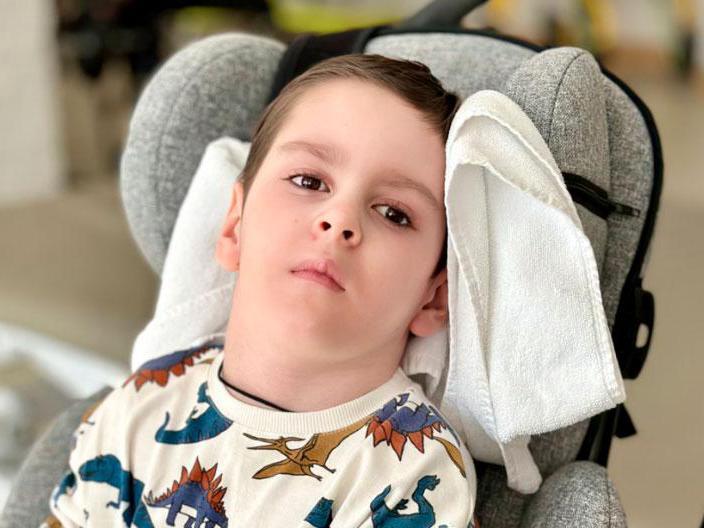
Seven-year-old Danya Ostapenko from St. Petersburg has been diagnosed with subacute sclerosing panencephalitis — a rare and extremely severe consequence of measles. Doctors failed to recognize the infection several years ago. The boy was on the brink of life and death, but through his mother«s efforts he has effectively returned from the other side. Now he is taking small but confident steps toward recovery, yet the road is long and requires significant funds.
For Natalya, Danya«s mother, one moment in intensive care became a turning point. Her five-year-old son, until recently active and cheerful, lay motionless. Suddenly the boy pursed his lips and blew her a kiss. That gesture his mother remembered forever — as a promise and a charge of strength for the long struggle.
At eight and a half months old, Danya contracted measles after being infected in a hospital. Doctors at the time did not recognize the disease, attributing the symptoms to laryngitis, tracheitis, laryngeal stenosis, conjunctivitis, and even atopic dermatitis. The boy had not yet received the measles vaccine according to the schedule — it is given at one year of age.
Danya recovered and grew up a healthy child. In kindergarten he was called a leader, he invented games, received certificates, and studied English and chess. No one suspected that the virus had remained in his body and would wait four years.
In June 2024, his father took Danya to his grandparents in Belarus. A few days later, alarming videos began reaching Natalya: the child was losing coordination, falling, complaining of fatigue. Relatives attributed it to the heat, but the boy was getting worse.
Natalya urgently flew to her son. At the Gomel Regional Hospital he was misdiagnosed with multiple sclerosis. After IV drips, Danya stopped walking, eating, and talking. On the fourth day came that very air kiss.
The exact diagnosis — subacute sclerosing post-measles panencephalitis — was made in Minsk. It is a progressive neurodegenerative disease of the central nervous system caused by the measles virus, often leading to death. The disease was destroying the boy«s brain.
Danya fell into a vegetative state: he did not open his eyes, did not move, did not respond. In the palliative care unit, a doctor told Natalya: “We cannot cure him; you will simply go home and help him live. How long he lives — no one knows.” He was given no hope.
At that difficult moment, Danya«s father left the family. Natalya was left alone with her son, but she did not give up: “I understood that no one but me would help the child. A constant search for information began, sustaining life, my boundless faith in my son.”
Transporting the boy to St. Petersburg was dangerous, so they had to stay in Belarus with his brother. Through social media, Natalya raised funds for a trip to Poland for stem cell treatment to strengthen the immune system. She worked with her son at home, talked to him, and waited.
Six months later, doctors at the same hospital could not believe their eyes. “Specialists came to us, and they were surprised at my son«s condition,” Natalya recalls. “Because they had assumed he would be on a ventilator. And here I am telling them: ‘Danya has started eating with a spoon, not through a tube, he has begun to react, to close his eyes. He holds his head up.’ ”
In November 2025, Danya grew strong enough that the family was able to return to St. Petersburg. Natalya registered his disability and obtained a referral to a rehabilitation center, where they were admitted on 21 March 2026. It was there that the long-awaited event happened — her son began to smile.
“Now he smiles every morning like a very small child. He hears the voice of his beloved occupational therapist Katya when she walks down the corridor, and his face lights up with happiness, he smiles content and happy,” his mother says.
Danya has begun to focus his gaze, look into eyes, and tries to raise his arms on request. Recently he was placed in a standing frame for the first time, and his body remembered how to bring his knees together properly. Specialists believe that to consolidate these gains, at least four months of continuous rehabilitation are needed so the body remembers how to hold the torso and sit.
The sessions are not covered by the compulsory medical insurance system (OMS); their cost is almost two million rubles ($21,900). Natalya receives financial help from her older brothers; Danya«s father pays alimony and helps with the mortgage, but this is not enough.
For support, the woman turned to the St. Petersburg charity foundation “Pomoshch” (Help), which has opened a fundraiser. The foundation says: “Danya is now seven years old. He has already done the practically impossible — emerged from a state from which people do not return. He smiles, he looks at his mother, he fights. And he desperately needs support.”
A fundraiser is open for a rehabilitation course costing 1,818,750 rubles ($19,900). The shortfall is 1,693,850 rubles ($18,500).
Read more