Thermal Packaging Is Essential, Expert Explains

Summer in Krasnoyarsk is hotter than usual: temperatures are above the climatic norm and last year«s figures. For food delivery services, this is traditionally a peak season. Few people want to stand by a hot stove at home; residents prefer to spend time at their dachas (country houses) or on the embankment.

According to Yuri Sitnikov, head of delivery for the Ginza Project restaurants and author of a themed Telegram channel, in the current reality — where the food service industry is affected by both general inflation and an increase in VAT — delivery economics must be calculated more carefully than a couple of years ago. Moreover, in summer the load on the kitchen and logistics is already at its maximum. The expert explained step by step what the food service industry needs to consider during the hot season.
How Summer Differs for Delivery
Demand is growing now, but with it risks also increase, because in the heat it is more difficult to deliver a dish without losing quality or presentation. What looks perfect on a table in the dining hall can lose both its appearance and taste after twenty minutes in a thermal bag at a temperature of 30°C (86°F).
Traditionally, summer is the vacation season, so it can be harder to keep the team intact, and quickly hiring temporary replacements is often difficult and expensive: there is a chronic shortage of staff on the market. According to HeadHunter, the average offered salary in this industry in 2025 rose by about a quarter, to 146,000 rubles (about $1,600 at current rates), and by the beginning of 2026 the income level in job openings reaches 170,000 rubles (about $1,900).
— A common mistake is to treat summer like an ordinary month and expect that rising demand alone will bring profit. You have to prepare for the season in advance and across several areas: menu, packaging, logistics, and shift schedules, — says Yuri Sitnikov.
Menu: What to Boost and What to Drop
In summer, it makes sense to restructure the menu around fresh items that require almost no heat treatment. Cold soups and okroshka (a cold soup) should be moved to the very top — they are a complete light meal, and people order them readily in summer. It is logical to immediately offer lemonades, fruit drinks, and homemade compotes alongside them. Paired items satisfy the need for something refreshing and also raise the average check without forcing the guest to add random dishes to the cart. Ice cream and sorbets are better placed in a separate block: they are bought impulsively, especially in the evening when one wants something light.
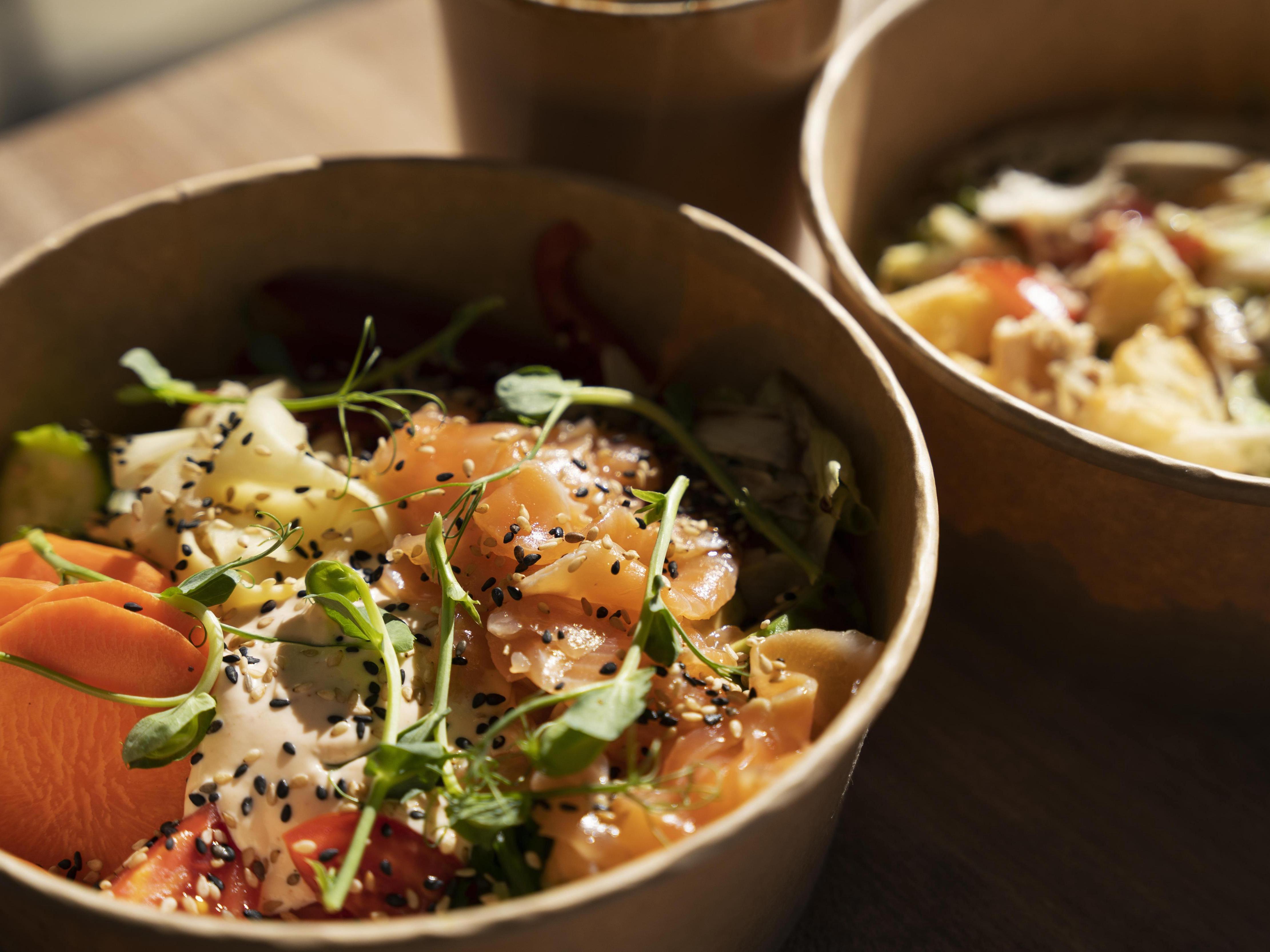
Summer sales are good for seasonal vegetable salads, poke bowls, and bowls that visually look cool, appear neat in the app, and, more importantly, do not fall apart during transport. The share of heavy and fatty items — casseroles, thick stews, dishes with rich creamy sauces — is best reduced for summer, because in the heat they sell worse and lose their appearance faster.
Ready-made combos like «okroshka plus lemonade» or «poke bowl plus iced tea» work well. They simplify the guest«s choice, and they can be assembled right in the dashboard — in some apps, for example, there is a combo builder for this.
Do not neglect short markers on the cards. Notes in the description like «refreshing» or «ideal in the heat» catch attention in the feed better than a dry list of ingredients. Another important point: the selected items must consistently maintain their taste and appearance in the thermal bag for the entire delivery time; otherwise, even the most summery dish will not keep the guest coming back.
What Tolerates Delivery Worst and How to Fix It
In summer, texture, temperature, and appearance suffer first during transport, and each category of dishes has its weakness. Nuggets, french fries, and fried chicken lose their crunch within 15–20 minutes. Separate packaging with ventilation or a temporary switch to baked alternatives during peak heat helps.
Cream and mousse desserts, cheesecakes, tiramisu «melt» and deform, so it is wiser to remove them from delivery during the hottest hours or transport them only in rigid containers with cold packs. Dishes with thick cream and egg sauces — carbonara, julienne, beef stroganoff — separate and lose flavor, and it is more honest to offer them for quick pickup or replace them with more stable versions based on tomato or light yogurt.
Heavy thermal packaging is a separate expense item. No matter how much one might want to save on it in 2026, it is most often what determines whether a dish arrives in good condition or not, so it should be treated as a mandatory part of the cost price.
If a dish remains in delivery but risks arriving in less than perfect condition, honesty with the guest helps. Clear notes in the app — «pickup only», «recommended chilled», «travel time no more than 25 minutes» — set expectations in advance and mitigate some future negativity. The aggregators themselves have long used the same trick: when a courier is late, the service warns about it in advance, and the customer reacts more calmly than to a silent delay.
Logistics and Couriers in the Vacation Season
— In summer, the issue of courier work becomes more acute, and here it is important to calculate everything correctly. An in-house courier service is justified only as long as the establishment has enough locations and orders to keep it busy. Delivery economics largely depend on mileage, and the longer the courier travels to the guest and back, the more expensive each order becomes, — said Yuri Sitnikov.
In summer, the situation is complicated from two sides: part of the team is on vacation, and there is a shortage of couriers on the market. Therefore, during peak season, many establishments find it easier to rely on aggregators. This is simpler than scrambling to fill their own ranks. The expert does not recommend completely abandoning one«s own couriers: a hybrid model, where the team provides stability and services allow quickly adding people during surges, is more reliable than betting on just one approach.
— I advise forming delivery zones not based on formal boundaries but on real points of seasonal attraction — parks, embankments, dacha destinations — and keep these zones flexible. On weekends and hot days, it makes sense to automatically expand suburban radii and simultaneously narrow urban ones, so as not to spread couriers thin. It is useful to integrate the weather forecast directly into operational processes. At temperatures above 30°C (86°F) or during rain, it is worth reducing urban zones, allowing an extra 10–15 minutes for delivery, and warning the guest, — says Yuri Sitnikov. — If you deliver yourself, on weekends and days with a bad forecast, it is prudent to keep about 15–20% of couriers in reserve. It is also worth monitoring the availability of time slots when the restaurant actually accepts orders. A figure of 96% or higher is considered good.
Working with the Platform: Display, Analytics, and Promotions
On the aggregator«s display, photos play a noticeable role in summer. Shots with greenery, ice, water droplets, and bright seasonal ingredients increase clickability, while a title photo with a summer vibe boosts the conversion rate for entering the card.
— I would build descriptions around sensation and speed rather than composition: a phrase like «refreshes in half an hour» hits the summer demand more accurately than a list of ingredients. Seasonal selections are better grouped not by the principle of «everything in a row» but by scenarios like «for a picnic», «for the office in the heat», «for an evening by the river»: such categories convert better than universal ones. A separate block of «Summer Hits» with 5–7 items works as a quick anchor for a guest who does not want to choose for long, — advises the expert. — In the aggregator«s search results, much depends on rating, delivery speed, and the user»s own preferences, so you can get into the customer«s field of view without big investments in advertising. Thematic selections and paid promotion increase visibility, but chasing the top spot at any cost, especially at the start, makes no sense.
According to Yuri, all of the above works only together with regular statistical analysis. For example, in Yandex Food (Yandex Eda), the personal account has a metrics section where you can see turnover compared to the previous year, order distribution by day of week and hour, cancellation rate, and assembly time. In summer, they first look at conversion by hour and zone to see where demand is growing and where cancellations begin. The gap between planned and actual delivery time is also important: if it increases, it is time to narrow the radius or connect service couriers. The cancellation rate and assembly time on increased volume are the first to drag down the rating, so it is wiser to reinforce the kitchen during peak hours in advance rather than after the score drops.
— At the same time, promotions should work on margin, not cut it. In my experience, combos and sets for a group with a small markup yield more than a direct discount. Inside the set, each item costs the guest a little less, and they perceive it as a benefit, but several dishes end up in the order, so the average check grows due to the number of items and order frequency, not due to a reduced price, — says the expert. — A straight discount simply cuts revenue. Free delivery from a certain order amount should be included selectively — during less busy hours or for distant zones, to stimulate orders without hurting profitability. For any promotion, it makes sense to calculate the cost of items in advance and build in a margin buffer, because the goal of the season is volume growth with stable profitability.
Price and Working for Repeat Orders
Cost is the topic around which there is the most debate now. When orders are numerous, there is always a temptation to build a markup into delivery — seasonal or hidden in the dish price, especially since costs have risen this year.
— I decided long ago not to do this. When the same dishes cost more in the app than in the dining room, the guest almost always perceives it as a lack of transparency, and repeat orders drop off. The establishment gets a one-time boost in revenue but pays for it with trust, and it is trust that brings the second, third, and tenth order. It is more honest to compensate for logistics by increasing the average check through the same combos and sets than to shift it into the dish price. In the long run, stable pricing and targeted demand management through promotions and zones, in my experience, is always better than attempts to recoup costs with sharp price increases, — believes Yuri. — This is especially important in summer, because the season brings many regular and situational guests — tourists, groups going to the dacha, those ordering from you for the first time. A new guest judges the establishment by speed and quality, not by the breadth of the assortment.
A bad first order is remembered, and people return to places where everything arrived on time and intact. To increase the chances of their return, you need to give a clear reason — a personal promo code for the next order or a small bonus with a menu hit — and reinforce the impression with what they ordered for. Hot dishes arrive hot, cold dishes arrive cold, exactly on time and with a nice little extra like a seasonal drink. The expert asserts that a situational summer guest becomes regular when the establishment, from the first order, works on the second, rather than squeezing maximum profit out of them here and now.
— Summer is a short season, and those who win are not the ones who sharply raise prices in June, but those who by June have already repackaged the menu, marked out zones, prepared the display, and decided who will cover shifts during vacations. There is plenty of talk this year about delivery becoming expensive and unprofitable, and costs have indeed risen, but the conclusion should not be to abandon aggregators, but rather that one needs to work with them more carefully, — the expert sums up. — For a small establishment, this is rather good news: to earn on summer demand, it is not necessary to maintain your own courier service. It is enough to prepare in advance on menu, packaging, zones, and shift schedules. It is not too late to start this preparation even in the middle of the season.