Even C-Students Can Ace EGE: 100, 100, 94


Daria is ready to take on Saint Petersburg, the Northern capital, for her studies.
Graduate of School No. 61 in Tolyatti, Daria Byakova, scored 100 points on the Unified State Exam (EGE) in Russian, 100 in Physics, and 94 in Advanced Mathematics. She is now choosing among top universities in Russia.
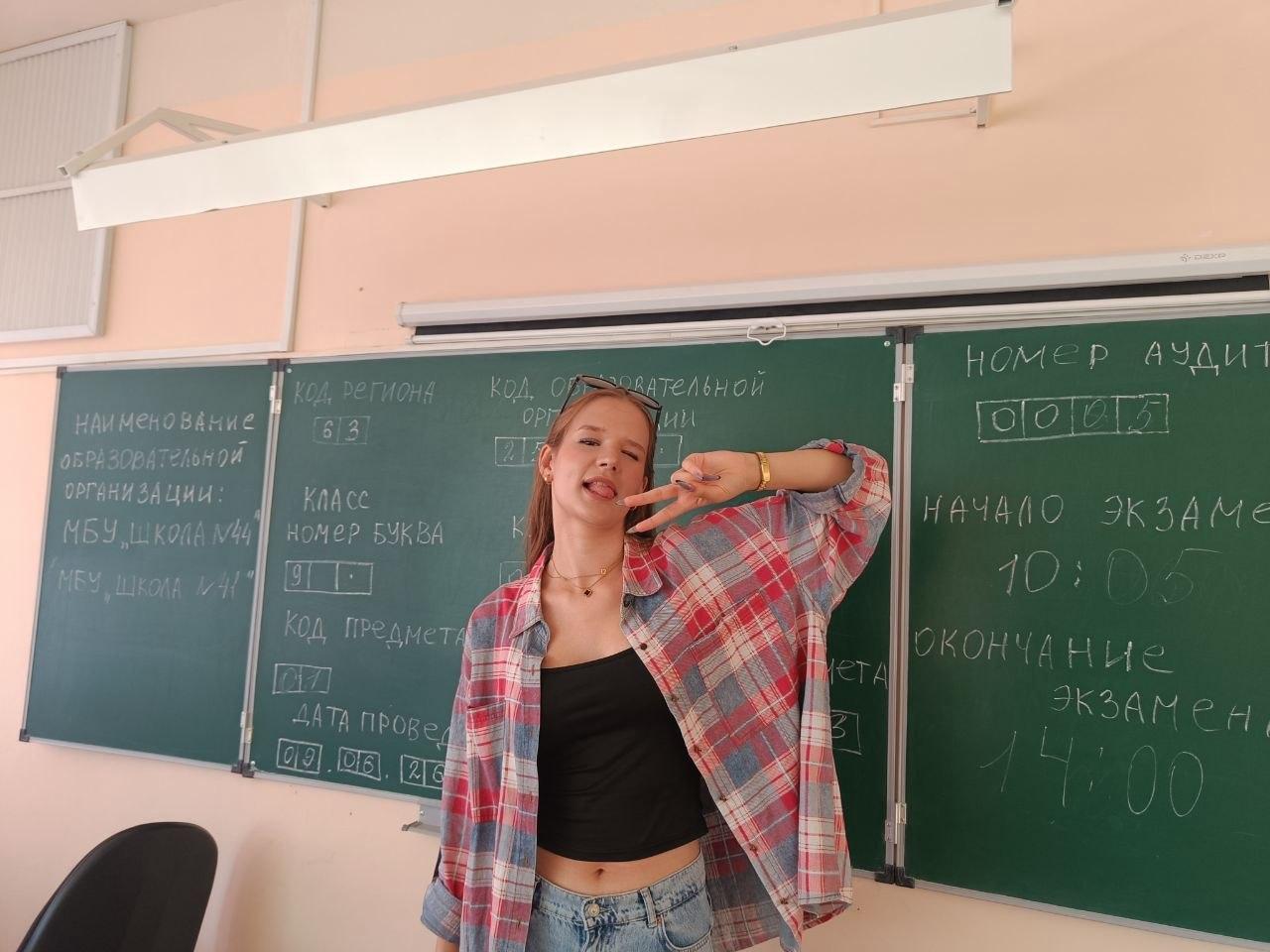
Daria excelled academically but kept a balanced life with friends and hobbies.
In an interview with TOLYATTY.RU correspondent, the girl told how she prepared for the exams, relieved stress, where she plans to enroll, and how colored pens help in EGE preparation.

Daria values time with friends and dance as a way to unwind from studies.
«I Lied on the Bed with Books, My Eyes Closing»

Daria visited Saint Petersburg with her sister and fell in love with the city.
— Dasha, congratulations on your brilliant result! Tell us, why did you choose Physics, Russian, and Advanced Mathematics?

Daria believes the EGE requires a special mindset and confidence in oneself.
— It all started back in ninth grade, when we were taking the Basic State Exam and had to gradually determine whether I was more inclined toward the humanities or exact sciences. I took Physics and Social Studies then and realized that Physics came easier to me: I have a good feel for the subject and understand it. Therefore, choosing Physics for the EGE was quite logical.

Daria’s first reaction to her perfect score was disbelief: she thought it was a dream.
Computer science, let’s just say, doesn’t inspire me, so I preferred Physics along with Advanced Mathematics. I also grasp Math pretty well, but I prepared for it especially thoroughly—it took the lion’s share of my time and effort.

The governor congratulated Daria and presented an award, making her achievement feel real.
— How were your grades? Were you a straight-A student from first grade?
— Yes, practically all my school years I studied with straight A’s; I have ten commendation certificates. Studying came easily: I never crammed anything, and my parents never checked or helped with homework—I handled everything on my own. At the same time, I couldn’t be called a nerd: I didn’t sit hunched over textbooks and notes for days. There was always time for friends—we hung out, had sleepovers—and for dancing. I did jazz-funk for a long time, then switched to high heels dance.
In tenth grade I joined a gym. At that time it was almost a trend—everyone suddenly started going to the fitness center, and I thought: why not, especially since the club was within walking distance from home. My mom and I bought discounted memberships and started attending group classes together, strength training, and even the pool. That helped me switch off and relieve psychological tension. When it’s nothing but studying day and night, it’s hard without a break, so disconnecting is essential.
About a month before the exams I stopped going to the gym: the online school started intensive review courses, and there was no time or energy left for sports. After the EGE I gradually returned to activity—started doing Pilates and stretching.
I’m also grateful for my family’s support. Mom encouraged me with little daily phrases and small treats. She’d come into the room, put out cut fruit, say, “Dasha, I love you”—that really cheered me up. Dad also supported me with words and spoiled me with goodies. My sister is now studying at Kazan Federal University, she finished her third year. We’d call each other whenever we had time, and I’d complain: “Oh, I’m so tired of all this.” Her support helped a lot.
— When did you start preparing specifically for the EGE?
— I took the first steps back in tenth grade: I did assignments, watched webinars, but I didn’t focus heavily on the EGE. I worked more to make eleventh grade easier—to build a foundation instead of encountering a huge volume of information from scratch.
In eleventh grade the preparation became more serious. The first semester was relatively calm: after summer you’re just getting into the rhythm, everything is just beginning. But after the New Year, I realized the exam was right around the corner and I had to go full throttle—study more, review more actively. I had a specific goal: to get a state-funded spot in Saint Petersburg. The competition there is fierce: at the universities I was considering, the minimum score started at 250. Of course, there are lower ones, but those aren’t the universities I was aiming for.
— What did a typical day look like in eleventh grade?
— I woke up about an hour before I had to leave home. I didn’t even think about makeup or extra preparations—I had no energy, I just wanted to snatch a few extra minutes of sleep. I’d get to school, spend the first two classes essentially coming to my senses, and by the third period my brain would wake up and finally start working at full capacity. After classes I’d come home, have a snack, and immediately start watching webinars. Often there were three per day, and then I’d start on homework.
Sometimes the volume of information was so huge that I’d stay up late, eventually lying on the bed with books, my eyes closing. When I felt I’d reached my limit and couldn’t take any more, I’d pass out. Most often that happened well after midnight. Staying in that mode for a long time is an incredibly draining mental ordeal.
And how many pens I wore out, how many notebooks! I spent a whole sum on stationery. For math I bought large A4 notebooks with 96 pages—just over the last six months I accumulated about five. Plus correction tape, markers, colored gel pens—all used up actively.
— Do colored pens help in solving math problems?
— Absolutely. For example, in parameter problems, which are often solved graphically, it was much more convenient and even pleasant to draw lines, curves, and circles in different shades. It’s more visual than on the exam, where only a black pen is allowed: axes, graphs—everything blends together, and sometimes it’s hard to figure out what’s what right away. On the actual exam I actually felt a bit lost because of that and worried I’d make a mistake, but in the end I got the maximum score for that problem.
In geometry, color also helps—you can highlight additional constructions, emphasize an important segment or part of the drawing to focus on the key element.
— And in Physics, what’s more important—knowing formulas or understanding processes?
— Actually, both are important, but the key is to understand in which situations to apply which formula. The simplest I’d call Ohm’s law for a circuit segment: current equals voltage divided by resistance, that is I = U / R. And I find it hard to pick the hardest—for me they’re all roughly the same level.
I spent relatively little time on Physics because that subject came easier to me. Math is objectively harder, and the volume of material is noticeably larger. You can even see that from the number of answer sheets: on the Physics EGE I usually use five or six sheets for extended answers, while for Math it can easily be up to twelve.
— When was it particularly hard for you?
— Objectively—in May. There was less and less time before the exam, and suddenly the realization hit: you’ve studied for eleven years, you’re graduating, leaving, becoming an adult. You don’t know how life will turn out, where you’ll be admitted, whether you’ll get a dormitory. If not, what then? Rent an apartment, live with relatives? Lots of questions. And they still trouble me. An anxious period.
«Even a C-Student Can Score 100 on the EGE»
— What role did school play in your preparation? Did it help?
— We regularly wrote mock exams, and I could always go to the teachers, ask questions, clarify unclear points. My math teacher genuinely worried about my result and supported me at every stage. My Russian language teacher was very strict, and that only benefited me: such rigor disciplines you, helps you truly learn the material and firmly consolidate it.
The principal also helped—Andrei Viktorovich Kordik came when I moved into eighth grade, and with his arrival noticeable changes began at the school: they equipped a sports ground, renovated the gym, and, as far as I know, now they plan to update the cafeteria and replace the fence. All that buzz really inspired us students!
— Be honest: can you score high on the EGE relying only on school, without tutors?
— I know examples of graduates who prepared exclusively at school and got the maximum 100 points. But honestly, the time spent in class from 8 a.m. to about 2 p.m. is not enough for many to achieve a serious result. Even with the greatest desire.
After classes you still need to continue working: study with a tutor, join online schools, solve practice tests on your own. I’m convinced: turning to a tutor is by no means a sign of weakness, inability, or poor school preparation. It’s just an assistant on the path to your goal. I myself studied at an online school, attended group classes, watched webinars, bought prep courses…
I also firmly know: even a student who previously got C’s and B’s can score high on the EGE if they become truly motivated, set a clear goal, and start preparing intensely. School grades are not at all an indicator of intelligence. They are rather a reflection of attitude toward studies, and even then at a particular moment. The last two years, or sometimes even just eleventh grade, as I now understand, can radically change the situation.
«You Can’t Get By with Just a “Gentleman’s Set”»
— What essay topic did you get on the Russian exam?
— The topic was: “What kind of person can be called truly cultured?” The author of the text was Korney Chukovsky. In the essay, we had to show the author’s position, give two examples with explanation, analyze the logical connection, provide our own example, and write a conclusion.
The text told how Chukovsky asked a female student to read aloud to him so he could rest a bit and listen. He chose Gogol’s “Nevsky Prospect” for her. The girl read absolutely monotonously, without any feeling—just running her eyes over the lines. The author himself genuinely admired the text, noting how many “verbal fireworks” it contained, what vivid images. He saw all that richness, but the girl remained indifferent, didn’t delve into the content.
The main idea of my essay was that a cultured person is one who can experience admiration for art: music, poetry, literature. Such a person has a rich inner world. I especially remembered the phrase that before the girl lay a beautiful multicolored patterned fabric, but to her it seemed gray and monochrome. I used that image in my essay and built the analysis of the logical connection on contrast: on one side, the student’s complete indifference; on the other, Chukovsky’s reverent perception of every artistic device. That way I managed to show the difference in perception and depth of the spiritual world of two people.
— Was the Physics EGE difficult?
— When I saw the exam paper, I just sat and laughed at how lucky I was! The first part came easily, though in a couple of tasks I hesitated: the wording was a bit strange, unfamiliar. The second part also turned out simple; I worried more about the formatting—to write everything properly, not make mistakes, so they wouldn’t deduct points for carelessness—but in the end everything was fine.
— What was the hardest part of the Advanced Math exam?
— In Advanced Math, there’s a so-called gentleman’s set: the first part and the second part, which includes seven high-difficulty tasks. Among them are a trigonometric equation, an inequality, and an economic problem. But for a high score, the gentleman’s set isn’t enough—you need to solve complex problems, for example with parameters.
To handle such a problem, it’s not enough just to find roots—you also need to understand how they behave when the parameter changes. And for that you’ll have to combine several branches of mathematics: algebra, function properties, and graphs. You need to be able to unify all that.
Another important point—the formatting. On the EGE, they look not only at the answer but also at how you reason. You have to explain every step, consider each case separately. If you skip something or miss a variant, points are deducted immediately. So it’s not just math, but also clarity and attention to detail. I scored 94—a great result for me.
«Is This a Dream?»
— How did you find out about your first 100 points? Remember your first reaction.
— The first 100 came in Russian. My parents were squealing with joy, and I was squealing too. I had never scored 100 on any practice test—my maximum was 94 or so. Before the results, I thought it could be 100, but I knew a lot depended on the grader’s strictness. There’s a human factor, typos, the computer might misread a digit. Such little things can prevent you from getting a perfect score.
Physics was the second 100. I found out when my homeroom teacher called me, and I woke up from that. Mom had just come into the room to wake me up. They tell me I got 100, and I ask: “Is this a dream?” Mom and Dad were very happy; all the relatives called, congratulated me, rejoiced, and said they were proud of me.
— Where do you plan to apply?
— I’m still deciding on fields. I’ve already chosen the universities: ITMO, SPbU, and ETU (LETI), all in Saint Petersburg. I’m in love with that city; I dream of studying and living there. As for a profession, I’m leaning more toward work related to studying Physics, but I don’t rule out going into IT.
— Why Saint Petersburg, not Samara, Kazan, or Moscow?
— I first visited the city with my sister in the summer after tenth grade. I went there a second time in eleventh grade, when my friend and I attended the spring school of the Physics Department at SPbU. Lectures lasted until four, and after that we’d go to the city center, wander the streets, relax, drop into cozy cafes. That really gave me a mental break, because studying was non-stop. On that visit I fell completely and irrevocably in love with Petersburg.
— Do you agree with the opinion that the EGE is a huge stress for students and should be abolished?
— The EGE is a mentally extremely difficult ordeal, especially when you’re aiming for a top university. At the same time, it’s the most convenient and fair option: imagine if you had to travel around to different cities and take exams at each university separately. Here the task is as clear as possible: prepare, give your best, and write to the maximum. A lot depends on your own mindset, on the belief that you can do it. It’s just a stage you have to go through with the thought: “I did everything I could.”