Family Creates Hydroponic Strawberry Farm Near Perm
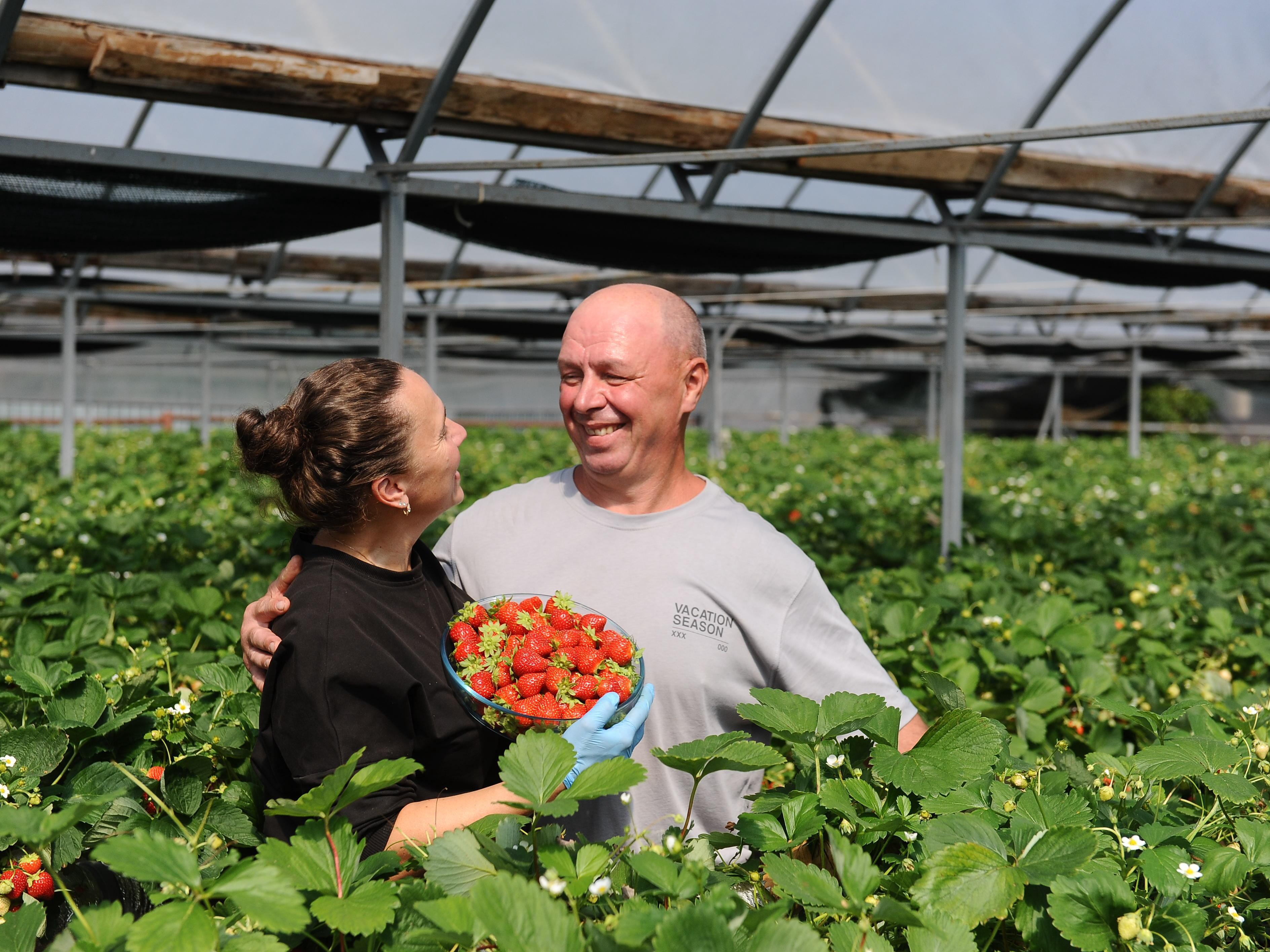

Spouses Dmitry and Elena have been growing hydroponic strawberries for nearly eight years
Spouses Dmitry and Elena Pashkov created a strawberry farm on their plot near Perm about eight years ago. This year the couple decided to conduct tourist excursions on the strawberry plantation. The idea quickly took hold, and tourists are delighted — after all, on the farm you can stroll among three thousand bushes of ripe strawberries! In the Perm region, this is the only farm where these berries are grown without soil, using the hydroponic method.
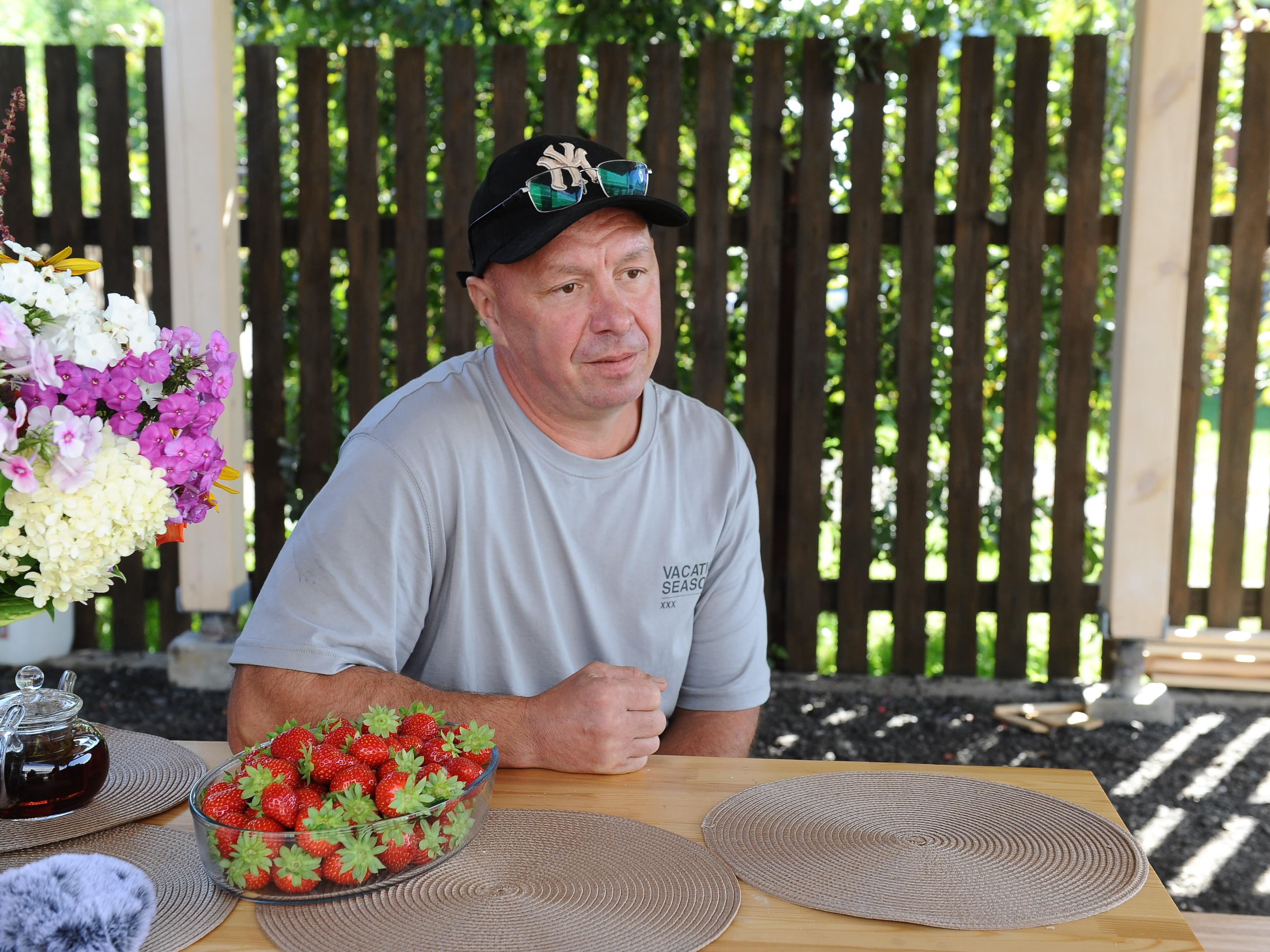
Dmitry Pashkov and his beautiful harvest
We spoke with the creator of the strawberry farm, Dmitry Pashkov. In winter he is a ski instructor, and in summer — the owner of a strawberry plantation. The farmer honestly shared how costly such a business is, whether there are risks, why the couple decided to grow strawberries specifically, and how many kilograms of berries their farm yields per season.
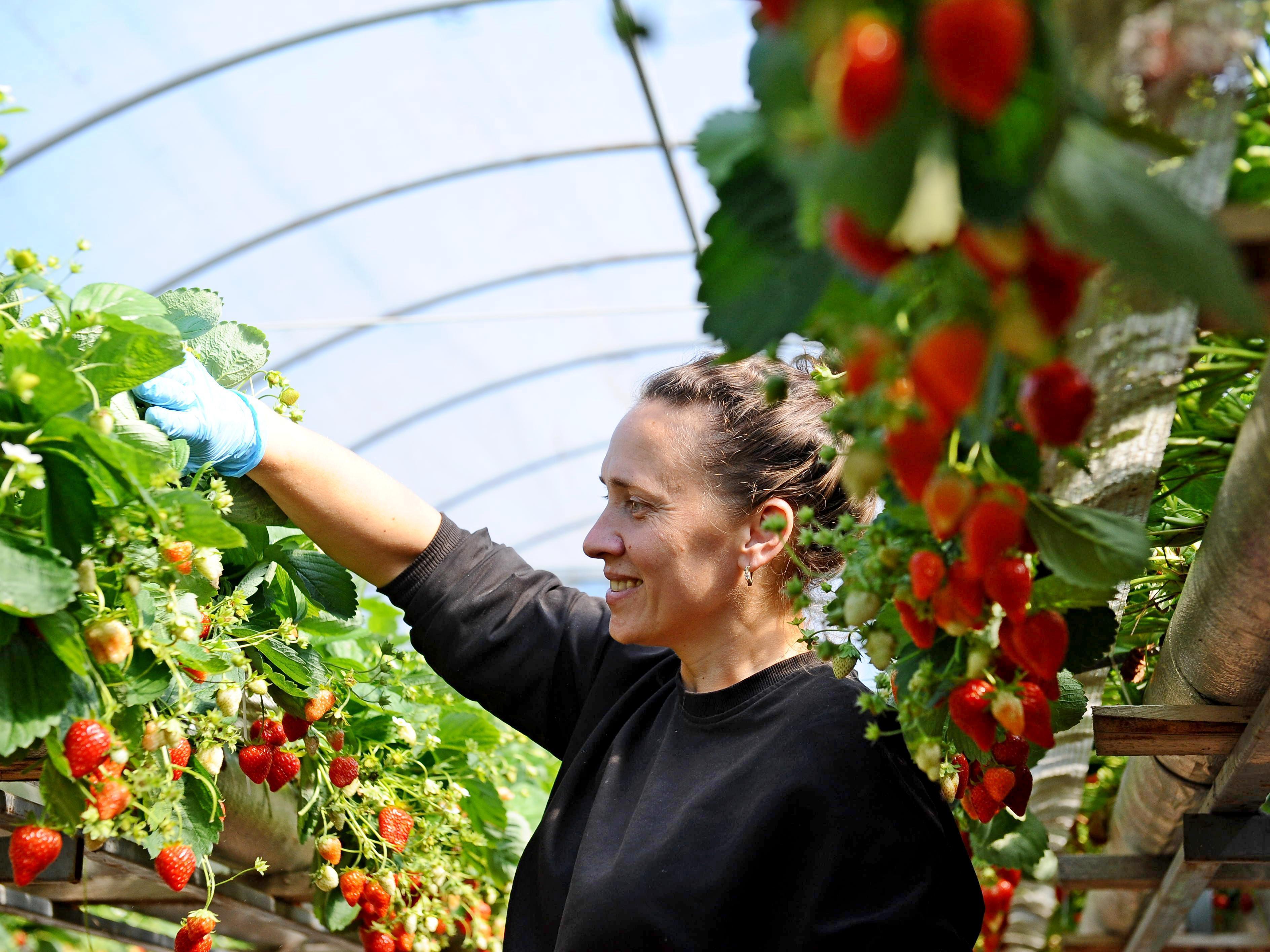
Elena doing what she loves. She admits the farm is a special place for her
Studied to build airplanes, but was drawn to farming
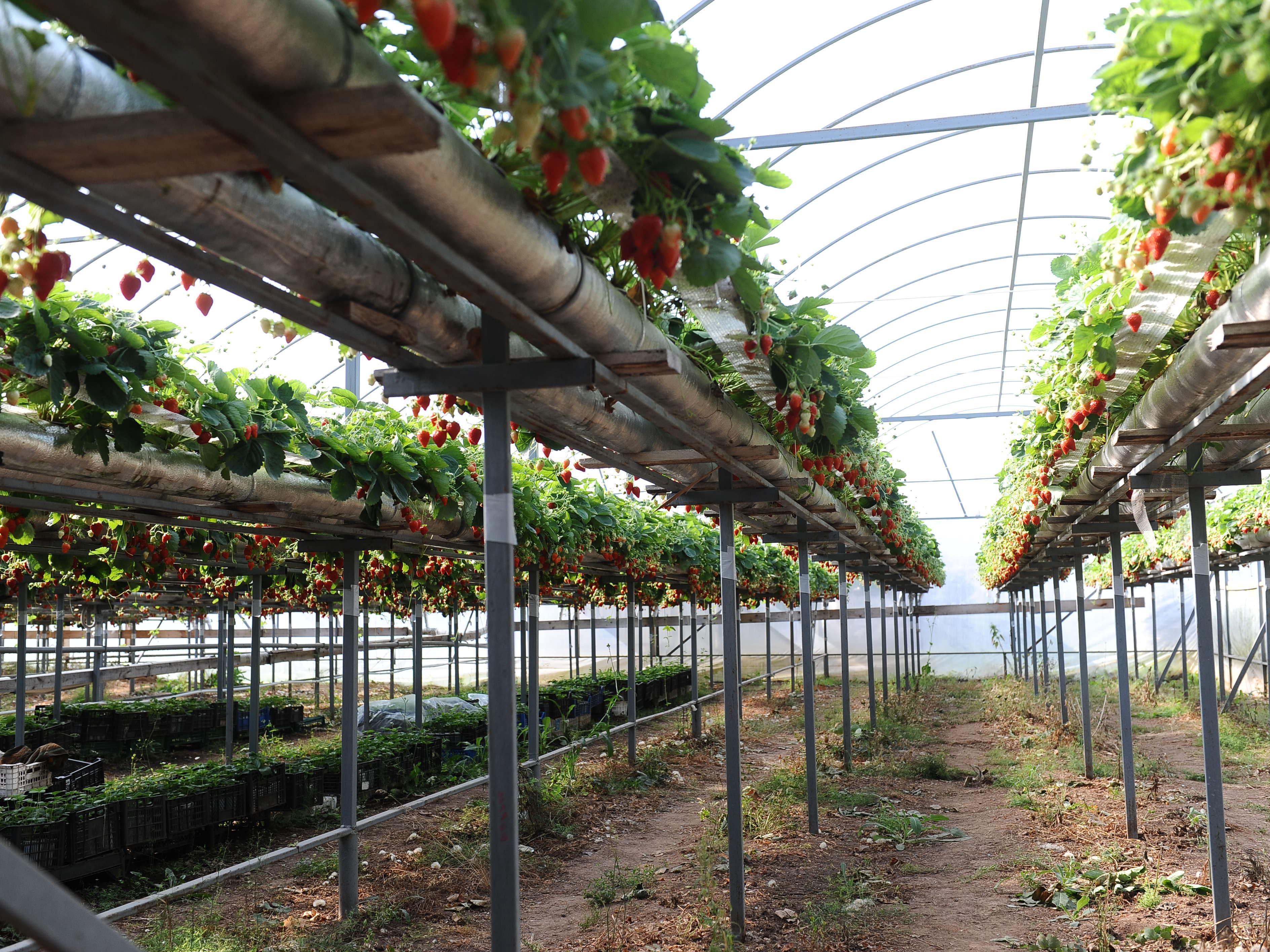
Several thousand strawberry bushes grow on the farm
Dmitry Pashkov studied aircraft construction in his student years; he has an incomplete engineering education. For the last 10 years the man has worked as a ski instructor. His wife Elena is raising their son — he studies in a math class and travels to olympiads in different cities, and professionally practices judo. Dmitry has an older daughter from his first marriage, and recently became a grandfather.
The farm has its own aesthetic
The family lives in the village of Ferma. About eight years ago the couple first thought about growing strawberries.
“I have no relation to agronomy at all. My beloved wife prompted me to do this,” Dmitry smiles. “She just always wanted fresh berries. She loves strawberries, and I must do everything so that my wife has berries, right? The desire to feed my wife turned into this kind of business.”
The couple planted the first bushes in the ground on garden beds, but the harvest was small.
“Thrushes flew in — pecked everything, snails came — ate them. I started studying all the intricacies of agronomy on my own, and came to the conclusion that it is better to grow strawberries using hydroponics,” Dmitry shares.
Hydroponics is a method of growing plants without using soil, in which the roots receive all necessary nutrients from a special water solution containing mineral salts and microelements.
Dmitry hand-built a relatively small greenhouse with an area of 6 by 12 meters. There were mistakes: in the second season the couple bought seedlings from Krasnodar Krai, but it turned out the bushes had pests and were weakened. As a result, the entire harvest was lost — that’s one season lost for the farmers.
“In short, the first two years were an unprofitable enterprise. Of course, there are always risks,” the interviewee admits.
How much to invest to get a ton of strawberries every season
Now Dmitry has accounted for all mistakes; for several years he has been buying proven varieties from suppliers in Italy and the Netherlands. On the family strawberry farm they currently grow four varieties: Dutch Favori and Italian Cantus, Brina, and Murano. The berries mainly differ in shape. The lion’s share of the bushes in the greenhouse — 1,900 — is the Murano variety.
“Murano is good in taste, optimal in yield. Very large, resistant to pests and diseases,” the farmer enthuses. “But Murano doesn’t like heat. This summer we endured severe heat above 30 degrees [86°F], and our Murano’s taste quality somewhat ‘dropped’ because with hydroponics, when the system circulates the solution, the leaves evaporate a lot of moisture in the heat.”
Dmitry says the ideal temperature for a strawberry greenhouse is no more than 26–28°C [79–82°F] during the day, while +14°C [57°F] is acceptable at night. Cooling panels help maintain the optimal temperature in the greenhouse.
“True, these coolers also humidify very strongly, and this year it’s either heat or prolonged downpours, the summer is so damp, an excess of rain. So we didn’t start these cooling panels because it’s already very humid,” Dmitry shares. “It was pure dampness. For plants this is also stress.”
We frankly ask the farmer how much money he invested for the strawberry farm to start turning a profit. Dmitry says that over time he made up his mind and also hand-built a more spacious greenhouse with an area of 440 square meters, and in the old greenhouse the family grows cucumbers and cherry tomatoes. Together with the installation of the cooling system, the construction of the new greenhouse cost one million rubles ($10,600 at current rates).
A ton of berries per season
Dmitry shows us the greenhouse from inside. The nutrient solution for strawberries is poured into a special tank connected to tubes that feed the strawberry bushes. All of this is a closed system. The solution circulates in a circle. The tank holds a thousand liters — enough for three thousand berry bushes.
Previously Dmitry bought ready-made solutions. A ten-liter canister of concentrate, for example, cost 12,000 rubles ($130 at current rates), and it lasted 10 days. Every day three thousand strawberry bushes can drink 500 liters of water and solution. Per month, buying ready-made solution could cost 200,000 rubles ($2,100 at current rates). In the end Dmitry decided to prepare the nutrient solution himself.
“Berries need simple salts, phosphate, nitrogen, phosphorus and potassium, this is the basis of their nutrition,” the interviewee lists. “Now 20,000 rubles [($210 at current rates)] is enough for me to prepare the solution for a season.”
The season on the strawberry farm begins in May and continues until the end of September. Every year new bushes must be planted. Over the season the family gets a ton of berries. Each bush gives 350 grams of strawberries.
Dmitry adds that the berry size will be larger if you control the number of flowers on the bush.
“We break off extra flowers and leave only 20 berries on each bush, that is, we give the bush development, the berry grows much larger and sweeter,” the farmer shares the secret. “The taste of the berry in September is such that you need to wash it down, it’s so sweet. With a refractometer — that’s a device that measures sugar level — we check the taste of the berry, and it goes off the charts. It shows 18 Brix — that’s a lot.”
Sales, first excursions to the strawberry farm, and a dream of a campsite
At first the couple grew strawberries only for themselves. Then Elena Pashkova started posting photos of the harvest on her social media. First neighbors got interested and asked to sell them strawberries. Then word of mouth worked. There are more and more clients.
“Lena has a queue, people can wait two to three weeks, some wait a month to buy our strawberries,” Dmitry says. “For the sake of quality they are ready to wait. People buy 20 and 30 liters at once. The berry doesn’t spoil even after two weeks.”
We ask what the secret is.
“Grown with love,” the farmer smiles. “It’s simply fresh for us, just picked. I find it amusing when dacha gardeners say that berries spoil quickly because they are natural. No! They spoil quickly because they are bad. Let’s be honest: they spoil because they are crushed, eaten by slugs or bitten by ants. Some agrarians abuse fungicides.”
The farmer explains: this is a means for treating plants against diseases. When heavy rains come, the berry starts to get sick and rots. According to the interviewee, to sell all of it, unscrupulous people spray it with fungicides. They do treat the plant from the inside, but all fungicides have a waiting period — the time when the product must not be consumed. The term can be from a week to a month. Unfortunately, some do not observe these terms.
“My grandson is six months old. I’ll pick a berry for him and not worry that I’ll poison him, because I monitor the quality of my berries,” Dmitry says.
The family hydroponic strawberry farm is the only one in the Perm region. Similar ones exist in Kazan and St. Petersburg.
“In St. Petersburg their production is bigger, they grow up to seven thousand bushes, and they grow in an enclosed space, not in an open greenhouse like us,” Dmitry says. “We tried growing strawberries very early in spring in a greenhouse with a heated floor. I made two layers of polycarbonate for heating, supplementary lighting, but the daylight length was insufficient. You need 18 hours of sunlight, otherwise the berries don’t accumulate sugars and the taste is completely different. Artificial supplementary lighting is just a helper, no more, but never a substitute for the sun.”
In the end the couple abandoned the idea of a closed-type greenhouse.
This year Dmitry and Elena for the first time decided to conduct tourist excursions on the family strawberry farm. Over the summer there have already been three. The couple turned to a professional guide, and the excursions are scheduled by a timetable.
“It’s a joy for me to conduct an excursion; as a ski instructor I often communicate with people,” Dmitry says. “In summer I had no work, and here is my outlet. I still do coaching, but possibly I will do less. I got very physically tired. That is, you fall asleep, and at night your legs start to cramp. I spent 10–11 hours on the mountain slope every day. It’s physically hard. In winter I lose 15 kilos [33 lb] of weight in no time.”
Dmitry shares that he has a dream — to open a campsite with a strawberry farm.
“It’s time to develop our agritourism, so that people can come, stay, rest, eat strawberries, stroll around the farm,” the interviewee shares.
Now the family is looking at buying a more spacious plot farther from the city. The couple likes the village of Yug, 30 kilometers [19 mi] from Perm. They say that “there is great nature and landscapes” — ideal for creating a campsite.