World's only wood-powered GAZ-42 truck arrives in Yekaterinburg


The only GAZ-42 in the world that runs on wood has been brought to the Urals. Masters spent ten years restoring this unique vehicle. The car is based on the popular GAZ-AA truck — the «polutorka» (so called for its 1.5-ton payload). The exclusive vehicle has joined the collection of the Verkhnyaya Pyshma Museum Complex.

«This GAZ-42 is a pre-war modification, exactly as it was produced from 1939. During the war, the car»s design was significantly simplified. Instead of doors and a steel rear wall, there was canvas, front fenders were made square, and running boards were wooden. All to save metal. It«s a Gorky Automobile Plant vehicle. The 42 is the gas-generator modification. The designers» task was to ensure the vehicle could run on alternative fuel. Gasoline was in short supply. Its production volumes in the Soviet Union were constantly growing before the war, but for motor transport, which was developing at an accelerated pace, there wasn«t enough fuel,» explained restorer Alexei Zaslavsky.

The master explained the principle behind the wood-powered car.

«Carbon dioxide — CO2 — is one carbon molecule and two oxygen molecules, which fully oxidizes the carbon molecule. Carbon dioxide is no longer flammable. You need to obtain something that can still burn, that can explode inside the engine and provide energy for the unit to work. That»s carbon monoxide — CO. Not fully oxidized carbon can still accept one oxygen molecule and oxidize completely. This chemical process is the basis of the entire gas-generator cycle.

The installation must produce carbon dioxide, then reduce it and extract carbon monoxide, and then channel that volume of gas into the engine itself. You have to make carbon dioxide give up one oxygen molecule — this happens if another carbon nearby is heated to about 1000 °C, but it must be in a sealed state so that oxygen doesn«t enter from outside,» the restorer noted.

The design must heat the coal but prevent excess oxygen from reaching it so it doesn«t oxidize on its own. When carbon dioxide passes through the heated coal, magic happens. CO2, coming into contact with coal (carbon) heated to 1000 °C, gives up one oxygen molecule and leaves as carbon monoxide. But the substance still needs to be cooled and cleaned of impurities (particles of unburned coal, coal dust, tar). If all that gets into the engine, it won»t last long. So the gas then passes through coolers and a fine filter.
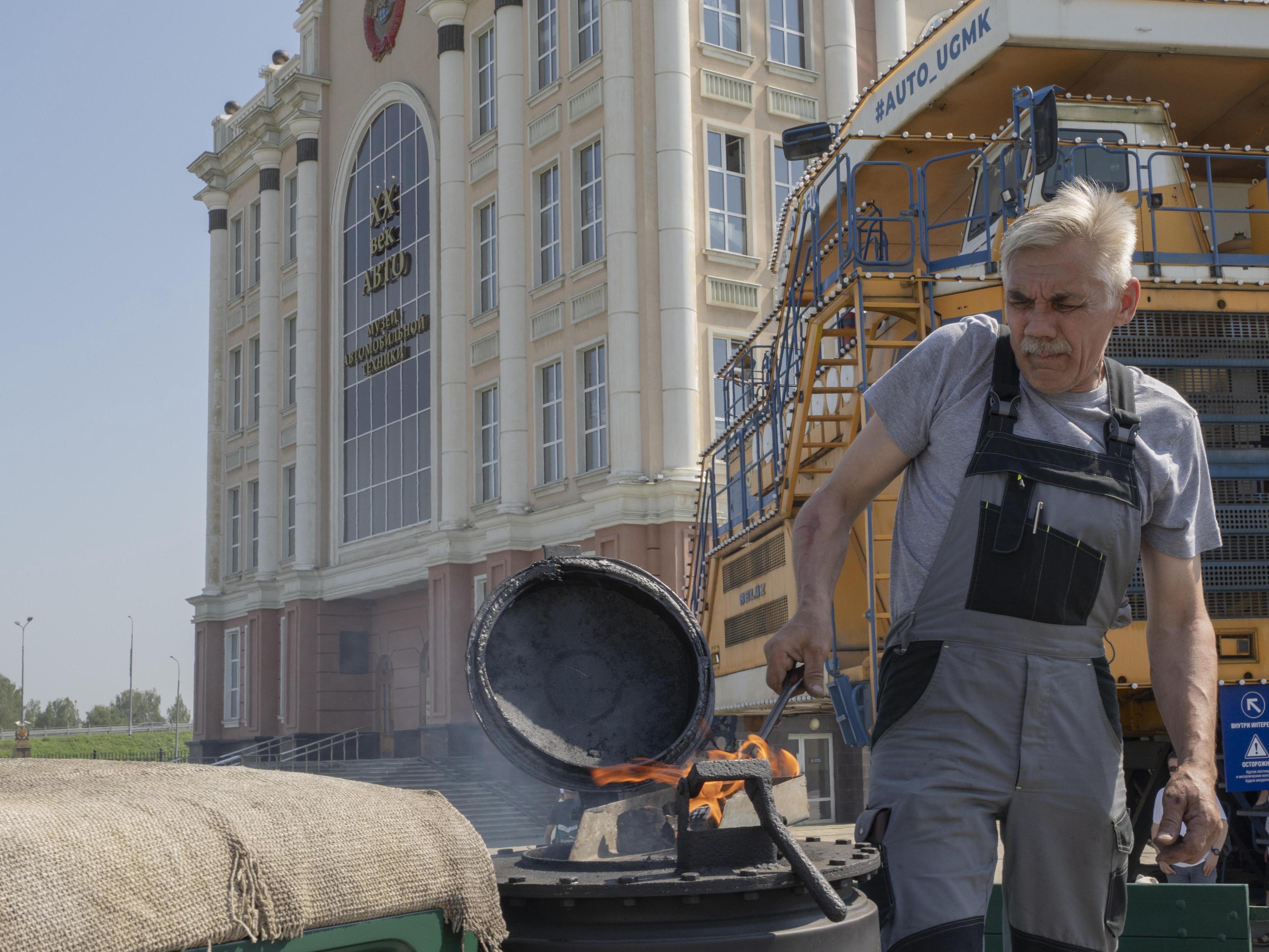
«Next, the gas has to reach the engine. And what makes the gas move through this whole system? There are two options. The first is a good battery (these were scarce in the 1930s). Then, using the lever in the cab, we block air access to the engine, switch on the ignition fan, and it creates draft in the entire system, pulling the gas through. The second ignition option is using gasoline. It»s poured into the fuel tank. The volume there is minimal; gasoline is used to start the engine to ignite the gas generator and to maneuver within the garage. You won«t be able to drive on it,» the master noted.

Igniting the gas generator is a very lengthy process. According to instructions, it can take up to an hour and a half. With such a slow start, gas-generator vehicles were completely unsuitable for army use. Moreover, the front received gasoline first. Wood-burning models were used only in the rear. Automotive enterprises in the regions even received blueprints on how to convert vehicles to wood.

To speed up the start at the museum site, staff ignited coal and wood, then loaded them into the tank. First, smoke came from the exhaust pipe — that meant it was too early to start the car. When gas starts pouring out of the pipe, it«s time to go. They check this by holding up a lighter. If a flame burns, the gas is ready, and the engine can be started. This time, the start-up process took about half an hour. And the truck drove off!

A full load of the «wood tank» is 53 kilograms (117 lb) of wood, enough for about 100 kilometers (62 miles). To refuel, the car has a wood hopper — a special box where chopped and dried logs were stored. The truck won«t run on freshly cut »fuel« — the wood»s moisture content must not exceed 15%.

In the post-war years, industrial recovery began, and the need for gas generators disappeared. By the 1950s, they were almost no longer used. As soon as collective farms received the necessary amount of fuel, the equipment was simply dismantled and sent for scrap. The usual gasoline scheme remained, and these cars drove until they were scrapped. In addition, over the years, the metal oxidized and turned to dust. So no original equipment survived. And craftsmen spent years figuring out how to restore a specimen.

«I bought parts from junk dealers as soon as they appeared on the market. The entire restoration process took about ten years. We started assembling the body when we had collected the under-hood equipment. An important point: blueprints for the gas-generator component exist and have been preserved. Based on them, we made the gas generator, fine filter, and coolers. Other car components — frame, axle, cab, fenders — were all assembled separately, everything was in different condition,» the restorer added.
Now all visitors to the Verkhnyaya Pyshma Museum Complex can see the unique vehicle.
«There are a few other similar GAZ specimens, but our exhibit is the only car in Russia that can run on wood. Of course, it was important for us to get a unique model for the collection, and we had already, during the restoration process, communicated with the workshop that carried out the restoration. The exhibit came to us from the Moscow region,» noted Elena Filatova, executive director of the Museum Complex.
Earlier we reported how a Yekaterinburg resident brought a rare sports car from Canada and spent 12 years restoring it. It«s a unique Alfa Romeo 6C 2500 Sport Freccia d»Oro — the «Golden Arrow» from 1947. One of the characters in the cult film «The Godfather» drove a car like this.
Also check out how a Yekaterinburg resident turned an old Volga into a unique batmobile that even Maserati drivers admire.
Read also about a Ural resident who, over 20 years, turned a pre-war GAZ sawed into pieces into a gem.