Winter diesel fuel suddenly disappears from gas stations in Volgograd


While searching for frost-resistant fuel, one can find out the right gas station from an attendant.
In Volgograd, owners of cars with engines running on heavy diesel fuel have unexpectedly encountered a serious problem — the absence of winter diesel fuel at some gas stations. Warning signs are often posted on the pumps, but gas station operators do not specify when frost-resistant diesel will be fully available.
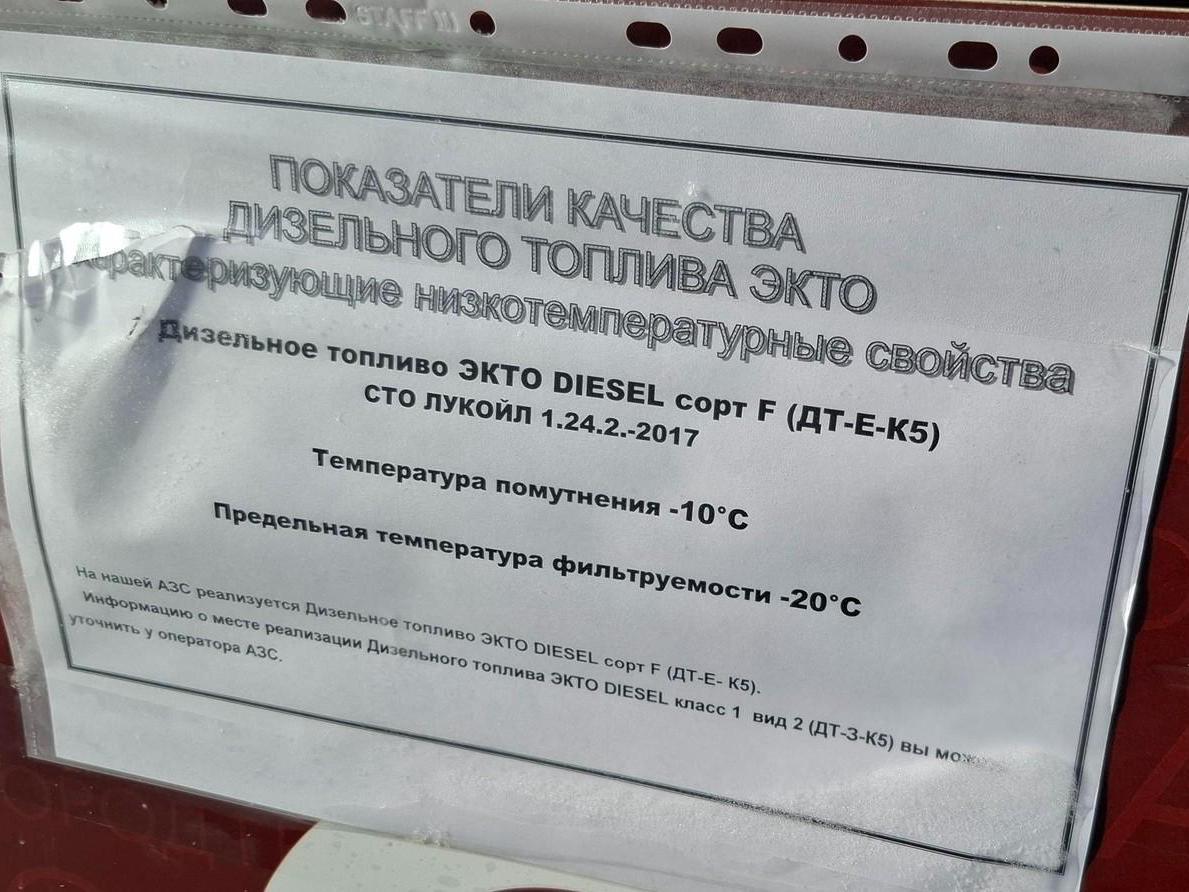
Such a sign hangs on every pump at one of the gas stations.
«Check with the gas station operator for information»
Motorists assure: the problem with winter diesel fuel, which does not cloud in the harsh Volgograd frosts, appeared several weeks ago. Against the backdrop of frosts and price increases, motorists wishing to refuel at some Lukoil gas stations encounter a warning: the fuel being sold may not withstand the upcoming cold of up to −30°C (-22°F).
«At our gas station, ECTO DIESEL grade F (DT-E-K5) diesel fuel is sold. Cloud point −10 °C (14°F), cold filter plugging point −20 °C (-4°F). Information on where ECTO DIESEL class 1 type 2 (DT-3-K5) diesel fuel is sold can be obtained from the gas station operator.»
Gas station employees, in a conversation with a journalist who came to the gas station posing as a customer, confirmed that the diesel being sold is inter-seasonal and may not withstand frosts. However, for the winter grade, as the warning requires, they advised going to another gas station of the same network.
At a Gazprom gas station, they assured that the fuel is winter-grade, and its cloud point is −20 °C (-4°F). Frost-resistant diesel, capable of withstanding temperatures down to −30 °C (-22°F), was also promised to be available at one of the Rosneft gas stations.
An official inquiry has been sent to the Lukoil-Yugnefteprodukt press center for clarification on what caused the shortage and delays in fuel supplies.
«The engine won«t be damaged. It just won»t start»
However, as a large landowner and driver of a diesel vehicle told, he has no problems refueling at «red» gas stations. As Arkady Dudov assures, severe frosts do not affect the condition of the car or equipment.
«I refuel in principle at only two gas stations. At the corner of Hiroshima and Parkhomenko, and at the Samara junction. I«m not really a fan of any promotions or advertising, but I haven»t seen any announcements, — noted the landowner. — Even if there is inter-seasonal diesel, the equipment starts without a hitch, and there are no problems with fuel in general. The real cold was four years ago, around −28 degrees (-18°F). At that temperature, I drove to the farm and the collective farm, nothing froze. I don«t accept other gas stations, especially since, if something happens, you know who to complain to.»
The consequences of filling up with fuel «not suited for the weather» were explained by auto consultant Vladimir Mityaev. Although the expert does not predict serious problems with the engine, some parts of the car«s fuel system will require replacement.
«The simplest diesel fuel withstands temperatures down to −5°C (23°F). Otherwise, paraffinization begins in the tank. When fuel starts to «paraffinize,» it thickens, and it cannot be returned to a liquid state until it is thawed, — commented the auto consultant. — The original state can only be restored in a warm garage or box. The first things affected are the fuel supply tubes and filters. The channels get clogged, and the car cannot «pump» the diesel. This does not affect the engine in any way, because it simply won«t start. Nowadays, special materials are used that can supposedly help, but it»s unknown how this will affect the injectors« operation in the future. Even incorrect refueling of modern diesels with gasoline or chemicals can disable them.»
«It«s just not profitable»
The auto consultant also explained how, besides letters and numbers, the types of diesel fuel differ in name. In conclusion, the expert expressed an assumption about the possible causes of the «winter diesel» shortage.
«Winter diesel differs from summer diesel in sulfur content. Depending on the amount, it prevents the diesel from «paraffinizing» at lower temperatures and makes the fuel more «fatty.» During the Soviet Union, there was «Arctic» diesel fuel with high sulfur content, but it was not eco-friendly. If there is no sulfur at all, the injectors will fail visibly, — explained the expert. — The price of diesel intended for northern regions is 30% higher than regular diesel — this is publicly available information. Volgograd is considered a southern region, so it«s not profitable to sell the fuel here. Earlier, when I worked at another enterprise, I already encountered a shortage of »winter diesel« on this very network, it»s not delivered everywhere. I had to transport an SUV on a tow truck a couple of times during the winter and take fuel filters «for spare».»