Chita Leader Disappeared After Stalin's Death
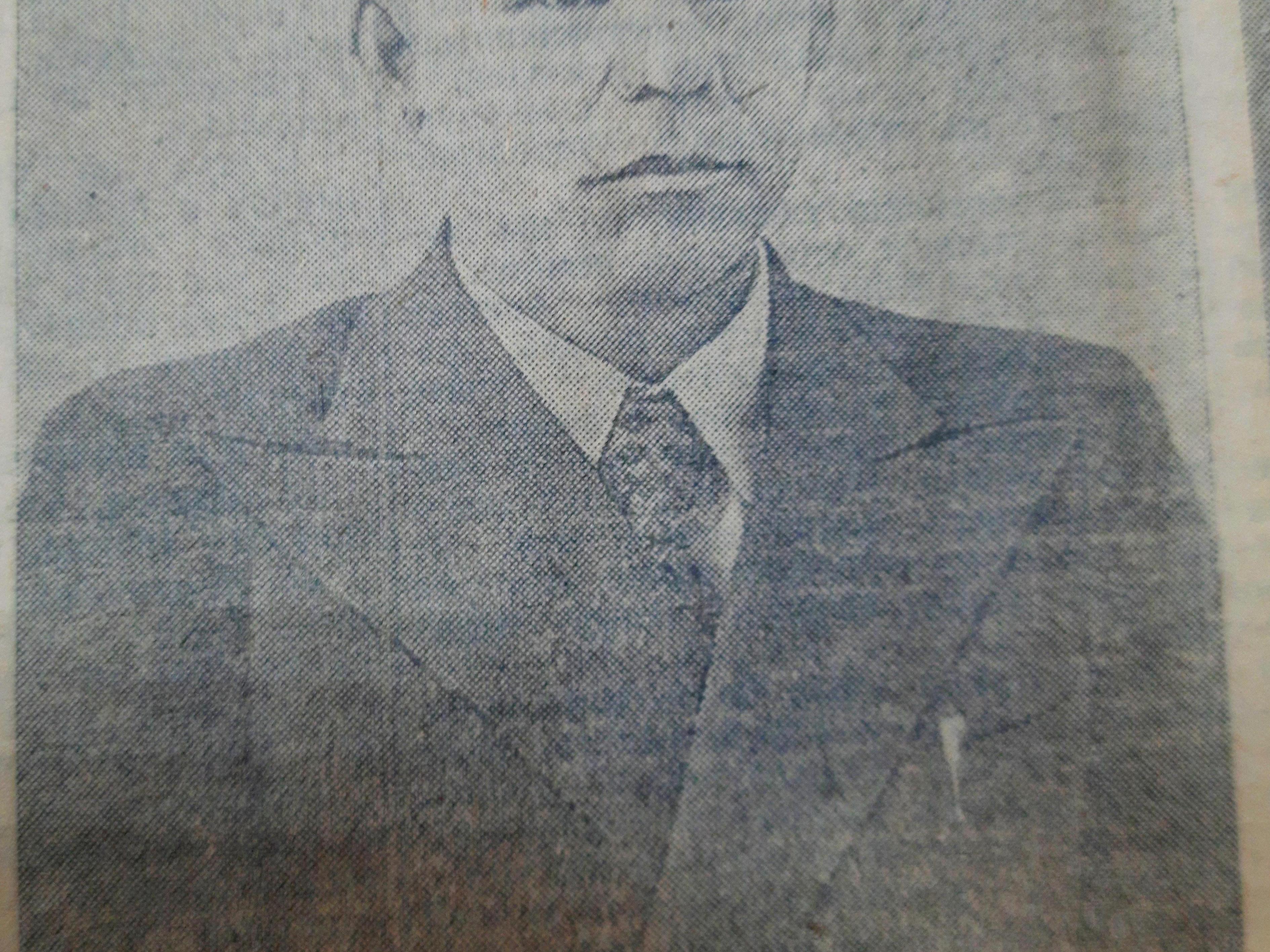

A photograph of Pavel Uzhev from the 1950 Supreme Soviet election campaign in the regional newspaper.
I don«t know how it happened, but the first chairman of the Chita Oblast Executive Committee, Mikhail Afanasyevich Konstantinov, who held the post from 1939 to 1945, his successor Konstantin Pavlovich Golubev, who left the chairman position in 1949, and the one who replaced them, Pavel Fyodorovich Uzhev, who headed the Soviet organs of the oblast from 1949 to July 1953, all disappeared after leaving Chita.
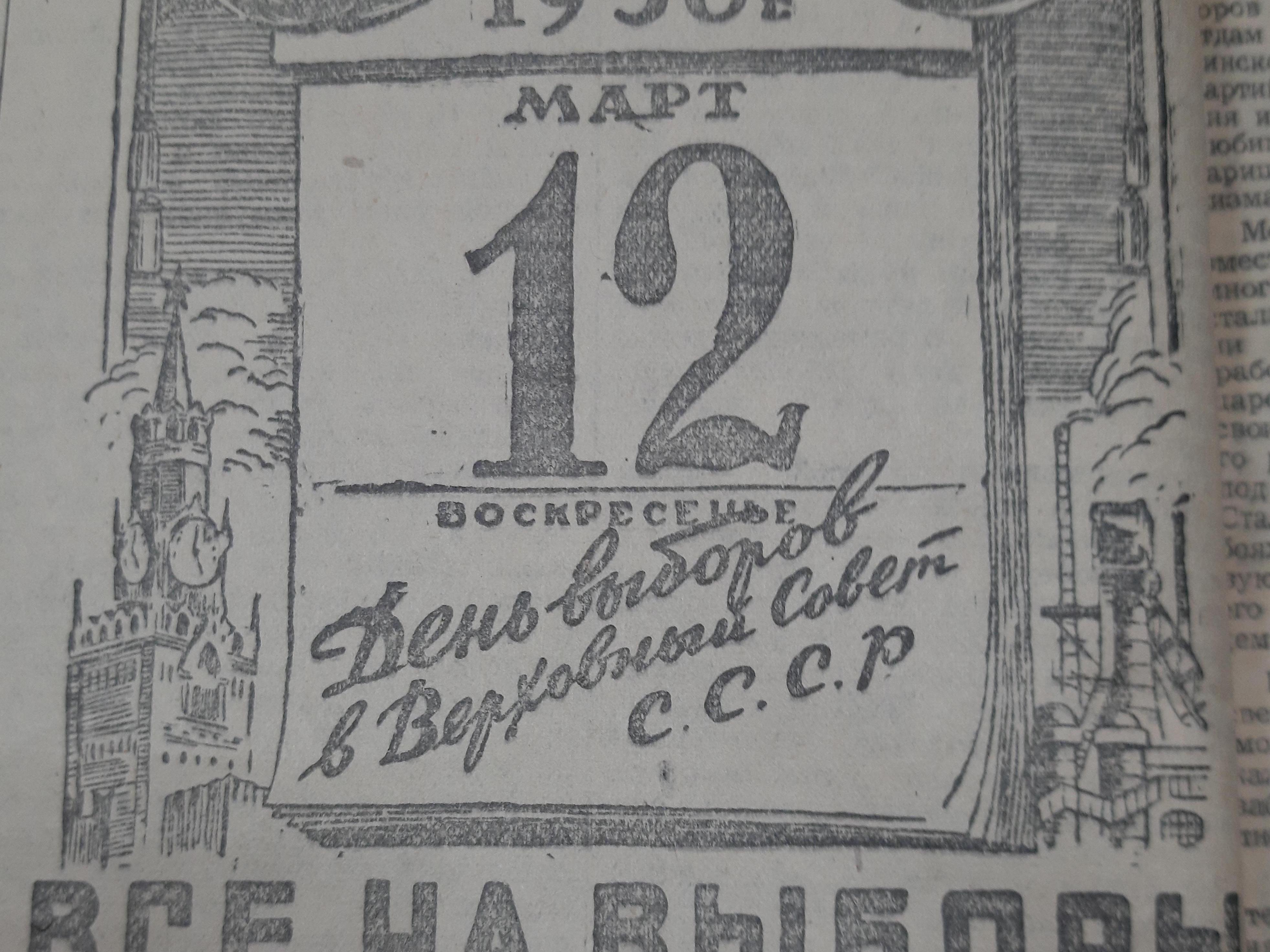
This issue reports on the results and aftermath of the national elections held in the oblast.
There is no information about them after leaving Transbaikalia in any available encyclopedias, lists of the repressed, or reference books on party figures of that time. By the way, a photograph of Uzhev, like those of his two predecessors, was not found on the internet or in the Encyclopedia of Transbaikalia. But the search algorithm, tested with his colleagues—the chairmen of the Chita Oblast Executive Committee—was already clear.
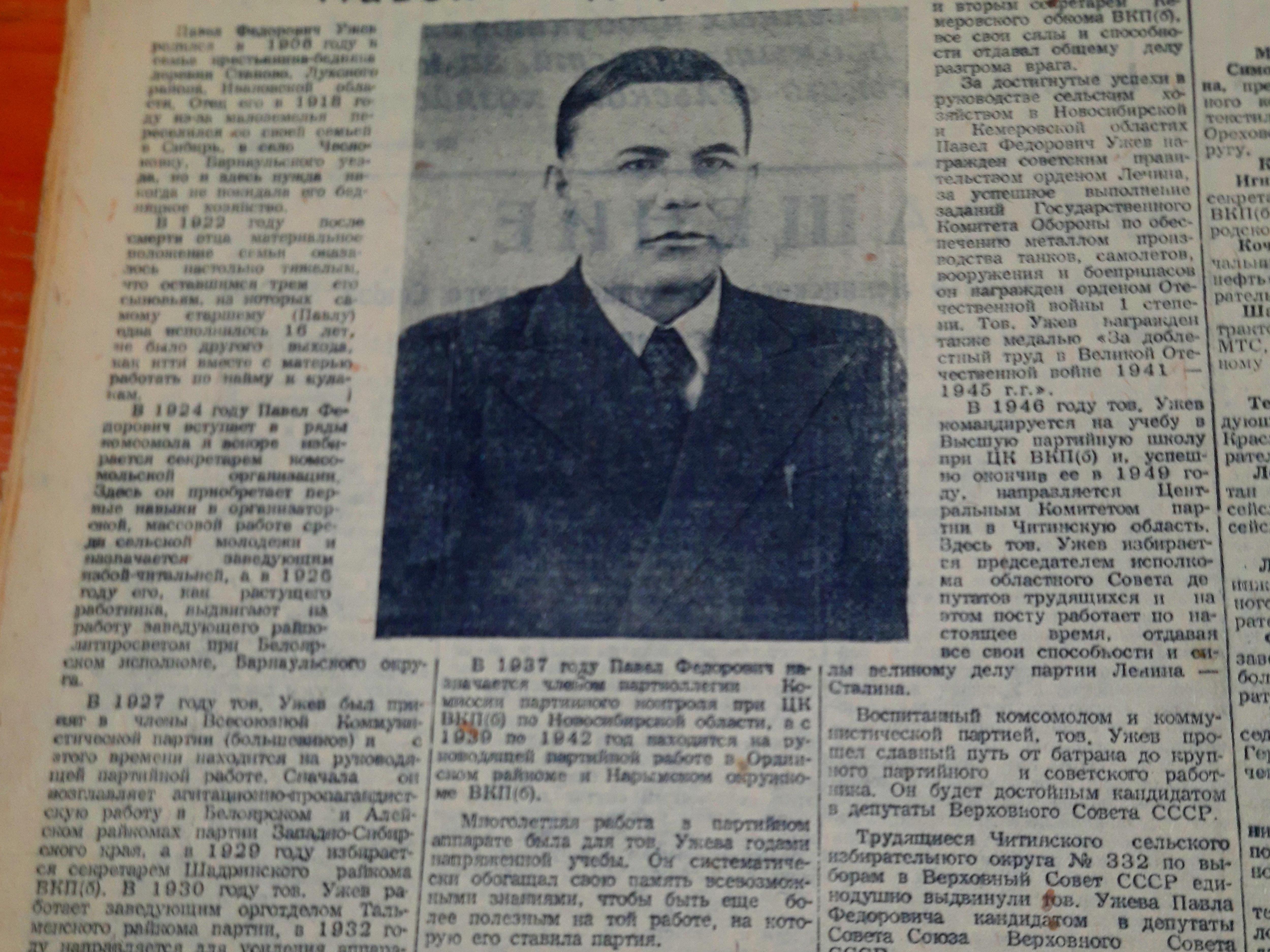
Pre-election materials feature party activities and candidate profiles for the upcoming Soviet vote.
Pavel Uzhev was elected to the Supreme Soviet of the USSR in 1950, which means his photograph was published in the Transbaikal Worker. And so it was. It is also worth recalling that the fourth (first post-war) five-year plan ended in 1950, and the fifth continued from 1951 to 1955.
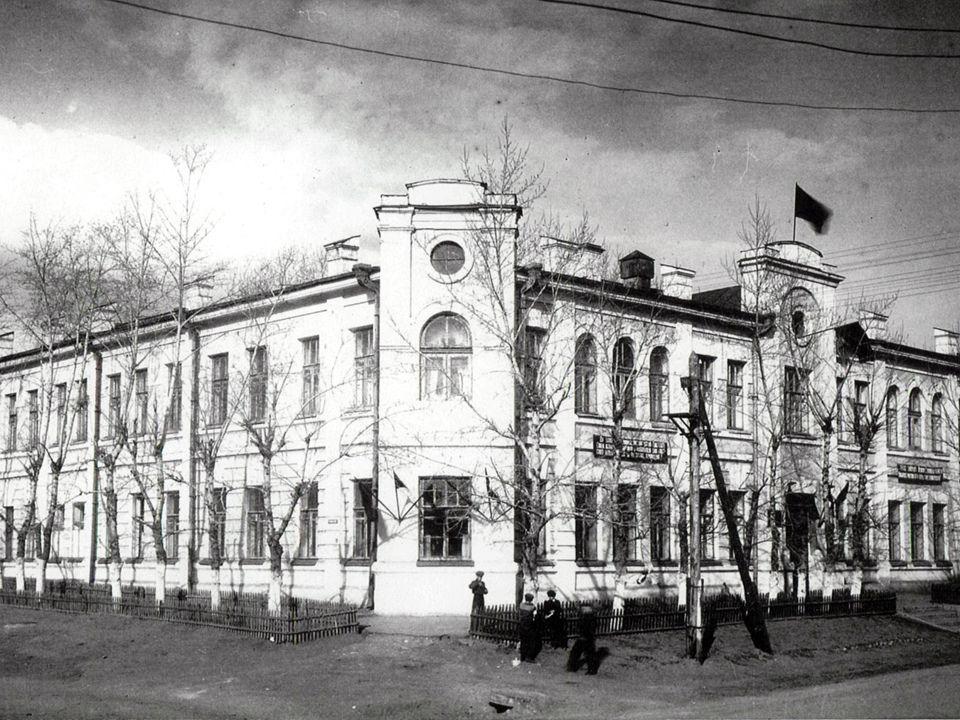
The official tourism site for Chita provides historical context on the region«s Soviet-era development.
From Farm Laborers to Komsomol and Party Members
Pavel Uzhev, like his predecessors, was a typical figure of that period, rising from the lower classes to a sufficiently high level of power. He was born in 1906 into a family of a poor peasant in the village of Stanovo in Yuryevsky Uyezd of Kostroma Governorate (now Ivanovo Oblast). The family had three sons, with Pavel being the eldest. When the October Revolution of 1917 occurred, he was only 11 years old. And at that time, he did not even suspect that this event would change his fate.
In 1918, the family moved to Siberia and settled in the village of Chesnokovka in Barnaul Uyezd of Altai Governorate. Unfortunately, his father died in 1922. Pavel, on whose shoulders fell the responsibility for his younger brothers and mother, began working as a farm laborer for kulaks (wealthy peasants). This «school» finally shaped his political stance. And in 1924, after the death of Bolshevik leader Vladimir Ilyich Lenin, Pavel joined the Komsomol (Young Communist League). Soon, he was elected secretary of the Komsomol organization. And over 3 years, he passed through his Komsomol university—working as an instructor for the district committee, manager of a reading hut, and head of the district department of political education. All this happened in Altai.
In 1927, a new stage of his biography began: Pavel Uzhev became a member of the All-Union Communist Party (Bolsheviks) (VKP(b)). Soon, his horizons expanded sharply, both horizontally—territorially, and vertically—in terms of party career. This stage lasted more than 20 years. It began in the same Barnaul Okrug, where Uzhev first worked as head of the agitation and propaganda department of one of the district party committees.
In 1929–1930, when mass collectivization and the struggle against kulaks began, the 24-year-old, class-conscious but poorly educated Bolshevik Pavel Uzhev became the first secretary of the Shadrinsky District Committee of the VKP(b). And here, collectivization and dekulakization proceeded at simply advanced rates. In 1930, collectivization in his district reached 77.3 percent. This was one of the highest indicators in Siberia. The number of dekulakized here was counted in the thousands.
Soon, Pavel Fyodorovich became head of the organizational department of the Talmenky District Party Committee in West Siberian Krai. Then he was transferred to the position of first secretary of the Krapivinsky District Committee in the same krai. From 1939 to 1942, party member Uzhev was in leadership work in the Ordinsky District Committee and Narym Okrug Committee of the party.
«Many years of work in the party apparatus were for Comrade Uzhev years of intense study,» was written in agitprop material during the 1950 elections in the newspaper Transbaikal Worker. «He systematically enriched his memory with all kinds of knowledge to be even more useful in the work to which the party assigned him.»
During the Great Patriotic War (World War II), he was among those who organized work in the rear. These people also bore a colossal burden at that time. In 1943, Pavel Fyodorovich became the third secretary, and from February 1945 to January 1947—the second secretary of the Kemerovo Oblast Committee of the VKP(b).
In the aforementioned material from Transbaikal Worker, when describing this period, it was said: «For achieved successes in guiding agriculture in Novosibirsk and Kemerovo oblasts, Pavel Fyodorovich Uzhev was awarded the Order of Lenin by the Soviet government. For successful fulfillment of assignments from the State Defense Committee in providing metal for the production of tanks, aircraft, weapons, and ammunition, he was awarded the Order of the Patriotic War 1st Class.»
In addition, Uzhev was awarded the medal «For Valiant Labor in the Great Patriotic War of 1941–1945.»
It was finally decided to raise the educational level of the active party apparatchik. In 1946, Uzhev was sent to Moscow to study at the Higher Party School under the Central Committee of the VKP(b). This was a real university, which Pavel Fyodorovich graduated from in 1949. He probably studied well. And immediately after graduating from this school, he was sent to Chita Oblast, and straight to the position of chairman of the oblast executive committee.
Lucky Temporary Leader
In history, it happens that an excellent, educated, intelligent, and active leader falls into such conditions that he simply cannot do anything. And sometimes the opposite happens. A poorly educated, inexperienced, narrow-minded, and lazy leader becomes a leader during a period of upswing and growth of everything. He doesn«t really need to do anything; everything goes by itself. The main thing is not to interfere.
In the history of our region, both types have been encountered. One of the lucky ones was the chairman of the Chita Oblast Executive Committee, Pavel Fyodorovich Uzhev. Someone might object that he wasn«t very lucky. First, the oblast he got was not only backward but also trimmed—in 1948, six entire eastern districts were cut off from it and transferred to the newly created Amur Oblast. And in 1949, a large amount of almost free labor was lost—Japanese prisoners of war were mass-repatriated to their homeland, only those with criminal convictions and punishments remained. On April 22, 1950, the newspaper Pravda published a TASS report on the completion of the repatriation of prisoners of war to Japan.
But, on the other hand, the oblast had already overcome the consequences of the terrible famine of 1946, as well as the flood of 1948. The economy was gaining momentum, and at the head of the oblast party committee stood an experienced and charismatic leader. In this situation, the new Soviet leader only had to integrate into the existing team. Whether he managed to do this or not is hard to say. Why? More on that below.
It is clear that soon he was elected to the bureau of the oblast party committee.
Well, then, in accordance with the status of the position that Pavel Fyodorovich occupied, he rose sufficiently high twice, and in very good campaigns. Thus, on March 12, 1950, elections to the Supreme Soviet of the USSR were held. This Soviet parliament consisted of two chambers: the Soviet of the Union and the Soviet of Nationalities. The election campaign, as always, was swift. The start was given by the Decree of the Presidium of the Supreme Soviet of the USSR on January 9 of the same year. Labor collectives unanimously nominated those who had already been coordinated by the oblast party committee with the Central Committee. Pre-election meetings and elections were held with high turnout and the expected result. Pavel Fyodorovich was elected from Chita Rural Electoral District No. 332.
To the Soviet of the Union, along with Uzhev, were elected the first secretary of the oblast party committee Gennady Voronov, the commander of the troops of the Transbaikal Military District, Hero of the Soviet Union Konstantin Koroteev, and the celebrated railway worker, order bearer Ivan Solovyov. And to the Soviet of Nationalities, they elected war veteran and order bearer, chairman of the Kirov Collective Farm from the Agin-Buryat-Mongolian National Okrug, Balzhinima Mazhiyev, and a Muscovite, Soviet philosopher, one of the authors of the biography of Joseph Stalin published in 1947, Mark Borisovich Mitin (Gershkovich).
Two years later, Uzhev was elected a delegate to the 19th Party Congress, which took place in October 1952. At it, the All-Union Communist Party (Bolsheviks) (VKP(b)) got a new name: the Communist Party of the Soviet Union (CPSU). This was the first congress after a 13-year break and the last at which Joseph Vissarionovich Stalin spoke.
In March 1953, the «father of nations» passed away, and personnel shake-ups began in the country. In August of that year, a couple of years before the end of the five-year plan, Uzhev was released from the position of chairman of the oblast executive committee; he was replaced by Alexei Ivanovich Kozlov, who had worked as the 2nd secretary of the Chita Oblast Committee of the CPSU. That is, either Uzhev was promoted and taken to Moscow, or the first secretary of the oblast committee, Voronov, removed him and replaced him with his associate.
The Region Began to Gain Momentum
At this time, Chita Oblast, despite its deeply peripheral position, began to gain momentum in its socio-economic development. Under the new chairman of the oblast executive committee, the results of the fourth (first post-war) five-year plan were summed up. And they were not bad.
In 1950, the oblast overall exceeded the 1940 level of industrial output by 17 percent. At the end of that year, freight turnover on the Transbaikal Railway also increased by more than 24 percent compared to 1940. And the coal industry of the oblast grew by 16 percent. In 1950, the first powerful Donbass combines appeared at the coal enterprises of the oblast. That year, Transbaikal steelworkers of the Petrovsk-Zabaikalsky Metallurgical Plant entered into competition with colleagues from one of the most advanced metallurgical enterprises in the country—the Moscow Serp i Molot (Sickle and Hammer) Plant. And they performed very well.
In 1950, the production of leather, fur, and footwear industry products in the oblast exceeded the pre-war level by 38 percent, and food industry by 21 percent.
«However,» as stated in the Essays on the History of the Chita Oblast Organization of the CPSU published in 1975, «there were still many shortcomings in the work of industry. The mining, forestry, and woodworking industries did not reach the pre-war level in output. Construction organizations failed to meet production assignments. The construction base was weak, and the production of building materials lagged behind needs.»
Not everything was good in agriculture either. Thus, in terms of total sown area, the pre-war level was reached only in 1953, and grain crops that year were sown on 88,000 hectares less than before the war. Yields remained low. But in animal husbandry, things were going very well. In 1953, there were 2,418,000 sheep in the oblast—almost 2.5 times more than in the pre-war 1940.
Therefore, what needed to be done in the fifth five-year plan was clear both in the oblast party committee and in the oblast executive committee. Weak points were addressed jointly, discussing problem industries and spheres at oblast party conferences and sessions of the oblast Council of Working People.
For example, to increase productivity in the countryside, it was decided to engage in the enlargement of collective farms. By the end of 1950, there were 696 of them in the oblast. At that, in 291 of them, there were only 60 families each, and in 159 collective farms—less than 100 families each. In 1953, there were already 454 collective farms in the oblast.
In this five-year plan, exploration work and prospecting for polymetallic ore deposits were intensified in the oblast. Exploration and operational mines were established—Blagodatsky, Kadainsky, Algachinsky, and Smirnovsky. The most important construction project was the Taseyevsky complex of the Baleyzoloto (Baley Gold) combine. For the exploration and development of the deposit, a group of combine leaders was awarded the State Prize in 1951. And at the Klyuchi (Keys) mine, part of the Darasunzoloto (Darasun Gold) combine, a new powerful processing plant was built in 1952.
Changes were also evident in the social, educational, and cultural spheres. On July 12, 1953, a medical institute began operating in Chita, initially with two faculties—therapeutic-prophylactic and dental. The appearance of this forge of medical personnel became an important breakthrough for the entire healthcare system of the oblast.
New faculties appeared at the Chita State Pedagogical Institute: in 1952, the faculty of foreign languages was opened, and in 1953—the natural-geographical faculty.
In April 1952, a permanent commission for studying the productive forces of Chita Oblast was created, consisting of 22 people, mainly from among Chita«s scientists. It was headed by the chairman of the oblast planning commission of the executive committee, V. A. Skurydin. The commission had to perform many tasks—from a comprehensive assessment of natural resources to determining the region»s prospective specialization.
And one more small touch. It is known that in December 1949, the founding conference of Chita Oblast literati was held, formalizing the creation of a writers« organization. And by 1953, 428 books with a total circulation of over 5 million copies were published in the region.
Yes, one always wants the pace of development, and most importantly, the results to be more impressive, but even these clearly testify that the development of Transbaikalia at this time was gaining momentum. It is all the more unclear why Chita was left by the chairman of the oblast executive committee, Pavel Fyodorovich Uzhev, whose further biography remains unknown for now.