10 Soviet Habits That Would Seem Wild Today

How quickly things change! Some things that were normal now seem very strange.
These small details rarely made it into history textbooks, yet they defined everyday life. Older generations will easily recognize their youth, while their descendants may simply be surprised. Our colleagues from Maxim have compiled 10 habits that far from all of us experienced personally.
Renting household appliances
In Soviet times, rental points were part of everyday life and surprised no one. People would temporarily rent items they didn«t need every day and that were difficult or expensive to buy outright. Rental points offered household appliances, furniture, baby strollers, camping gear, and musical instruments. For many families, this was the only way to use such things.
Watching films in a video salon
Video salons appeared towards the end of the Soviet period. They bore little resemblance to the cinemas familiar today. Instead of a large screen, there was a small convex TV connected to a VCR; instead of armchairs, rows of chairs; and all around, people who had come to watch another Hollywood action film starring Arnold Schwarzenegger or Sylvester Stallone.
The picture and sound quality left much to be desired, but that didn«t stop video salons from filling up in the 1980s–1990s. Such a »cinema« could pop up anywhere: in apartments, basements, school gyms, and other unexpected places.
The reason for the popularity of this pastime was clear. A personal VCR remained an unaffordable luxury for most and was considered a sign of wealth. In the 1980s, the first Soviet domestic VCR, the «Elektronika VM-12», cost about 1,280 rubles—roughly equivalent to ten average monthly salaries (approx. $1,950 at current rates). And even at that price, not everyone managed to buy one. On the black market, the price could reach 1,800 rubles.
Dancing next to your bag at a disco
At discos in clubs and houses of culture, female visitors would often place their bags right on the floor and dance next to them so they wouldn«t be in the way and would always remain in sight. For Soviet youth, this looked absolutely normal: there were no lockers, and no one wanted to leave their belongings unattended.
One popular music performer recalled doing the same thing at the start of his career during concerts. There was no security or producer nearby, and no talk of dressing rooms. He would come on stage with his bag, place it next to him, do his number, and move on—the main thing was that after the performance, his passport and money were still there.
Eating everything with bread
The phrase «eat it with bread» is familiar to many from childhood: it was repeated often by parents and grandparents. The habit of adding bread to almost any dish—be it soup, pasta, or dumplings—formed in Soviet times. Under conditions of constant food shortages, bread remained the most accessible and reliable way to make a meal more filling. Even a modest lunch became substantial with it.
Placing a coffin lid in the stairwell during a funeral
On social media, older people often share memories of how funerals were conducted in Soviet times, and these stories frequently shock younger readers. If someone died, the coffin could be left in the apartment for several days: it was believed this allowed the deceased to say goodbye to their home. During this time, the coffin lid was taken out to the stairwell: neighbors understood from it that there was a mourning period in the building. Sometimes the coffin itself was placed at the entrance to the stairwell, with chairs nearby so anyone who wished could pay their respects.
Trying on clothes on cardboard at the market
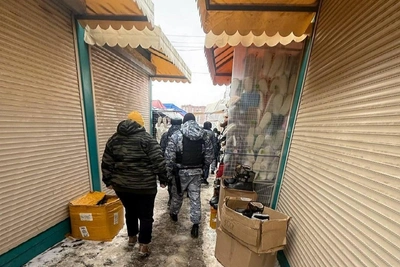
The habit of trying on clothes right at the market turned out to be one of the most enduring everyday rituals that originated during Perestroika. Many who grew up in the 2000s well remember pulling on jeans or nylon track pants in the freezing cold while standing on a spread-out piece of cardboard. Parents stood nearby, calming them with the phrase, «no one»s looking at you.« This, by the way, did little to ease the tension.
For those only familiar with shopping malls with warm fitting rooms, such an experience would seem exotic today.
Leaving the key under the doormat
The story about a key hidden under a doormat might sound like a tall tale to some. But for others, it«s a recognizable part of childhood. In Soviet years, neighbors were often acquainted and treated each other with trust. This was especially common in small towns. If apartment residents left for a short time, they might not lock the doors at all. And when children had to return from school before the adults, a key was left for them in an agreed place—in the mailbox or right by the entrance, under the doormat.
Letting children play outside all day
In Soviet times, children were let out to play in the courtyard all day without much worry. Even when they were still quite young. It was assumed that there would always be some familiar adults or other kids in the yard; there was no fear.
Stockpiling purchases due to shortages
The habit of buying food «in reserve» formed in Soviet times not out of thrift. Many goods in the country were in short supply and appeared for sale irregularly or quickly vanished from shelves. Due to state regulation, prices were indeed low, but demand significantly outstripped supply. Therefore, people tried to buy more at once—to have a stock of meat, sugar, or canned goods at home in case the desired item simply wasn«t available next time.
Going to neighbors for salt
If while cooking someone suddenly discovered they were out of salt, flour, or baking soda, it rarely became a problem. You could simply go to the neighbors and ask for what was missing—usually, they would pour a little into a bag or paper without extra questions. Today, when hundreds of people live in residential complexes and neighbors don«t meet for years, the idea of getting out of a situation this way seems strange.