Teacher Faces 7 Years in Illegal Migration Case Centered on Russian Exam
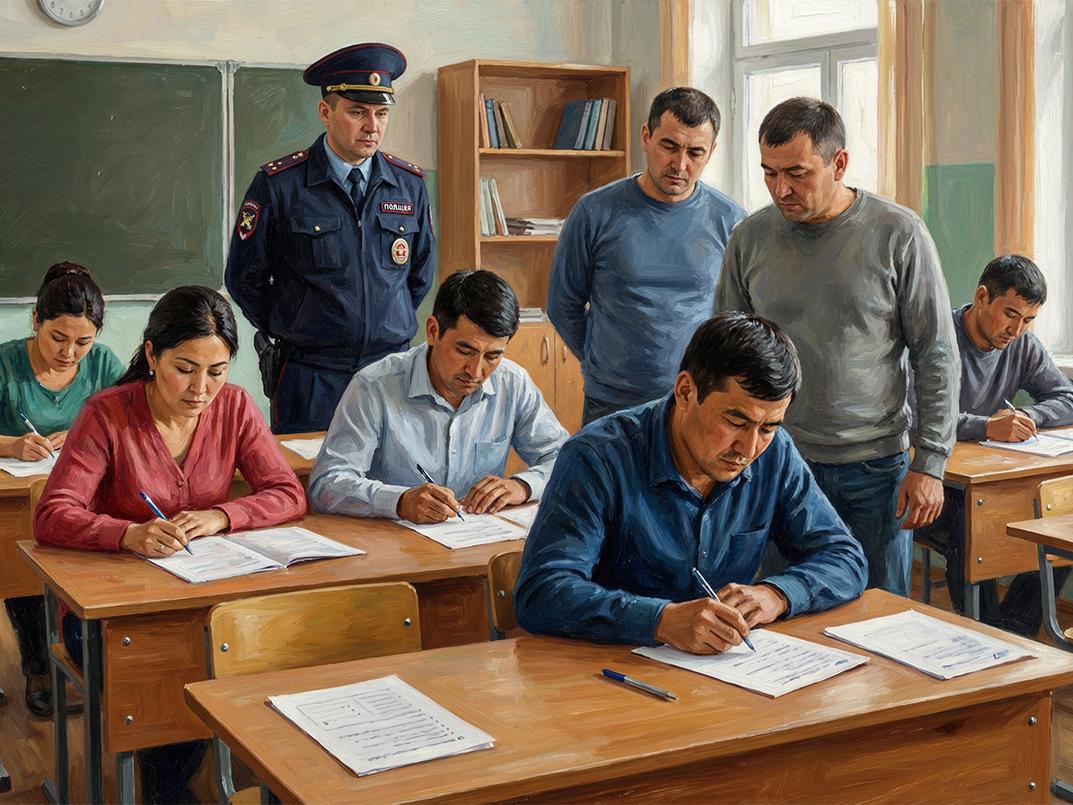

To obtain a work patent, migrants are required to pass a Russian language proficiency exam.
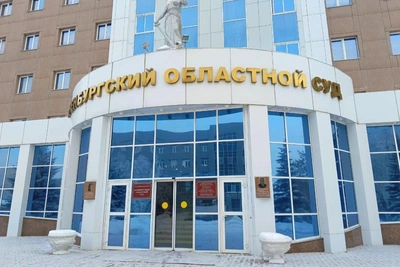
The Ordynsky District Court is hearing a high-profile case involving a multiethnic group of Novosibirsk residents who, according to investigators, helped migrants legalize their status with fake documents. To get a work patent, migrant workers allegedly only needed to pay, with the group«s participants handling the rest—even taking the mandatory Russian language exam. While law enforcement touts the shutdown of an illegal migration channel, the defendants staunchly deny guilt and point to serious investigative violations. Crime correspondent for NGS Pavel Tiunov found out the details.
High-Profile Arrests
Media outlets in December 2022 reported with fanfare that an »interethnic group« helping migrants legalize their stay in Russia had been busted in Novosibirsk Region. Police at that time detained the head of the »Ordynsky« district Interior Ministry»s migration department, Sergey Pilipovich, and former traffic police inspector Goydja Guseinov.
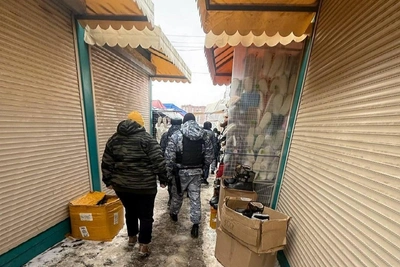
The arrests of Sergey Pilipovich and Goydja Guseinov were captured on video.
Investigators call the latter the group«s leader, allegedly heading the illegal business. The »Migrant Assistance Center« he organized, according to law enforcement, helped guest workers obtain fake documents, which they then used to get sham registration and work patents in the town of Ordynskoye from Pilipovich. Allegedly, 13 people were legalized this way.
The investigation took nearly two years, but after its completion, the prosecutor»s office sent the case back for revision several more times. The defendants suggest investigators tried to piece together a coherent indictment from disparate facts to fit a predetermined outcome.
Undercover Purchase: Two Versions of One Exam
The Investigator«s View
The criminal case (the indictment is at the editorial office»s disposal) is based on Russian language exams that migrants, according to investigators, paid for and did not take themselves; therefore, the certificates of successful testing can be considered fake, law enforcement argues.
In the summer of 2022, operatives sent a Tajik national to take the exam with a fellow countryman accompanying him, who was wired with recording devices. At the exam, they were met by a representative of the Russian University of Peoples« Friendship (RUDN), Marina Prishchepa, who allegedly stated the migrant only needed to »simulate« the test, »pretending to complete the tasks independently.« The teacher promised to fill in the correct answers on the tests herself.
The allegedly fake Russian exam forms the core of the illegal migration organization charges.
The undercover purchase was included in the criminal case materials. Subsequently, the guest worker received a package of fake documents containing, besides the allegedly counterfeit Russian language certificate, a fake translation of his passport and a sham arrival notification.
Next, the migrant was taken to the Ordynsky migration department of the Interior Ministry, where his fingerprints were taken, he was photographed, and later handed a fake registration and a work patent. In Ordynskoye, the process was personally overseen by the head of the migration department, Sergey Pilipovich, after hours.
In total, the migrant«s legalization cost 39,700 rubles (about $441 at current rates), which group leader Goydja Guseinov distributed at his discretion, investigators are convinced.
The Defendant Teacher»s View
Marina Prishchepa described to an NGS correspondent how the exam looked from her side. She said the appearance of an escort with the migrant did not alarm her: guest workers often come with relatives who help them navigate the city. Only later did she learn the Tajik«s companion was wired with equipment: a video camera was attached to his body, and an audio recorder was in his bag.
»I ask the test-taker: «Do you speak Russian?» He says: «Yes, I do.» He sits down to fill out the questionnaire. His escort at this time starts to fuss, says he needs to repark the car and runs out. The bag with the audio recorder remains in the classroom,« the teacher recounted.
When the test-taker, filling out the questionnaire, reached the »Test Location« field, he asked: »What should I write here?« Marina Prishchepa insists that »RUDN« is already written in that field, so her reply sounded like this:
»It«s already filled out for you.»
The phrase was caught on the audio recording and subsequently, according to the teacher, became the basis for her indictment.
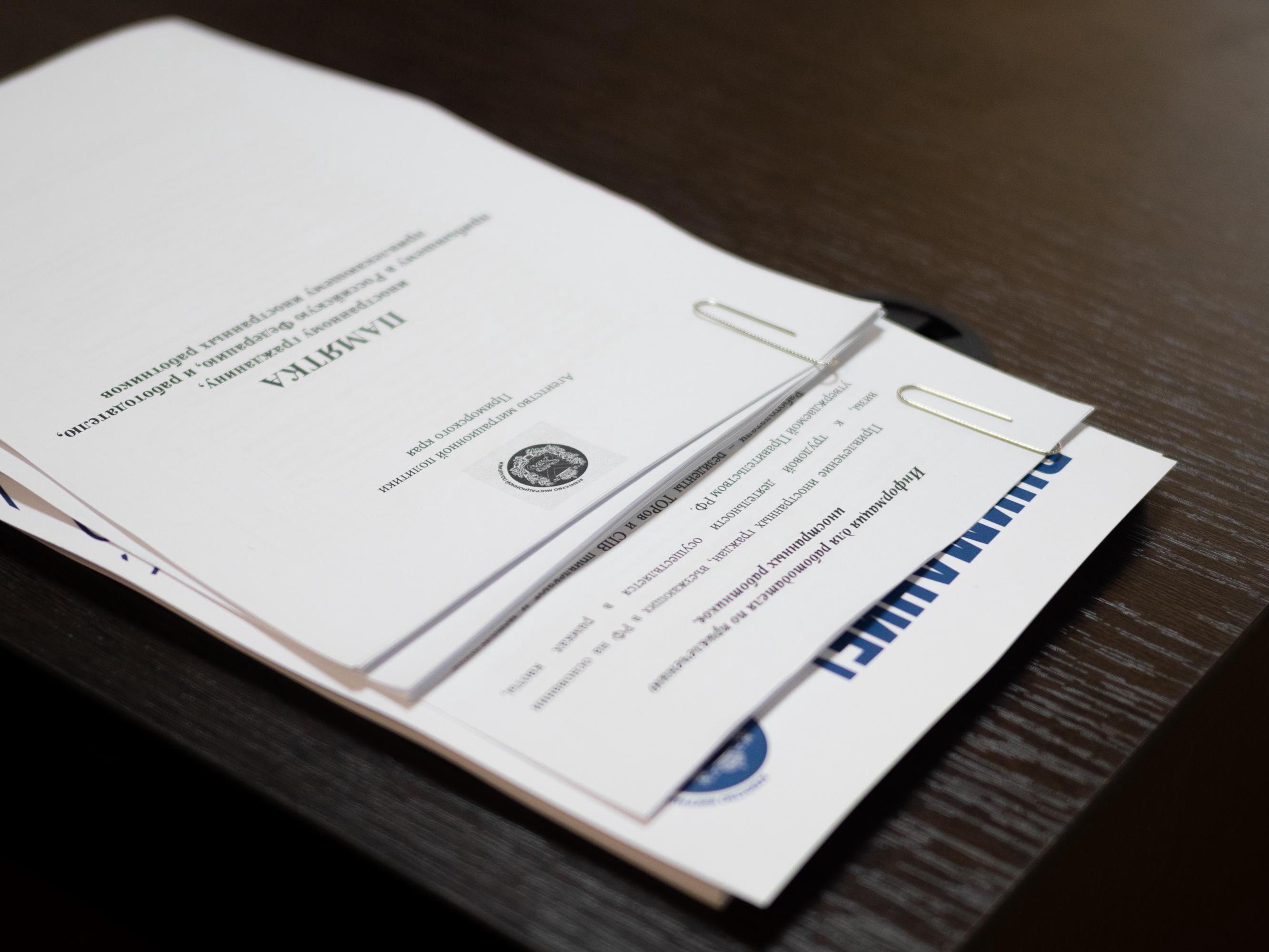
To legalize their status, a migrant must assemble a package of documents.
The Russian language exam is always recorded on video, but Marina Prishchepa had to start the testing twice. The first time, the Tajik, she says, sabotaged the exam: he sat down and did nothing. After an emotional admonition, he filled out the test materials independently, which was recorded on a 20-minute video, the teacher assures. The recording was sent to Moscow, where a special commission assessed the migrant«s knowledge and issued him a certificate of successful exam completion.
»The prosecution claims I filled out the test materials for him. I told the investigator: «Request the video from Moscow, everything is visible on it.» I was refused. Meanwhile, the only evidence in the case is an audio recording with a phrase taken out of context,« Marina Prishchepa explained.
She also emphasized that the other alleged episodes of conducting a sham exam are built »by analogy«: meaning without interrogations, without seizing documents, without investigative actions. Law enforcement, she says, simply compared those who took the test with her to those who later received work patents in Ordynskoye from Pilipovich. Surname matches allowed them to significantly expand the charges.
The »Leader«s» Opinion
The man named as the group«s head, Goydja Guseinov, insists he never knew police officer Sergey Pilipovich. When the papers necessary for registration and obtaining a patent were collected, he introduced the Tajik and his escort to Murad Zhalilov—a person who earned money by driving guests from neighboring countries to Ordynskoye, where documents could be processed much faster than, for example, at the migration center on Yesenina Street in Novosibirsk. Zhalilov allegedly used a long-standing acquaintance with high-ranking police officer Sergey Pilipovich.
»His services cost money, the migrant and his escort were supposed to pay Zhalilov, but for some reason they didn«t. I told Murad I»d settle up myself because I didn«t want to spoil the relationship. So investigators built a chain of financial relations, which they presented as a stable connection,» stated Goydja Guseinov.

Investigators cite transfers to Guseinov«s card as evidence, but he insists they are unrelated to illegal migrants.
According to him, his role was expanded by the investigation after analyzing transfers to his bank card: any match between the sender«s or recipient»s surname and that of a person who registered through the Ordynsky department turned into a separate episode of «organizing illegal migration.»
«But there are no exact matches at all! For example, my wife»s friend repays a debt to my card, her surname is, say, Shakhbazova. They find some Shakhbazov who was registered in Ordynskoye and assign him to me as an episode,« notes Guseinov.
The former head of the »Migrant Assistance Center« emphasizes that many people paid him via card transfers, but these were for ordinary everyday services and debts, not related to migration schemes.
Public Observers or Witnesses?
While conducting the undercover purchase and accompanying the migrant on the path to getting a work patent, police officers formalized the investigative activities with »the involvement of public representatives.« The defendants call them »witnesses« (ponyatye) and insist they are assigned precisely this legal status in the case materials.
The defense found out that the two »public representatives« (or witnesses?) and the police operative conducting the activities have known each other for a long time: all three are from Ust-Tarka, attended the same school, and appear together in numerous photos that were published on social media until a certain time: at a wedding, on vacation in the Altai Mountains, etc.
This concerns Maksim G., with whom the operative (the editorial office is not authorized to disclose the operative»s name) studied in the same class, and Igor I.—their older friend. When all three were asked in court if they knew each other, they flatly denied any acquaintance. As a result, defendant Goydja Guseinov filed a report with the Investigative Committee demanding they be held accountable for giving false testimony; Marina Prishchepa filed a report about evidence falsification.

The police officer and public observers vacationed at the same wedding.
Investigators conducted a check and questioned the police officer, Maksim G., and Igor I. They stated that the word «acquainted» was misinterpreted in court. They assumed it meant friendship and constant communication, which, they said, never existed between them.
The operative in his testimony emphasized that he never asked his fellow townsmen for favors and never heard requests from them.
«Public representatives in investigative activities do not sign protocols, do not give official explanations, and are not interrogated in court. In our case, the operative»s acquaintances acted precisely as witnesses because they documented the seizure of documents, signed protocols, and gave explanations that formed the basis of the charges. Their status is confirmed by the undercover purchase materials,« explained Marina Prishchepa.
In the end, investigators concluded that all three met completely by chance on Marx Square in the summer of 2022, the policeman asked the men to participate in the activities, and they agreed. As a result, investigators issued two refusals to initiate criminal cases (the rulings are at the editorial office»s disposal).
The NGS correspondent reached out to Maksim G. and Igor I. for comment. Both ignored the journalist«s messages.
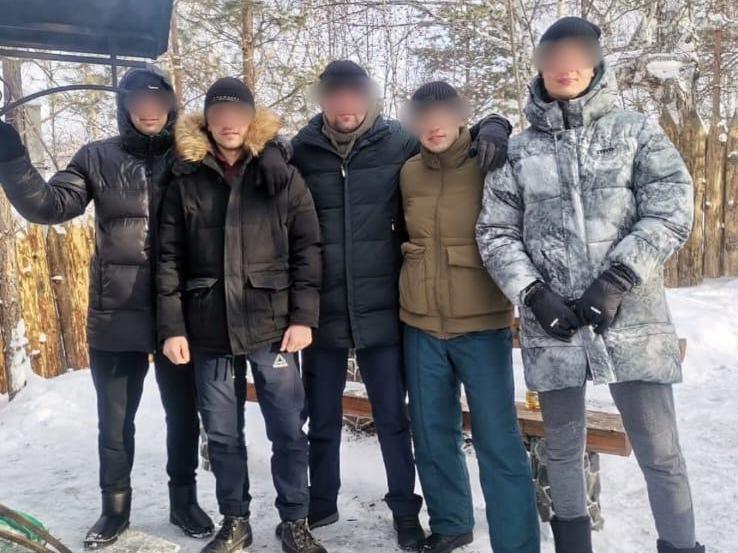
A trip to Altai brought together the police officer and public observers who claimed to barely know each other.
The press service of the Main Directorate of the Interior Ministry for Novosibirsk Region insists that the men involved in the investigative activities were precisely «public representatives,» since according to Russian legislation, witnesses are not involved during investigative activities.
«Individuals may, with their consent, be involved in the preparation or conduct of investigative activities while maintaining the confidentiality of their assistance to the authorities if they so wish. Requirements for attracting participating individuals are not regulated,» the police explained.
The defendants, in turn, believe there can be no talk of any objective recording of the activities in this case. They suspect the «public representatives» might not have been present at all during the events, and their signatures could have been used without their knowledge. Investigators also raised this question, but the police officer assured the Investigative Committee employees that none of his fellow townsmen signed blank protocols.
The trial of the criminal case «on suppressing a channel of illegal migration» is meanwhile drawing to a close. Today, the charges brought against the defendants carry a potential penalty of up to 7 years in prison for each of them.
Last year, the NGS editorial office described in detail who in Novosibirsk sells fake documents for migrants and for how much one can buy a Russian passport or driver«s license.