Barnaul residents find 'special zen' playing African drums on streets
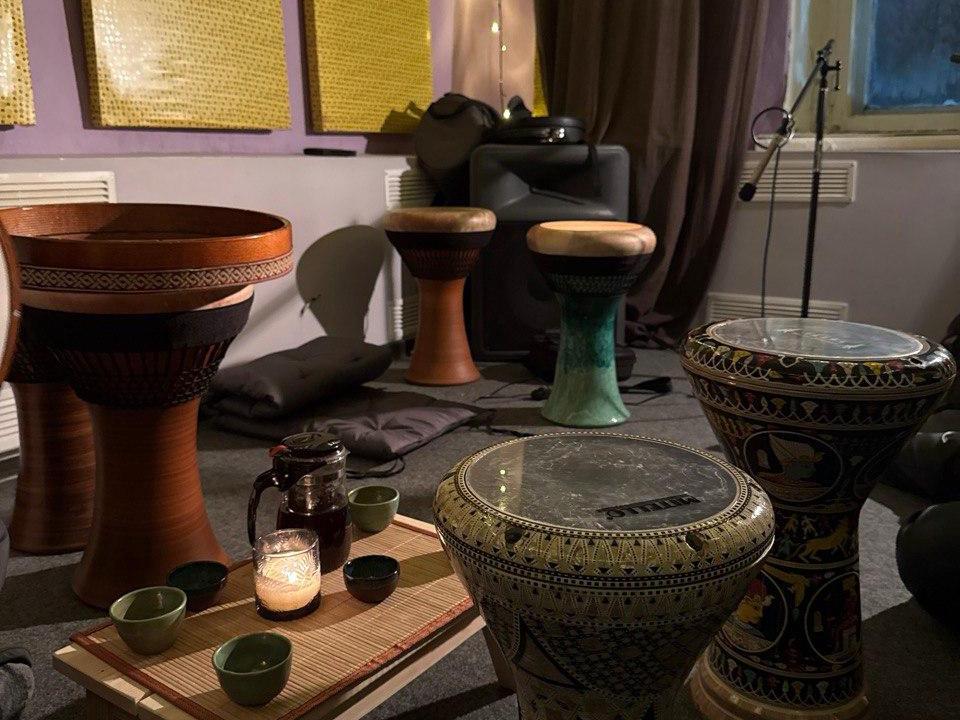

This is what darbukas look like. In the studio, everyone plays drums while sitting on the floor.
On the streets of Barnaul, you can meet young people with unusual African drums — darbuka and djembe. They beat rhythms, gather passersby around them, and turn urban spaces into an impromptu stage. A correspondent from NGS22.RU became interested in this trend, decided to try learning African drums, and found out who is developing this direction in the city.
The alluring sound of beats, a swinging rhythm, and a mesmerized crowd around — you can see this in Barnaul not only at festivals or city holidays but on a regular weekend. As a rule, musicians come out to pedestrian streets in summer, and all passersby have only one question: what interesting drums are they using? I also became interested, having once seen how much pleasure such music brings to people, seemingly completely unpopular in Barnaul.
Quite by chance, a few months later, friends brought me to a percussion studio, where I managed to find out what exactly I had seen in summer, and most importantly — to try and sound on the drums myself. I had no such experience before, although for most of my life I was inseparable from vocals and guitar. One of those who started developing the direction of playing African drums in Barnaul turned out to be Dmitry Spirin.
The man has been passionate about music since childhood, played on a classic drum kit, but over time realized that the familiar rhythms were starting to tire him. Then he accidentally, like me, heard the sound of a darbuka and didn«t immediately understand what instrument it was, but clearly became interested in the complex, dense sound. His interest quickly grew into self-study, and after a few years, together with his friend Maxim Ivanov, they decided to open their own studio of ethnic percussion.
«Actually, the studio appeared only because the neighbors didn»t like our hobby when we were drumming at home and the sounds were heard everywhere, so the idea came to find our own spot where we could sound. At first, it was a stuffy little utility room where we intensively learned technique and spent five hours at a time. Then, of course, we just wanted to have fun because we were tired of pop music, where everything is banal to the point of ugliness, and then gradually we started teaching people,« recalls Dima.
After some time, the percussionists managed to find a more spacious room, which they equipped with good sound insulation. However, the location also turned out to be lucky: in the very center of the city, next to a sewing atelier, which at first resisted the unexpected appearance of musicians, but Maxim and Dima managed to establish relations with them.
«We did everything for ourselves, and then realized that people were also getting interested, and gradually started teaching everyone who wanted to learn some basics. Moreover, it wasn»t so hard to notice us: very often we went out earlier to jam (play instruments without much preparation. — Ed.) on the city streets — that«s how our training studio appeared. However, after a while we changed direction, now we only hold impromptu closed jams within the studio walls and sometimes take in newcomers,» the musician specified.
What are darbuka and djembe and how do they differ?
Darbuka and djembe are two percussion instruments that are often confused due to their similar shape, but they are radically different. Thus, darbuka is a drum of Near Eastern origin, used in the music of North African countries, the Middle East, and Turkey. The instrument has a goblet shape and is most often made of metal or ceramic, with the upper membrane usually made of synthetic material.
I was told to hold the instrument under my arm or on my knees, and to play it with palms and fingers. But for the student to achieve a sharp and clear sound, with distinguishable, correct accents, one really has to try: the technique is difficult, although at first glance it seems simpler than simple — just hit the drum and hit it.
Djembe, on the other hand, appeared in West Africa — Mali, Guinea, and Senegal. It is a wooden drum, made from a solid trunk with a membrane of goat skin. Unlike darbuka, djembe is traditionally used in collective play, associated with dances and rituals. The instrument is also placed between the knees or hung on a strap. Its sound is more voluminous and powerful, but to be honest, darbuka struck a chord with me more. On it, relying on a sense of rhythm, I managed for the first time to feel what percussion is and even fit into a general jam, despite the fact that mainly only advanced amateurs and professionals go there.
In fact, there are many intricacies in this direction, from how to strike to produce a powerful sound correctly, to various variations of where to put your fingers. But, despite this, sitting in such an atmosphere, you catch a special zen, completely forgetting about all problems and the fact that you actually don«t know how to play this instrument. Keeping rhythm is perhaps the basic and rather routine task of a beginner, but it still allows you to enjoy the process, since you immediately hear your contribution to the overall sound, and also manage to pay attention to what others are doing.