Will Key Rate Decision Finish Off Russian Economy?


The Russian stock market has fallen to levels not seen since late 2022, and businesses are reporting rising costs and plans to raise prices amid the fuel crisis. Under these conditions, the Central Bank will have to make another decision on the key rate. The forecasts are grim. For more details, see Fontanka.
Economists Worsen Forecasts Ahead of Central Bank Meeting
A week before the decision on the key rate, the Bank of Russia stops publishing materials on monetary policy. On July 24, the board of directors will meet to take the next step and update its medium-term forecast. It reflects expectations for the economy in 2026–2029. And nothing positive is expected from it. A spoiler came from the results of a survey of economists conducted before each meeting. Forecasts for key indicators have worsened.
Why the Fuel Crisis Could Hinder a Key Rate Cut
Nearly all key macroeconomic indicators have been revised downward. Higher inflation, a higher rate, and weaker economic growth mean that the room for further monetary policy easing is shrinking.
In one of the main analytical materials, the «Enterprise Monitoring,» the Central Bank recorded a sharp decline in the business climate indicator, to -3.6 points from 0.9 in June. Investment banker Evgeny Kogan called the data «quite deplorable» on his blog. «So you understand: in the entire history of observations since 2002, only five months have seen the indicator deteriorate faster. Moreover, the indicator has turned negative. The graph clearly shows that historically this corresponds to crises,» he commented.
At the same time, the economist noted that this is bad data for only one month and much will depend on how quickly the fuel crisis is resolved, but businesses have already seen a jump in short-term inflation expectations, indicating explosive cost growth. «As a result, the fuel crisis can both accelerate price growth and send the economy into recession. This situation is called stagflation,» Kogan states.
The Central Bank faces a difficult choice: if it raises the rate to fight inflation, it could finish off the economy, but if it lowers it to support business activity, price growth could accelerate even more and «become uncontrollably increasing.» The regulator has already made clear that it certainly does not intend to allow the second option.
Why the Central Bank Is in No Hurry to Cut Rates Despite Business Demands
Businesses question the thesis that price growth will necessarily accelerate when rates are cut, but they do not take into account the labor market situation. Record-low unemployment indicates that there are no free workers in the country who could increase the output of goods and services. The logic of the regulator is this: if we cut the rate, you will take cheap loans, buy more equipment, but who will work on it if the economy is already at full employment? Thus, prices will rise, because costs will rise (for example, expenses for the same equipment and salary increases for employees who will have to be retained or poached), and supply will not expand.
This behind-the-scenes discussion can be traced through public statements. According to the head of the Russian Union of Industrialists and Entrepreneurs (RSPP, Rossiyskiy soyuz promyshlennikov i predprinimateley) Alexander Shokhin, business expects that the Central Bank will not react to rising fuel prices by raising the key rate. Central Bank Deputy Chairman Alexey Zabotkin explained that the regulator cannot ignore the rise in fuel prices and its impact on other economic indicators. Russian President Vladimir Putin, at a meeting with the head of Yakutia, said that the rate should decline and that this would be a natural process. But for now, the words of the head of state are the only significant factor supporting a continued reduction of the «key.»
Why the Russian Stock Market Fell to Lows Since 2022
And then there is the Russian stock market, whose capitalization is supposed to double by 2030 and reach 66% of GDP, but it has completely wilted. Its main indicator, the Moscow Exchange index, fell below 2,000 points for the first time since October 2022. Shares of the largest companies — Gazprom, Sberbank, T-Technologies — are trading at historic lows. In 2022, unprecedented sanctions contributed to this; in 2026, everything happened naturally. According to Kogan, investors see no reason to buy securities, but many reasons to sell them. The economist called this a «crisis of deceived hopes» — including hopes for a peaceful resolution of the conflict in Ukraine.
«The current crisis on the Russian stock market is primarily a crisis of despair and the destruction of hopes. So even temporary factors that provide at least a little positivity could become at least a temporary factor for rebounds. You’ll say: that’s not enough to reverse the trend. Most likely, that’s true. But for a rebound... maybe today that will be enough,» the economist muses.
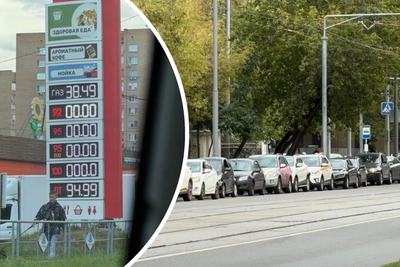
Positive news could be, for example, a statement from the Central Bank that no further rate hikes are planned, or the resolution of the fuel crisis. The first seems slightly more likely for now, because, as experts explained to Fontanka, resolving the gasoline situation will depend on the speed of repairing damaged refineries. Motorists waiting in lines at gas stations may see the first relief by the end of July to early August, but a more noticeable effect is expected closer to autumn, when demand for fuel from farmers subsides.
All that remains is to hope for the calming effect of the Central Bank«s statement. After all, an additional hike in the key rate may indeed not be necessary, although inflation data looks bad.
«The regulator«s position could be significantly affected by the acceleration of inflation: according to Rosstat, in June, against the backdrop of the fuel crisis, annual inflation reached 6.02%, and monthly inflation 0.87%, marking peak consumer price growth since the beginning of the year. Additional pressure on the Central Bank»s decision could come from the trend of weekly inflation in July: its steady increase of an average of 0.2% per week looks like an alarming signal,» says Natalya Milchakova, leading analyst at Freedom Global.
Will the Central Bank Raise the Key Rate on July 24: Experts« Forecasts
«At the moment, the most likely scenario, in our view, is keeping the rate at the current level,» believes Natalya Pyryeva, head of the analytical department at Tsifra Broker.
In addition to gasoline, the budget remains a high risk. The deficit amounts to about 6 trillion rubles (approximately $66.7 billion at current rates) and is more than 1.5 times the planned value for the end of 2026, the expert notes. Yes, in the second quarter the situation was positively affected by the rise in oil prices, but the effect is short-term, and pressure from the budget will persist, Pyryeva believes.
«We expect the key rate to be kept unchanged in July. The pause will last until the picture in the fuel market becomes clearer. By the September meeting, the Central Bank will have a better understanding of the primary and secondary effects of rising fuel prices and their outlook,» says Ilya Fedorov, chief economist at BCS World of Investments.
According to the expert, the trajectory of fuel prices will be L-shaped. Production costs for fuel have risen, its price will peak and remain at that level, and if it does decline, it will not be by much.
It follows that the period of high rates in the economy will last longer than previously assumed. When gasoline and diesel prices stabilize, the Central Bank could return to cutting rates in the fourth quarter (October to December) of 2026.
Will the Central Bank Return to Raising the Key Rate
As for raising the rate, analysts are not including it in their forecasts. But it could be an emergency measure if fuel supply does not begin to recover, Fedorov believes. Pyryeva believes that the toughest measure will still be a longer hold of the rate at the current level.
If we consider the probability of the regulator making one or another decision, leading analyst at Freedom Global Natalya Milchakova gives 75% to keeping the rate at 14.25% on July 24, 20% to a cut to 14%, and 5% to a hike. As is known, the Central Bank can surprise the market. The latter two options, according to the expert, would be unexpected.
If the Russian economy gets through the fuel crisis period fairly calmly and inflation does not spiral into uncontrollable growth, then by the end of the year the probability of a key rate hike will drop to zero, the expert believes.