Tomsk woman speaks Old Russian after injury
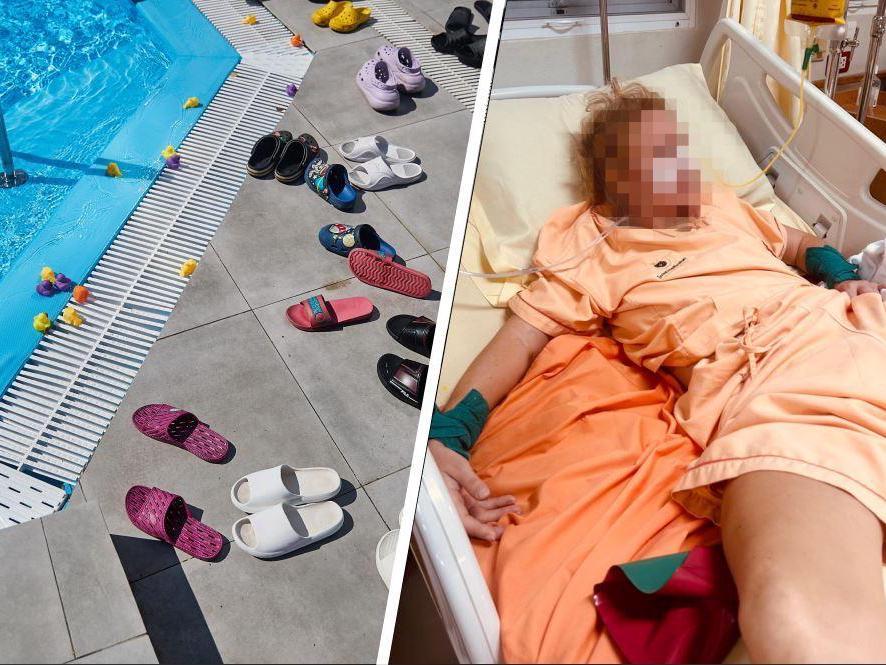

Volunteers raised funds and covered medical bills and logistics to return her to Russia.
This story may give you a new phobia. Have you ever caught yourself thinking as you step out of a pool: «Don’t fall or you’ll smash your head»? That is exactly what happened to Anna (name changed) from Tomsk. A tropical paradise became the scene of a tragic accident for her. She slipped on the pool steps, struck her head, and was taken to intensive care. As a result she regressed to the level of a three-year-old, and something astonishing happened — she began using Old Russian words. After an entire rescue operation Anna returned to Russia and now faces a long recovery.
From a funeral to intensive care
A slender, attractive woman looks at us from a photograph. Her fair hair is slightly wavy. She is sitting on a swing in a picturesque resort spot, smiling. The photo was posted on her personal page in 2020. A few years later this woman would face a series of hard blows.
Anna is 45 and was born in Tomsk. She holds two degrees, in philology and psychology. Recently she lived and worked in Pattaya (Thailand), selling excursions on Russian Street.
According to the blog of Anna’s friend, Svetlana Sherstoboeva, in 2025 Anna traveled to Tomsk. She said goodbye to her father, who had died of cancer, and gave moral support to her mother, who had recently undergone surgery due to oncology.
Anna then returned to Thailand, where the terrible incident occurred. On the evening of 28 August, at one of the complexes, as she was leaving the pool, Anna slipped on the tiled steps, lost her balance, and smashed her head against the edge. She landed on her ear, then rolled into the water, writes Svetlana Sherstoboeva.
Eyewitnesses pulled the woman from the water and called an ambulance. Doctors performed cardiopulmonary resuscitation and then placed her in intensive care. Her friend Marina, who visited the patient, said Anna had lost her memory and began speaking in Old Russian.
— «She is speaking some completely unintelligible language. We googled a couple of words; it turned out it might be some very Old Russian», — reports Svetlana.
On an «NTV» broadcast, Elena Makovetskaya, a friend from Tomsk, says Anna used phrases like: «Who are your rodsy (relatives)?» and «lanochki» (cheeks).
About Thai healthcare
By striking her head on the pool edge, Anna suffered not only memory loss and disordered speech. She was diagnosed with a traumatic brain injury and serious damage to the external ear. Moreover, according to Svetlana, Thai doctors delayed surgery, and the tissue began to necrotize.
Doctors at Chonburi Hospital, where the woman was transferred, performed surgery to amputate most of the ear. Initially, they planned a craniotomy — an operation to remove a hematoma compressing the brain. However, according to Svetlana Sherstoboeva, this was not done.
Anna was discharged home immediately after surgery, without waiting for her condition to stabilize. That decision by the doctors also raised questions. The woman had a severe open wound on her head. Volunteers sympathetic to Anna’s plight and her mother, who flew to Thailand, handled the dressings.
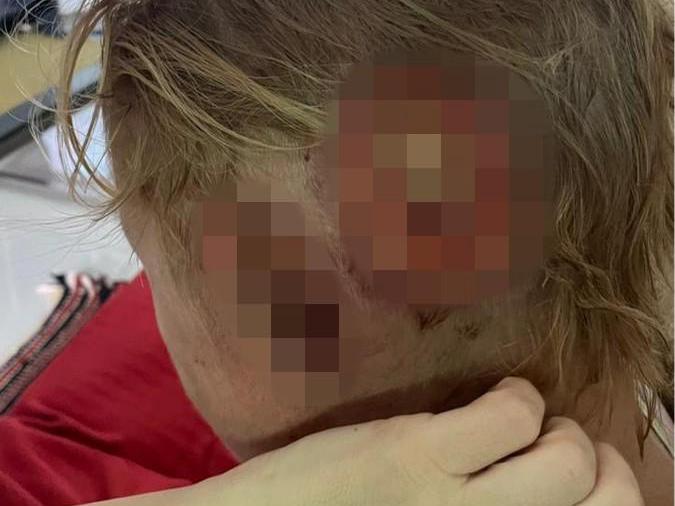
The accident left severe head wounds, and relatives managed dressings during early recovery.
Rescue cost 10,000 dollars
Anna was in a severe state of amnesia — she did not remember her name or recognize loved ones. A turning point came when she met her mother: suddenly she recognized her. This glimmer of memory gave hope, but the joy was short-lived: memories returned only for a few minutes. Then Anna’s condition worsened sharply — her speech became incoherent and her behavior resembled that of a three-year-old child.
To bring Anna back to Russia, concerned volunteers organized a veritable special operation. They needed to pay medical bills, buy dressing supplies, and arrange special transport conditions to the airport. Volunteers managed to raise and spend about 320,000 Thai baht — more than 10,000 dollars.
— «You can’t imagine what we went through when, the day before the flight, Anna flatly refused even to leave the apartment, to cross the threshold: “No! I’m not going anywhere from here.” But the tickets were already purchased, fast-track and a wheelchair ordered at the airport… Friends carried a half-asleep Anna to a taxi at night, and that’s how we got to the airport. There were also tantrums there, like a sleepy toddler’s: “I want to go here. And I don’t want to go there. I’ll sit here, but not there”», — recalls Svetlana Sherstoboeva.
How is the Tomsk woman now?
Anna’s mother refused to speak to the journalist. The victim’s uncle confirmed that she is receiving treatment in Tomsk. Svetlana Sherstoboeva told the reporter that her condition has not yet changed. She remains at the level of a three-year-old child. As for Anna’s speech, she periodically produces a mixture of three languages — Russian, English, and Old Russian.
— «They are treating her ear and the back of her head now. The ear is already healing. I asked her mother about an ear prosthesis, but she said that is still a long way off. Recently, for the first time, a speech therapist-psychologist visited her at home. She started showing Anna pictures, but Anna refused to work. After the first day the psychologist said she would gradually recover. For now the family is coping», — she said.
Svetlana Sherstoboeva said that the diagnosis of a brain hematoma made by Thai doctors was not confirmed by further examination.
Expert opinion
A journalist asked Oleg Grebenyuk, an associate professor at the Department of Neurology and Neurosurgery of SibGMU (Siberian State Medical University, SibGMU), to comment on the phenomenon of Old Russian words. The expert did not see anything unique in this case.
With a serious injury, a person’s native speech can be disrupted, the expert says. For example, sensorimotor aphasia can develop: damage to parts of the brain responsible for understanding the meaning of speech addressed to a person, along with the centers responsible for articulation. After an injury, dysarthria may also appear — an impairment of word and sound pronunciation due to partial paralysis of the tongue, lips, or soft palate. In such cases the person understands others’ speech.
Medical practice also encounters cases linked to the brain’s neuroplasticity. After a head injury, long-forgotten experience can unexpectedly surface. For instance, if someone once studied English at school and retained a few everyday phrases, these bits of knowledge can reactivate after trauma. The person begins spontaneously using previously learned expressions in speech, even though they might have completely forgotten them before the injury.
— «But this will not be a full-fledged foreign language. Essentially, they are fragments and snippets a person can use in everyday life. There is nothing unusual here. Similar cases were described in textbooks as early as the late 19th century», — says Oleg Grebenyuk.
The interlocutor also mentioned non-scientific concepts used to explain such manifestations. For example, there is xenoglossy — a term in parapsychology meaning a person’s use of a language that they supposedly could not have learned under natural conditions. For instance, someone speaks Italian well but never studied it, has never been to countries where it is spoken, and has no ties to Italian speakers.
Adherents of xenoglossy believe the new ability usually appears in special states of consciousness — after intense meditation, in a trance, or under the influence of certain substances. It is important to note that most scientists do not recognize xenoglossy.