Scientists explain severe frosts in Irkutsk during Epiphany


It is clear that the peak of January frosts in the Irkutsk region has passed. The cold is shifting to the Urals and the European part of Russia, and in Irkutsk, it has already warmed up noticeably. At least for this weekend, for sure. But the cold wave that came to us on Epiphany has become one of the most notable in recent years. What conclusions scientists have drawn and what to expect next was told to an IrCity journalist by the head of the department of meteorology and physics of near-Earth space at Irkutsk State University (IGU) Inna Latysheva.
According to her, it is still too early to talk about the end of winter.
«We have only just passed the «equator of the calendar winter,» and, according to preliminary forecasts, the Asian anticyclone will again try to maintain its cool influence already at the beginning of next week. February is also often accompanied by cold waves,» notes Inna Latysheva.
How strong were the frosts
In the Irkutsk region, «severe frosts» are classified as dangerous winter phenomena. This is when the temperature in northern areas drops to -58°C (-72°F), in most of the territory to -47°C (-53°F), and on Lake Baikal to -40°C (-40°F).
In this January cold wave, officially such a level was recorded only at the Balagansk weather station, where thermometers dropped to -47°C (-53°F). Meanwhile, residents of many districts, including southern ones, reported frosts below -50°C (-58°F), but these data are not included in official statistics as they were not recorded at weather stations.
In Irkutsk, according to airport data, the temperature reached -41°C (-42°F). This, according to Latysheva, is cold, but still not a record: in January 1915, -49.7°C (-58°F) was recorded, and in 1910 it was -47.6°C (-54°F). In the north of the region, frosts reached -55°C (-67°F), and this is also not the absolute minimum (-61.2°C or -78°F). It was recorded in 1966.
«Another, no less dangerous phenomenon is «abnormally cold weather.» It is characterized by the average daily temperature dropping 7 or more degrees below the long-term norm and lasting at least 5 days. In the Irkutsk region, this phenomenon was observed almost everywhere in January 2026,» noted Inna Latysheva.
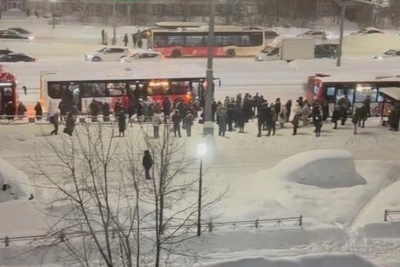
In the Far North, the cold lasted 11 days, and in the rest of the territory about a week. The frosts were accompanied by fog, black ice, and frost, which complicated the work of transport and energy workers.
Where did this cold come from
According to Inna Latysheva, the current cold wave developed unusually. On 16 January, several powerful anticyclones merged over Russia — from Scandinavia and Taimyr. As a result, a huge area of high pressure covered almost the entire country.
«If traditionally the main center of the winter anticyclone is often over Mongolia or Yakutia, then in this cold wave it stationed for a long time over the north of Krasnoyarsk Krai,» she explains.
Because of this, the main blow fell on Western and Eastern Siberia. In Western Siberia, especially many new daily temperature minima were recorded — colder than in 1947, 1960, 1969, 1990, and 1996.
In the Irkutsk region, the record was updated by the high-altitude station Khmar-Daban: -35.6°C (-32°F) at an altitude of 1,442 meters above sea level (4,731 ft).
Frosts, fogs, and «fluffy» frost
The Irkutsk region, like Krasnoyarsk Krai, found itself under the influence of two cold epicenters at once.
«At altitudes towards Baikal, a cold cyclone shifted, into which Arctic air from the coldest regions of Yakutia and Greenland flowed. At the earth«s surface, the descending cold dense air for a long time supported the growth of atmospheric pressure in the center of the anticyclone over Krasnoyarsk Krai. As a result, the Irkutsk region came under the influence of a prolonged cold wave,» explains Inna Latysheva.
An additional effect was given by weak snow, which reflects solar heat and enhances cooling. In the morning, thick frosty fogs formed — visibility in them sometimes fell below 200 meters and remained so for more than 8 hours.
Another feature was unusually large frost. The frosts were accompanied by «fluffy garlands» of crystals more than 18 millimeters in diameter.
Why the cold felt even stronger
In Irkutsk, frosty weather began to form already on 13 January. By 15 January, the temperature dropped below -30°C (-22°F), and on the morning of 19 and 20 January it reached -41°C (-42°F). Simultaneously, atmospheric pressure grew for several days in a row — up to 733 millimeters of mercury.
«The prolonged rise in pressure was accompanied by an equally impressive «cold collapse,» that is, a sharp drop in temperatures,» notes the interlocutor.
At the same time, as Inna Latysheva emphasizes, the frosts felt much stronger than what thermometers showed. All because even a weak wind or small changes in air humidity sharply intensified the cold.
«In Irkutsk, according to thermal sensations, from 15 January, there was a «danger of frostbite.» According to meteorological data from the airport, the Epiphany frosts in the morning hours with an east wind of 3 meters per second were perceived as -52°C (-62°F) by thermal sensation. Residents of Khuzhir in the morning hours with a southeast wind of 3 m/s felt -42°C (-44°F), and at the southern tip of Lake Baikal with a weak southwest wind, they felt frosts down to -35°C (-31°F),» told Latysheva.
Is this rarity or norm?
Despite the impressive numbers, the current frosts cannot be called exceptional. Over the past 25 years in Irkutsk, there have been six similar prolonged cold periods, with a recurrence rate of 24%.
The longest cold wave this century was observed in January 2001, when the temperature dropped to -42.8°C (-45°F) and lasted almost two weeks (from the 2nd to the 15th). In 2000, frosts down to -39.4°C (-39°F) stood in Irkutsk for nine days, and in 2010 for five days the temperature dropped to -36.6°C (-34°F).
More prolonged frosts (for five and eight days) were recorded in January 2012 and 2018.
«However, this January still contrasts very strongly with last January. For example, in Irkutsk on the holiday of Epiphany, 19 January, last year during the day it was -4°C (25°F), this year up to -30°C (-22°F); at night the thermometer showed -10°C (14°F), and this year it was up to -40°C (-40°F),» reported Inna Latysheva.
Climate of the last century
According to Inna Latysheva, this January strongly resembles the cold winters of the 20th century. In recent decades, such frosts are not so frequent.
«If we talk about the causes of abnormally cold weather, then by the nature of atmospheric processes, the current January cold wave in the Irkutsk region is the climatic winter of the last century and about a third of winters in the current century,» she notes.
The causes of this anomaly, according to Latysheva, are no less than ten, if not more.
«The specificity of the current cold wave is that active heat flows formed powerful Arctic anticyclones, which shifted cold atmospheric vortices at altitudes to the southern latitudes of Siberia and Kuban. There, the cold wave became prolonged and strong. A cold cyclonic vortex over Kuban and Eastern Siberia maintained the cold and anticyclones, and over the Far East, such an atmospheric vortex was accompanied by heavy snowfalls,» noted Inna Latysheva.
Paradoxically, but on the same days when fierce frosts stood in Siberia, on the coast of the Arctic Ocean (where the breath of the Arctic should be felt) record-high winter temperatures were recorded. For example, at the weather station on Cape Chelyuskin on 15 January, a record was set — only -6.7°C (20°F). Meanwhile, in Krasnodar on 14 January, it was up to -15.3°C (4°F).
This contrast, according to Inna Latysheva, clearly shows how closely anomalies of heat and cold are connected in different regions of the country.