Perm woman crafts unique glass beads inspired by archaeology
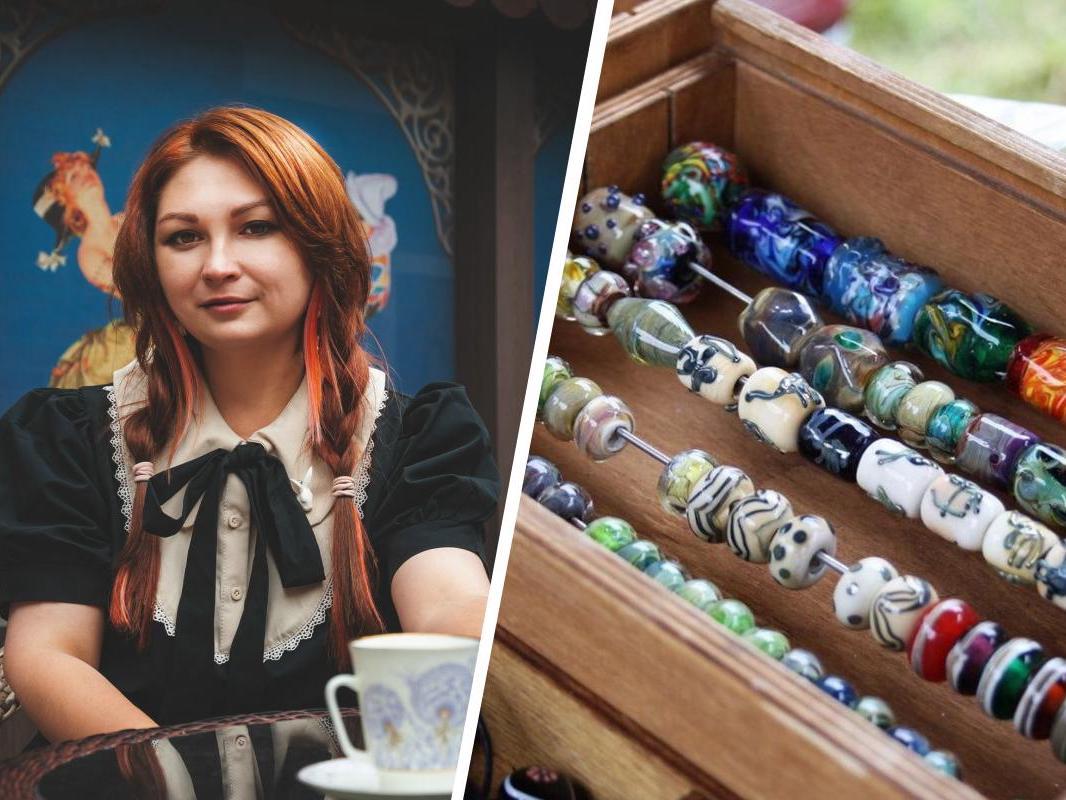

Perm resident Ksenia Tsygankova creates “historical beads” and jewelry from them. The beads have this name because they closely resemble archaeological finds in size, color, and shape. At some point, this hobby turned into work, and now the woman has students to whom she passes on her knowledge. In a conversation with 59.RU, Ksenia talked about what makes working with glass interesting, how she studies the history of the items, and which beads were found only in the Perm Krai and neighboring regions.
“It Started Working Completely Unexpectedly”
Ksenia Tsygankova has been involved in historical reenactment for 15 years, has worked with glass for 13 years, and sews costumes that are as close to the originals as possible. Interestingly, Ksenia’s first education is unrelated to her creative work—she graduated from the Faculty of Criminal Law and Prosecutor’s Supervision at Perm State University. Her fascination with glass began during maternity leave after the birth of her daughter—the Perm resident decided to find a hobby to avoid boredom, and then she got “sucked in”.
— “I ordered a burner, glass, and it started working completely unexpectedly,” Ksenia shares with 59.RU. “I didn’t expect anything more. After maternity leave, I didn’t return to work and started doing my own thing.”
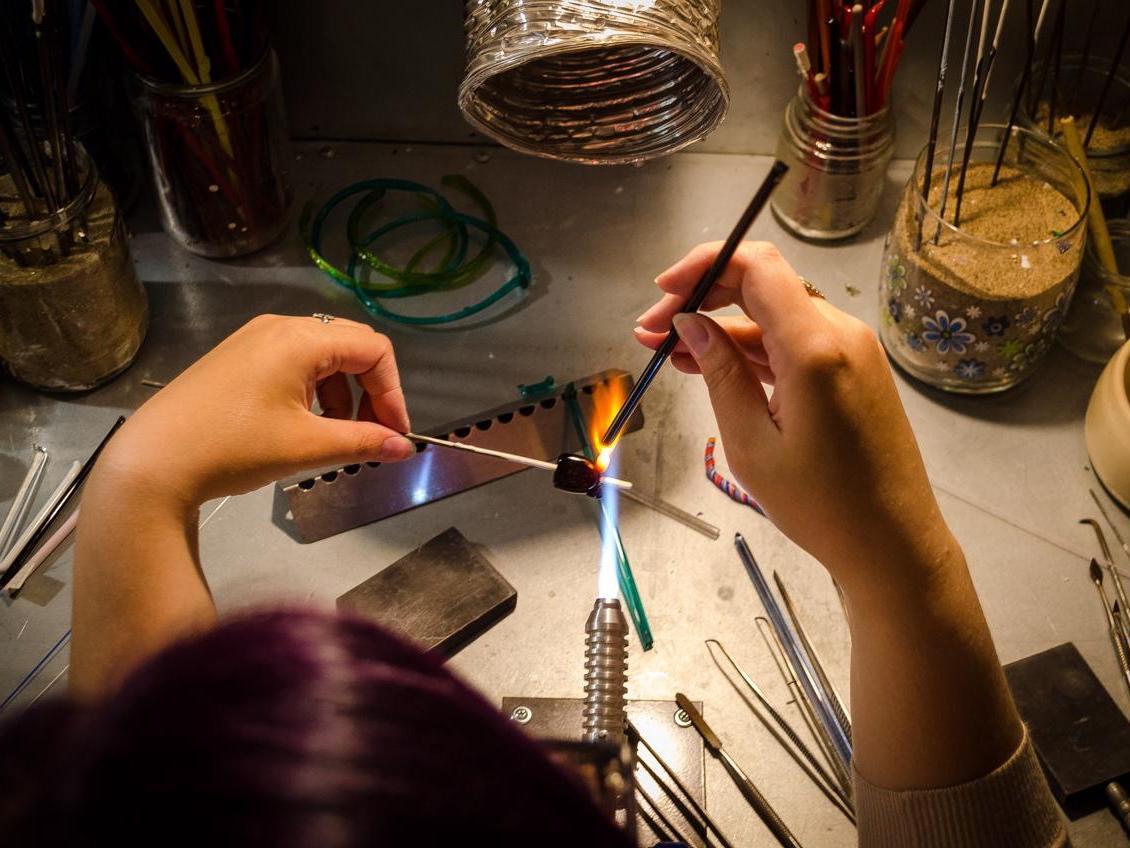
Now the woman is studying to become a historian-archaeologist at Perm State Humanitarian Pedagogical University and is preparing to defend her dissertation on archaeological glass. Ksenia admits that she has never been on an archaeological dig, but after defending her scientific work, she might have such an opportunity.
To make the items as authentic as possible, the craftswoman studies various sources: descriptions of finds in documents, information on museum websites, scientific publications, and works of art.
“A Bead or Figurine Needs to Be Made on the First Try”
There are many techniques in working with glass, but most often our heroine uses the lampwork technique—this is melting glass on a burner at high temperature. Sometimes she resorts to other methods. For example, when working in the technique of classical Gothic stained glass, masters cut flat glass and frame it with lead profiles. In Tiffany stained glass, they wrap the glass in copper foil with a sticky base, frame it with a lead profile, and solder them together using tin.
— “There are different techniques and types of glass. Glasses differ in their coefficient of thermal expansion—this is the temperature at which they melt,” Ksenia explains to us. “For lampwork, low-melting glass is used—it starts melting at 600°C (1112°F), and the working temperature in our burners is 1200°C (2192°F).”
Glass consists of sand, soda, and metal oxides. Metal oxide is necessary for coloring the glass in one color or another: for example, copper oxide gives green color, copper suboxide gives red-burgundy, cobalt gives blue, and aluminum gives yellow.
Our attention was drawn to beads “with sparkles,” shimmering in various shades. Ksenia explained that this is dichroic glass—initially shiny and light-reflecting. Particles of silver, gold, and rare-earth metals are applied to a glass plate—this is how sparkling beads are later obtained. The shimmering in purple, blue, and pink is due to the reaction of silver in silver-containing glass.
For melting glass, Ksenia uses a propane and oxygen burner, a powerful exhaust hood, and a muffle furnace. When working with glass, many subtleties need to be considered. Before starting the melting, it is necessary to wear special glasses with violet lenses—they “cut off” the yellow spectrum of the flame, allowing a clear view of the bead itself. The furnace constantly maintains a temperature of 500–520°C (932–968°F) so that the finished beads cool gradually. Soft glass must be fired immediately because the finished item can crack right after cooling. But borosilicate glass is more durable—you can make a bead and leave it on the table to cool. Therefore, borosilicate glass is used for casting glass chains or very thin figurines.
— “The item is made immediately as a whole, multicolored—all dots, stripes, and other decor are applied glass on glass directly in the flame. A bead or figurine needs to be made in one go,” Ksenia tells 59.RU. “You prepare all the glass and tools in advance, sit down at the burner, make the item, and immediately put it in the muffle furnace. It’s ready about the next day. Sometimes the idea doesn’t work out, but it works out for me most of the time because I’ve been doing this for a long time.”
“For the First Year or Two, the Items Will Be Just Like Your Teacher’s”
Ksenia regularly participates in historical reenactment festivals—for example, “Kulikovo Field” in Tula, dedicated to the anniversary of the Battle of Kulikovo, and the medieval combat festival “Great Bolgar” in Tatarstan. She brings with her a small clay forge—similar to those used in the 14th century. Bellows are attached to it and air is pumped in so that the air temperature reaches 1200°C (2192°F), as in a burner. The Perm woman conducts master classes on bead-making and sells finished items.
Ksenia also conducts training in her workshop Archaic Glass in Perm—here, her assistant works, as well as an artist who draws designs for postcards, and several other masters.
— “I’ve been teaching adults for about 10 years. Sometimes two or three master classes are enough for a person to learn the technique of working with glass,” Ksenia shares. “There’s a case where a girl attended classes every week for six months, and now she works successfully on her own. It reached such a level that I took her works out of the furnace, and they were very similar to mine. It’s like with any art—if you want to learn lampwork, you need to look at whose works you like more and go study with the person who created them. For the first year or two, the items will be just like your teacher’s, and then you’ll start making something of your own. Because you’ll understand how glass reacts and flows in the flame and what you can make from it.”
According to Ksenia, every master “trains the hands” of the student, so the works of the master and his student will be very similar, though not entirely identical. When a layperson looks at them, they won’t see differences, but someone who has studied the process more deeply will see that the items differ slightly.
“Blue Beads Are Mainly Characteristic of the Perm Krai”
Ksenia has long been involved in reenactment and has thus managed to study different periods in various regions of Russia and other countries. In a conversation with 59.RU, the woman admits that it’s difficult for her to choose a favorite era and recalls which ones she has deeply immersed herself in.
— “Initially, I was in a club that recreated Novgorod of the 13th–14th centuries. In that period, the first colonizers of the Urals were the ushkuyniki from Novgorod, they were also river pirates (ushkuy is a light river vessel they sailed on—Ed.), who robbed the inhabitants. Over time, they reached the territory of the Perm Krai. Now I’m interested in Italy of the 14th–15th centuries—we in the ‘Bern’ club mainly do historical medieval combat, where we put on armor and fight each other. I also sew costumes and hit people,” the woman jokes.
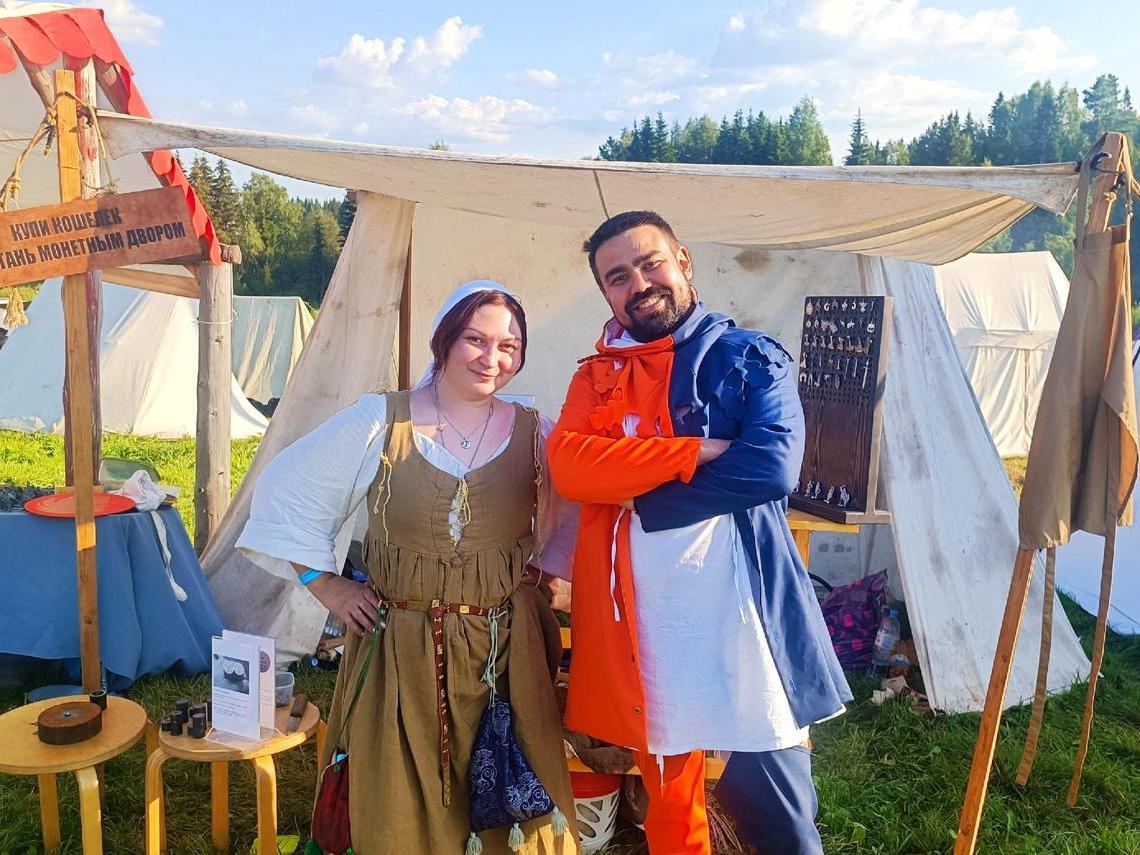
While studying jewelry in different historical periods, the Perm woman noticed that there are things found only in specific places at specific times. For example, in the territory of the former Irish kingdom of Lagore, or Southern Brega, blue-and-white beads from the 8th–9th centuries were found—they occurred only there for about 100 years. If such items were found in some burial in Norway, one could assume that the deceased was a settler from Ireland and simply brought them with him. Ksenia also suggests that in Lagore, there might have been a master creating certain beads. He taught two or three masters, but this tradition did not survive—in the 11th–12th centuries and later, blue-and-white beads were no longer found there. Perhaps the master died or moved to another country and didn’t manage to pass on his craft to anyone.
Lately, the Perm woman’s attention has been drawn to the Lomovatovka culture, named after the Lomovatovka River, on the banks of which scientists began studying archaeological finds. It originated in the territory of the Perm Krai—where the Ilyinsky, Dobryansky, and Chusovskoy districts are now located. The Lomovatovka culture existed from approximately the 6th to the 12th centuries, with its peak in the 7th–8th centuries. After this period, not only many metal artifacts with images in the “Perm Animal Style” remained, but also imported beads. They were mainly brought from Iran and Egypt.
— “By the chemical composition and appearance of the beads, one can determine where they were brought from, approximately in what period they were made, and in which region,” Ksenia explains to 59.RU. “We also have many silver- and gold-glass beads. They consist of a thin layer of glass, behind which is a thin plate of 999 fine silver or gold, and on top—either transparent glass, or yellow, or blue. Blue beads are mainly characteristic of the Perm Krai, and they are also found in Glazov. They are not found in such quantities in the territory of Rus or Scandinavia.”
The craftswoman made many beads specifically for the Komi-Permyak Ethnocultural Center in Kudymkar—they are stored there as an exhibit.
On the Difficulties of Work After the Start of the Special Military Operation
Glass for work needs to be ordered from other countries. For example, multicolored glass is melted in Italy, Murano (or Venetian) and dichroic glasses are made in the USA, and other types are produced in Germany, the Czech Republic, and China. In Russia, glass is not melted. The material must be selected so that all glasses match in coefficient of thermal expansion and fuse together. If there is no match, cracks form on the glass. After the start of the special military operation, Ksenia orders glass through Turkey using parallel imports or through her acquaintances in Kazakhstan.
Before the special military operation, beads and items were often ordered by Russian-speaking girls from Germany—they were involved in reenactment of the Middle Ages and helped create Viking images. Once, a man from Poland ordered a silk robe for reenacting events during the raids of the Golden Horde. Most often, buyers found the woman on Facebook (owned by Meta, recognized as extremist and banned in the Russian Federation). When the special military operation began, Ksenia stopped processing overseas shipments—she fears that her package might be damaged or destroyed at the border.
Now the woman works only within the country—customers range from Kaliningrad to Vladivostok. She recalls that the most unusual and large order in Russia was a whole 150 Christmas tree ornaments for the company “GeoSpecTechnology”—then both she and the customers were delighted with the work done.
Earlier we reported on a Perm woman who quit programming and knits toys and keychains—her works live all over the world.