Ural Federal University Astronomers Discover Laughing Gas in Interstellar Ices
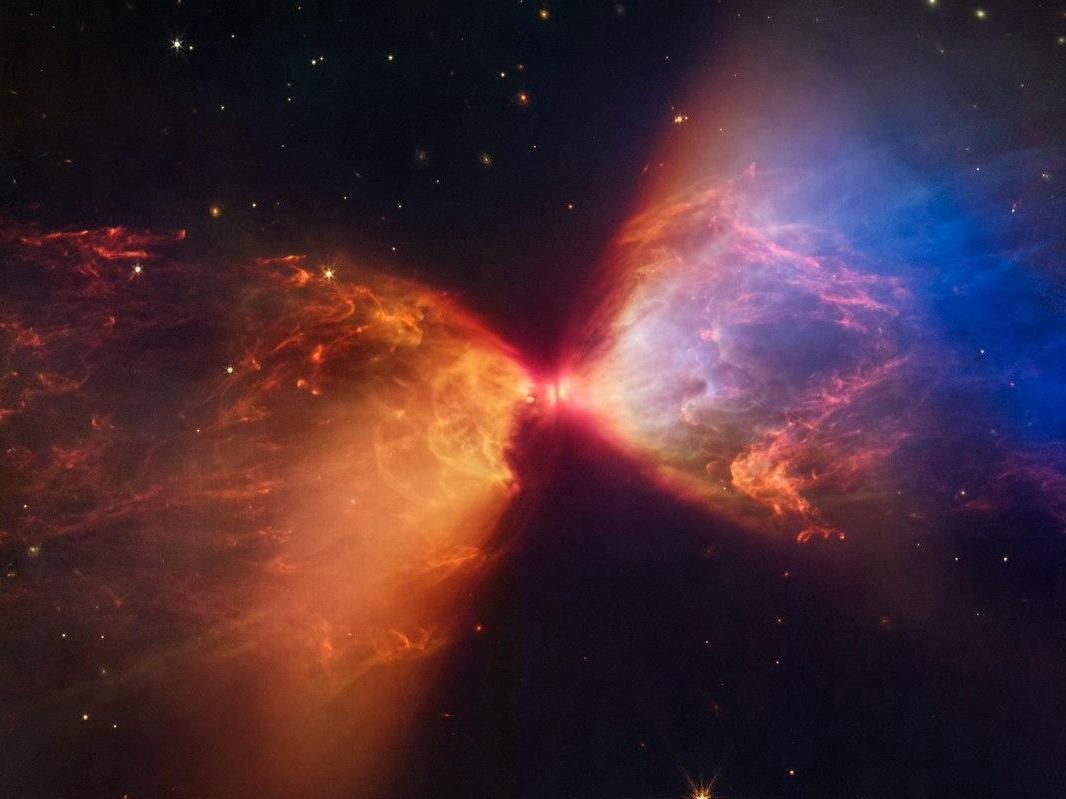

Astronomers from Ural Federal University (UrFU) have made a breakthrough discovery by confidently detecting nitrous oxide, known as «laughing gas,» in interstellar ices for the first time. This molecule is the ninth to be found in the icy mantles of cosmic objects.
Researchers detected N2O in the direction of 16 out of 50 studied protostars. The concentration of the substance varied from 0.2% to 2.1% relative to ice consisting of carbon monoxide. “We detected nitrous oxide in ices in the direction of 16 protostars out of 50 that we analyzed. The N2O content in these protostars ranges from 0.2% to 2.1% relative to ice consisting of CO molecules. The detection of nitrous oxide in more than a dozen protostars means that this molecule is widely distributed in interstellar ices, and our work is the first confident detection of icy N2O,” said Varvara Karteeva, a research assistant at the Astrochemical Research Laboratory of UrFU.
In the gas phase of interstellar clouds, which serve as material for the formation of stars and planets, scientists know of over 300 different molecules. However, in the icy shells that form at temperatures around -263 degrees Celsius (-441°F), only eight have been confidently identified so far. Nitrous oxide, found by the UrFU team, is the ninth. In addition, researchers also reported the preliminary detection of isocyanic acid (HNCO).
Detecting molecules in the solid phase presents greater difficulty compared to gas. In ices, compounds are visible only in the infrared range, and for observations, a nearby star is needed that «illuminates» the studied area.
To interpret data obtained by the James Webb Space Telescope last year, scientists used spectra of analogs of interstellar ices created on the laboratory setup ISEAge. “We used spectra of analogs of interstellar ices grown on our laboratory setup ISEAge to interpret the results obtained by the James Webb Space Telescope last year. With the help of laboratory-obtained spectra, we were able to analyze observations of interstellar clouds and confidently detect N2O in ices,” explained Anton Vasyunin, head of the laboratory.
The detection of nitrous oxide has important implications for astrochemistry. This molecule reacts more actively at low temperatures than, for example, molecular nitrogen (N2), which is considered the main carrier of nitrogen in icy mantles. N2O can participate in the formation of more complex nitrogen-containing compounds, including amino acids — the building blocks of proteins and the basis of life.
“It is believed that reactions in the gas phase of interstellar clouds most likely do not lead to the formation of complex organic molecules. With ice, the situation is different: the ice surface is kind of catalytic. Surface reactions can be more effective in forming a number of chemical compounds that are poorly formed or not formed at all in gas. Therefore, studying the chemistry in ices and the composition of these ices is, on one hand, more difficult, and on the other — more interesting, because there is a slightly different chemistry leading to the formation of a different set of molecules,” added Vasyunin.
The scientist also pointed out the likelihood that substance from interstellar ice can more easily reach planetary surfaces, for example, as part of the icy nuclei of comets. Such bodies, falling onto young planets, can deliver significant amounts of organic material. Thus, the transfer of chemical compounds in solid state appears more probable and efficient than in gaseous form.