Exhibition on Blockade Crematorium Opens in Victory Park
The exhibition 'Leningrad. 1942' has opened in the chess pavilion of Moscow Victory Park, dedicated to the work of a crematorium at a brick factory during the blockade and the post-war creation of the park.
Mar 1, 2026 0
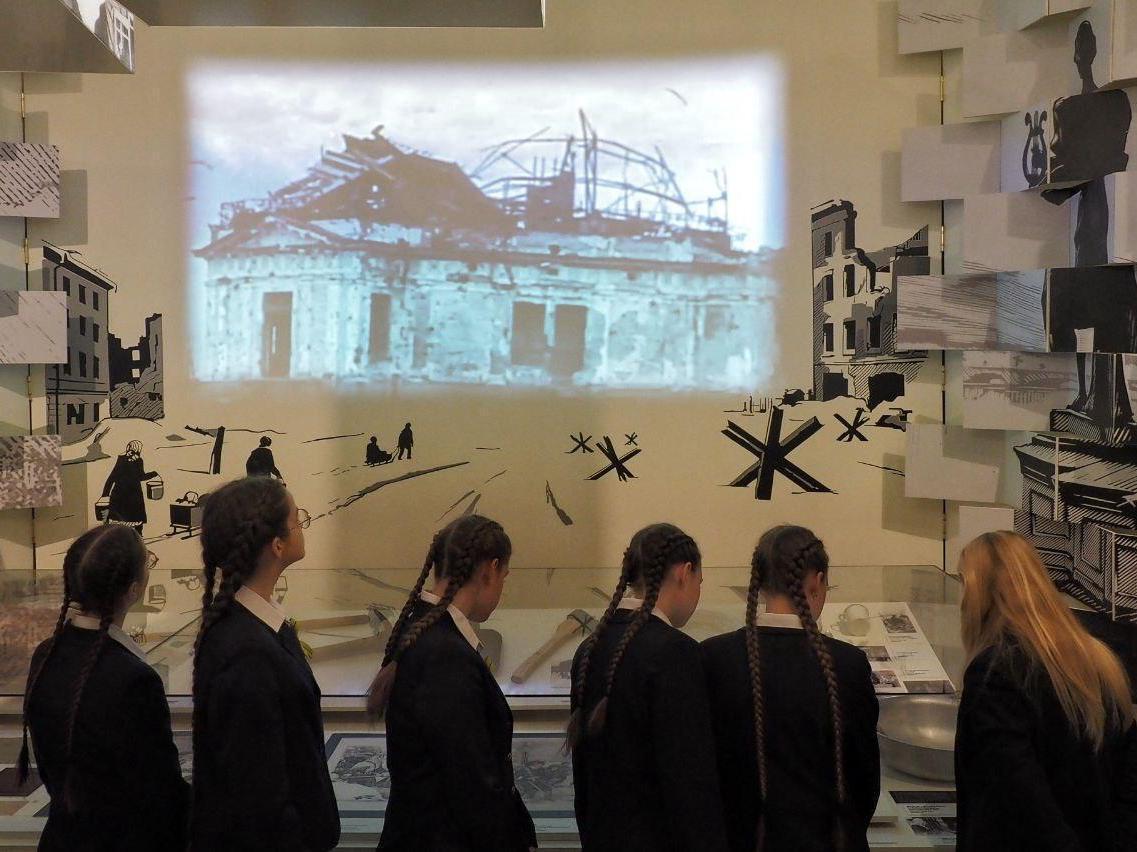

The exhibition features a memorial wall with names of blockade victims and historical documents.
Source:
The new exhibition, which has become a branch of the State Memorial Museum of the Defense and Siege of Leningrad, has opened in the chess pavilion. In the small space, visitors enter a memorial area: a semicircular wall of black blocks with white inscriptions — names, addresses, and dates of death.
This is a collective image created by artist Vadim Teterin, since precise data on the victims whose bodies were cremated at Brick and Pumice Plant No. 1 has not survived. According to information from historians, made public in 2025, 131,985 bodies passed through this crematorium. The ashes were buried in trolleys in special trenches, where ponds were later dug when the park was developed. The plant itself was demolished in 1960.
In one section, a model of the plant with rails for trolleys is displayed. Nearby on a screen, documents with shocking details of the crematorium«s operation are shown: each trolley held 30–35 bodies, 21 trolleys were in the furnaces simultaneously, the temperature reached 1000–1300 degrees Celsius (1832–2372°F), and the entire burning process took from 36 to 48 hours.
A separate section is dedicated to the crematorium workers who were nominated for government awards for completing a special assignment. Among them are ashwoman Abramova, who «despite the difficult working conditions, consistently fulfilled production norms by 180% all the time,» corpse loader Belova, whose work is described as «meticulous, very heavy, and responsible,» and chief mechanic Dubrovin, who personally fixed accidents in the furnaces.
The main hall of the exhibition tells about the spring of 1942, when the city was dealing with the aftermath of the first siege winter. Here, one can see a burial registration book from Decembrists Island, where for 25 out of 30 recorded deceased, dystrophy is listed as the cause of death, as well as unclaimed death certificates from hospitals.
«For those who survived the first, most terrible siege winter, dystrophy caught up with them in the spring,» explains chief curator Anna Saveleva. «There were many deaths precisely in the spring of 1942.» Chief research associate Yulia Buyanova adds that the exhibition also highlights the creation of the park in 1945 and the problems the city faced: a sharp increase in mortality, the threat of epidemics, and the mobilization of the population to clean the streets.
Among the exhibits are photographs of besieged Leningrad, a summons for labor duty to clear snow in 1942, and fire protection equipment. On screens, newsreels are shown, as well as a quote from Olga Berggolts«s »Blockade Bath« read by Nikolai Burov, describing the »dystrophic politeness« of people in the baths.
The second part of the exhibition is dedicated to the post-war history of Moscow Victory Park, which coexisted with the crematorium plant for 15 years. Park projects, photographs of its foundation, as well as leisure items of Leningrad residents from the 1950s–1960s are presented: skis, skates, cameras, chess sets. A video created with AI «brings to life» old photographs from that time.
At the opening ceremony, St. Petersburg Governor Alexander Beglov announced plans to digitize all the names of those cremated at the plant. «We will create a single database of all those who died for our city — both soldiers and residents,» he promised.
Head of the organization «Residents of Besieged Leningrad» Elena Tikhomirova in her speech recalled the children who worked in those years: «Twelve-year-old children were full, normal factory workers. They went to stores, participated in cleaning the city.»
Materials for the exhibition were provided by several museums and archives, including the Museum of the History of St. Petersburg, the Central State Archive of St. Petersburg, and the Archive of Film, Photo, and Phonodocuments in Krasnogorsk.
Visiting the exhibition in the chess pavilion, like the main exhibition of the Museum of Defense and Siege on Solyanoi Lane, is free of charge.
Read more