Strongest Solar Storm in Two Decades Strikes Earth, Prompts Forecast
A solar flare has triggered radiation disturbances, resulting in the most intense solar storm in two decades, according to astronomers.
Jan 24, 2026 0


The coverage includes tips for alleviating headaches that can occur during periods of high geomagnetic activity.
Source:
A powerful solar storm, which caused the strongest radiation storm of the current century, is weakening. According to the Laboratory of Solar Astronomy of the Institute for Space Research (IKI) and the Institute of Solar-Terrestrial Physics (ISZF) of the Russian Academy of Sciences (RAS), the peak of geomagnetic activity occurred on the night of January 19-20.
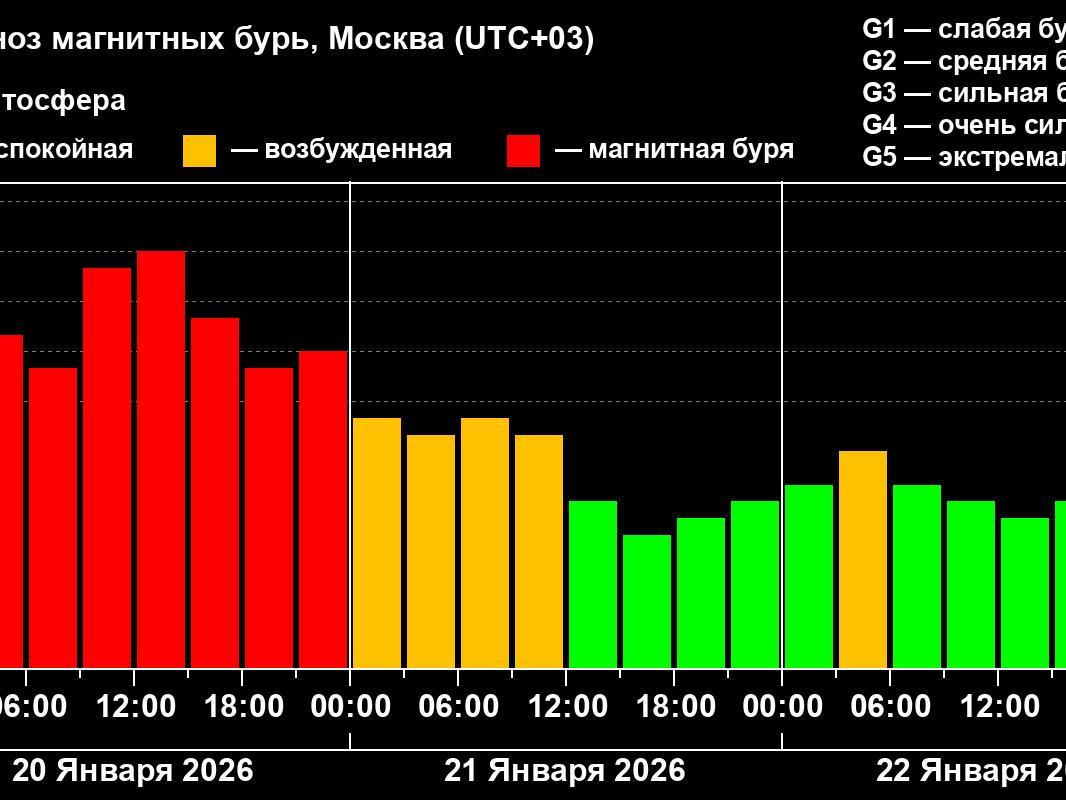
The article presents a specific forecast for geomagnetic conditions expected on January 21 and 22.
Source:
Yesterday, the radiation storm around our planet reached maximum strength. The level of solar proton flux density then was 37,000 units. This is the highest reading since 2001. For comparison, the previous record of this solar cycle, registered in autumn 2024, was almost twenty times weaker.
Currently, the radiation situation has significantly improved. The load on spacecraft persists, but no longer poses a critical threat. The geomagnetic storm is also gradually subsiding. Specialists note that on January 20, the last noticeable surge in activity occurred. Currently, the disturbance index corresponds to level G3, which is classified as a strong storm.
By the end of Wednesday, January 21, Earth«s magnetosphere, according to scientists» forecast, should stabilize. Disturbances are expected to fluctuate from minor to moderate. The probability of a new powerful flare capable of causing an extreme storm of the highest level G5 is assessed as extremely low.
The main cloud of solar plasma that caused this event has already passed Earth and is moving further into the Solar System. In the coming days, it will reach the vicinity of Jupiter, and as early as tomorrow, it will cover comet 3I/ATLAS, which is halfway between our planet and the gas giant.
Read more