St. Petersburg speeds up buses and trams by separating them from cars
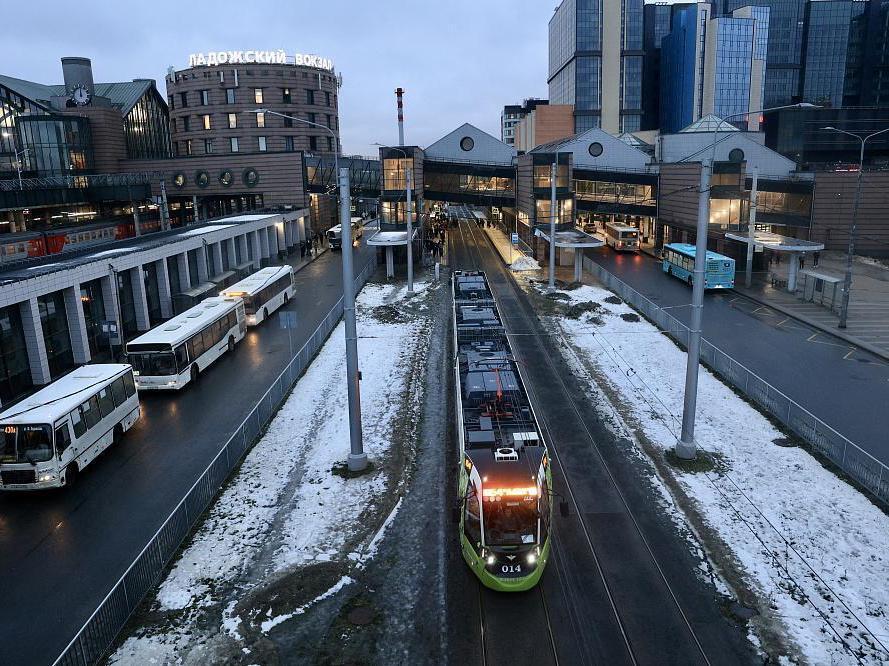

A new version of the state transport system development program has been presented in St. Petersburg, which includes various measures to reduce travel time — from building high-speed highways and interchanges to expanding the metro network and implementing intelligent traffic lights.
The transport committee has clearly stated the priority: first and foremost, speeding up public transport, while car drivers are at the bottom of the list.
According to the program, the metro handles 49% of all passenger transport, buses (462 routes) — 30%, trolleybuses (48 routes) and trams (44 routes) — 21%.
Despite many routes having intervals of less than 10 minutes during peak hours, delays due to traffic jams remain a problem. The program«s authors note: »It remains typical for many routes of St. Petersburg«s ground urban passenger transport to have low regularity during peak hours, caused by trip delays in traffic congestion when moving in the general flow.»
According to 2025 data, the average operational speed of buses was 14.8 km/h, trams — 13.8 km/h, trolleybuses — 13.4 km/h.
The three main mechanisms for acceleration, according to the program, are dedicated lanes, coordinated traffic light control, and priority passage for public transport at intersections.
Currently, the city has about 150 km of segregated tram tracks, as well as dedicated lanes for buses and trolleybuses on major arteries such as Bolshoy Prospekt of Petrogradskaya Side, Bolshaya Pushkarskaya Street, Nevsky Prospekt, Leninsky Prospekt, Medikov Prospekt, Kantemirovskaya Street, Marshal Blyukher Prospekt, as well as reversible lanes on Zagorodny Prospekt and Gorokhovaya Street. Additionally, Ligovsky Prospekt has a dedicated lane for trams and buses.
An example of successful dedicated lane implementation is Komendantsky Prospekt, where in 2025, 8.8 km of lanes for route transport were organized. The transport committee reported that during peak hours, travel time was almost halved, and the average speed of public transport increased by 50%, affecting 16 routes (13 bus and 3 trolleybus).
Vice Governor Kirill Polyakov confirmed the effectiveness during a direct line: «I promised that we would create a dedicated lane, and we did. We launched express routes that go non-stop to »Komendantsky Prospekt«. The passenger flow at this stop is like that of an average metro station. Thanks to the dedicated lane, we have significantly sped up public transport movement.»
In 2026, it is planned to create dedicated lanes on Kolomyazhsky Prospekt (4 km), as well as segregate tram tracks on Nalichnaya Street, Dobrolyubova Prospekt, Obukhovskoy Oborony Prospekt, Volodarsky Bridge, and Sredny Prospekt of Vasilyevsky Island.
The committee explained that segregating tracks will increase the average operational speed of trams by 10-15%: «The expected effect is an increase in average operational speed by 10-15% while maintaining reliability, improving reliability while maintaining speed, or a combination of these indicators.»
For coordinated traffic light control, several conditions must be met, including having at least two lanes, the same regulation cycle, transit flow of at least 70%, connection to the Automated Traffic Control System (ATCS), and a distance between intersections of no more than 800 meters. Officials explain: «With a greater distance, the arrival of cars at the subsequent intersection is random, which breaks the connection with the neighboring intersection — coordinated control becomes ineffective.»
In St. Petersburg, interaction systems are being implemented that allow traffic lights to receive signals from buses and trams to ensure priority passage. Currently, 84.2% of the city«s 1900 traffic lights are connected to the ATCS, and by 2031, it is planned to add another 300 objects. Coordinated control is already in effect on major arteries such as Nevsky, Moskovsky, Liteyny, Suvorovsky, Kamenoostrovsky Prospekts, Stachek Prospekt, Vyborgskoye Shosse, Kantemirovskaya Street, Lesnoy Prospekt, and Obukhovskoy Oborony Prospekt.
For monitoring compliance with rules on dedicated lanes, photo and video recording complexes have been installed. According to 2025 data, 132,211 fines were issued for driving or stopping on a dedicated lane, 385,929 for running a red light, and 180,127 for crossing the stop line.
In case of a priority conflict, advantage is usually given to rail transport. Road maps have been approved to accelerate nine tram routes (No. 6, 18, 27, 36, 47, 52, 55, 60, 100), and after all measures are implemented, their speed may increase by an average of 7%.