Hunters report mass roe deer deaths as Siberian migration turns tragic

On 1 December, the official Telegram channel of the Novosibirsk Region Ministry of Natural Resources published a message about the rescue of 300 roe deer on a lake in the Karasuk District. According to the agency, the animals were evacuated by state inspectors from the ministry and Emergencies Ministry rescuers, and most of the population was saved. But local residents are in no hurry to celebrate: they say hundreds of roe deer were trapped, not all animals pulled ashore will survive, and most importantly, the disaster is not confined to a single lake. NGS listened to hunters who have been rescuing roe deer with their own efforts for several days, a hunting farm director, and examined the official position of the Ministry of Natural Resources.
‘Pulled ashore does not mean saved’
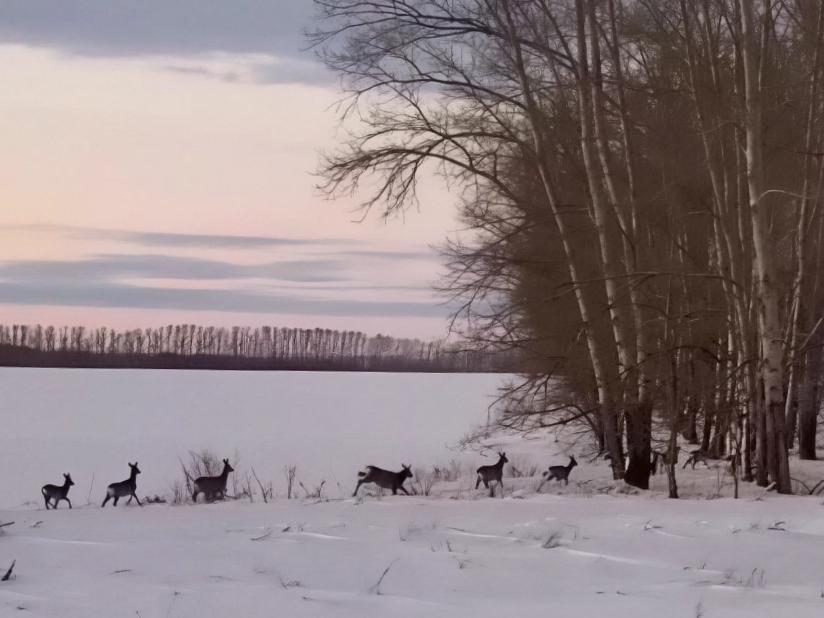
Residents of the Karasuk municipal district started noticing the roe deer about three weeks ago. The animals were moving from the Karakan Pine Forest towards Kazakhstan. At first, locals say, there were dozens, then—hundreds.
‘Wherever you go, you look at a field—and there are hundreds of them standing, not even a patch of white ground is visible,’ said Yulia (name changed), a resident of Karasuk District. ‘We have a bunch of lakes and swamps in Karasuk District, and some roe deer went along the shore, while others went out onto the ice—and didn’t come back. They [slip], lie down on the ice, tear their tendons, slide on their bellies and eventually die. I personally saw such a scene at Khorosheye Lake, at Krasnoye Lake, and at Topolnoye (though that’s already in Altai Krai).’
Neither the woman nor experienced hunters from Karasuk District doubt that a thaw killed many of the animals: temperatures rose above freezing, rain fell, and the ice on the lakes became smooth as glass. Roe deer have difficulty moving even on crust ice—a thin icy layer frozen over the snow cover—and the skating rinks the lakes turned into became a deadly trap for them.
‘We already pulled one [male roe deer] out today. He was splayed out on the ice, his legs gave way, but [on shore] he got back on his feet. I broke off some reeds for him and left him to lie down,’ said another local resident, Vladimir Protsenko. ‘And now we drove in from the Bagan side of [Osolodochnoye Lake], there are goats [on the ice]. We jumped across the channel on the ice, and we’ll go pull them out now. There are many, dozens. There’s no point in pulling out dead ones, it’s just a waste of time, but there are live ones too.’
Yulia and other hunters began sending videos of helpless ungulates splayed out on the ice to Novosibirsk public pages. They wrote about hundreds of fallen animals, called the situation nothing less than a disaster, and genuinely wondered why the death of the roe deer could not have been prevented. Since Thursday, 27 November, hunters have begun rescuing the animals on their own.
‘We didn’t gather on purpose, nothing was organized,’ stated Viktor (name changed), a pensioner and resident of Karasuk District, categorically. ‘I went fishing and saw roe deer lying [on the ice]. I called a friend, he came. I didn’t count how many such roe deer there were, but we have a lot of lakes, and on each there are up to a hundred dead animals.’
The regional Ministry of Natural Resources categorically disagreed with the assessments of Karasuk residents.
‘The information spreading online about the death of several hundred individuals does not correspond to reality. Unfortunately, there were losses, but through joint efforts we managed to save most of the population,’ the words of Semyon Doppler, head of the Wildlife Protection Department, were quoted in the agency’s official Telegram channel.
Ministry of Natural Resources specialists, Emergencies Ministry rescuers, and ordinary hunters united on the last weekend of November to evacuate more than three hundred roe deer from the ice of a frozen lake, the ministry assured.
But firstly, Khorosheye Lake, from where animals were evacuated using a hovercraft, is not the only one that became a trap for the ungulates, hunters noted. And secondly, calling these roe deer saved is premature.
‘That roe deer were pulled ashore does not mean they were saved. They are in different conditions: some get on their feet right away, others cannot. If a roe deer is lying like Christ on the cross, crucified, I think it won’t get up again. I’ve had such ones die already. I pulled it ashore, and the next day I look: and it’s lying there dead,’ lamented Vladimir Protsenko.
Following the roe deer, right on their trail, Yulia added, comes another problem—wolves.
‘No one has heard of wolves here for the last 30 years, but now a pack has already been seen near Krasnozyorka,’ the woman said.
According to Yulia, roe deer are threatened not only by ice and wolves. At Krasnoye Lake, she said, more than two dozen animals were torn apart by dogs living at a nearby shooting club. Some hunters decided that the roe deer splayed out helplessly on the ice were convenient game. Both Yulia and other NGS interviewees are sure the mass migration could have been predicted in advance and its transition into mass animal death prevented.
‘Why didn’t [specialists] from the Ministry of Natural Resources, game managers track this in advance, why wasn’t proper migration escort organized? Poachers jumped out—of course, the meat came by itself,’ the woman wondered. ‘Some inspection came, was horrified by the number of dead roe deer, underreported their numbers in reports, and left. Why is there no such disaster in neighboring districts? Because there, escort was organized.’
Another complaint ‘against the authorities,’ as hunters put it, is the lack of sensible organization during the animal rescue. Allegedly, everyone worked on their own, and the hunting farm and representatives of the Ministry of Natural Resources conducted only one operation—at Khorosheye. Not for show, of course, but clearly insufficient.
‘Roe deer are not a bus full of children’
The hunting grounds containing Khorosheye Lake and other water bodies dangerous for roe deer are managed by the Yuzhnoozernoye hunting farm (JSC).
According to the Rusprofile service, the Yuzhnoozernoye farm was registered in 1999 in the Karasuk District of Novosibirsk Region. Its sole type of activity is hunting, trapping, and shooting wild animals, including providing services in these areas. For the last 6 years, it has been managed by Vasily Prokopchuk; the ultimate beneficiaries are unknown due to the legal entity’s organizational and legal form. As of the end of 2024, Yuzhnoozernoye earned 1.8 million rubles (approx. $20,000 at current rates), its net profit was 5 thousand rubles (approx. $56).
Vasily Prokopchuk categorically disagreed with the hunters’ complaints. In his opinion, nature is to blame for the mass death of roe deer specifically in Karasuk District: firstly, the notorious thaw, and secondly, the district’s topography, abundant with large lakes.
‘How can you organize migration escort over a distance of 400 kilometers from Novosibirsk to Karasuk and further to Bagan, Kupino, and Tatarka? I am a game manager and biologist, I graduated from the institute in 1985, and I don’t know how this can be done,’ he responded to the complaints of Karasuk residents. ‘This is not a bus full of children. Roe deer don’t move in one little herd—they move like scattered peas, across the entire area of the district. You can’t drive roe deer away, you can’t escort them, it’s a wild animal: it will run away from you and go where it needs to. It’s impossible to stop them from going onto the ice.’
According to Vasily Prokopchuk, many animals died on roads under heavy trucks, some ran into barbed wire on the border with Kazakhstan. But indeed, the most roe deer died on Khorosheye Lake.
This didn’t happen by chance: this water body is the largest, 30 kilometers in perimeter or about 10 kilometers straight across on the ice. Ungulates find it easier to cross small lakes, and if they end up there on the ice, unorganized hunter-volunteers find it easier to evacuate them from there. But on Khorosheye, not only roe deer but also people risked their lives.
‘The ice is thin now, you can’t go out on the lake, people did it at their own risk. To pull out 300 [roe deer], you need to work very hard. A roe deer kicks, thrashes its legs—you have to tie its legs, put it in a plastic trough. And you can’t load it heavily, you might fall through. You can fit three–four, maximum five [roe deer]. And that’s how they were taken out from the middle of the lake on snowmobiles,’ said the head of Yuzhnoozernoye.
Vasily Prokopchuk admitted that in the current situation, he couldn’t even order the start of a rescue operation: he only has a couple of his own subordinates, and he couldn’t send them to risk their lives under orders. It was volunteers who saved the roe deer.
‘About 30 people worked for us on Friday, Saturday, and Sunday—whoever we could call up, we called up. We will, of course, reward them, with a free permit or something,’ he assured. ‘But from one edge we couldn’t even take them out on a snowmobile because the “dog” mustn’t fall through, and it already started to go under the ice. We don’t have a helicopter, a hovercraft—only the Emergencies Ministry guys have that.’
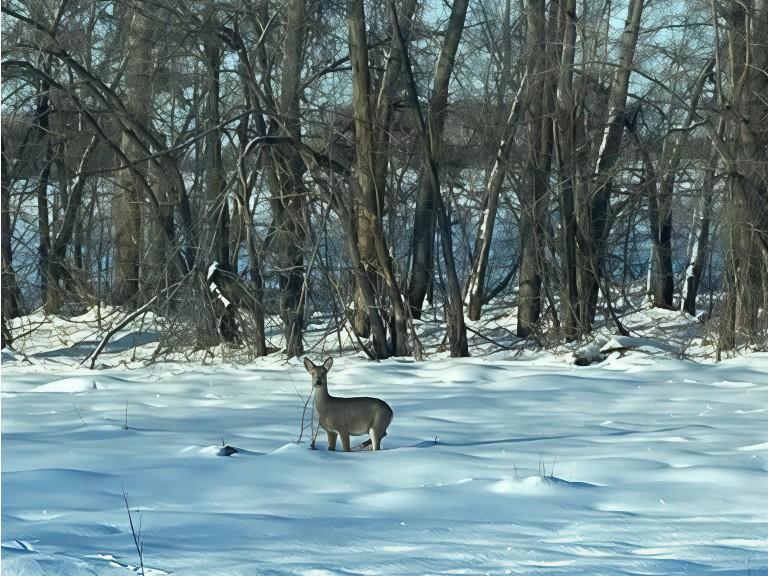
What worries Vasily Prokopchuk much more are the slightly salty lakes, where water freezes at significantly lower temperatures. Roe deer stuck on them are essentially doomed, because there is no ice on their surface yet that can support machinery.
The answers to the question of what happens next are as varied among hunters and game managers as their opinions on the situation and their estimates of the number of dead animals.
Residents of Karasuk expect that new waves of roe deer migration will fall into the same trap as the previous ones. In the game manager’s opinion, there is no need to fear another such terrible warming, and right before his eyes, new herds of roe deer calmly crossed the frozen and snow-covered Khorosheye Lake after the frost hit.
According to the Yandex.Weather service, on the night of Tuesday, 2 December, the temperature in Karasuk rose to +1 degree Celsius (34°F). All day the thermometer will remain at the zero mark (32°F).
NGS sent an inquiry to the Novosibirsk Region Ministry of Natural Resources to clarify a number of questions about the rescue operation on Khorosheye Lake, as well as to find out whether the scale of the roe deer migration could have been predicted in advance and the flow of animals somehow directed. Furthermore, NGS asked whether specialists had enhanced measures to combat poachers.
Nature and weather are far from the only things threatening roe deer in Novosibirsk Region. Last year, four state inspectors from the Kizha Nature Reserve heard a verdict for organizing illegal safaris for moose and roe deer.