Owner: 70% of Fire Reports Were False
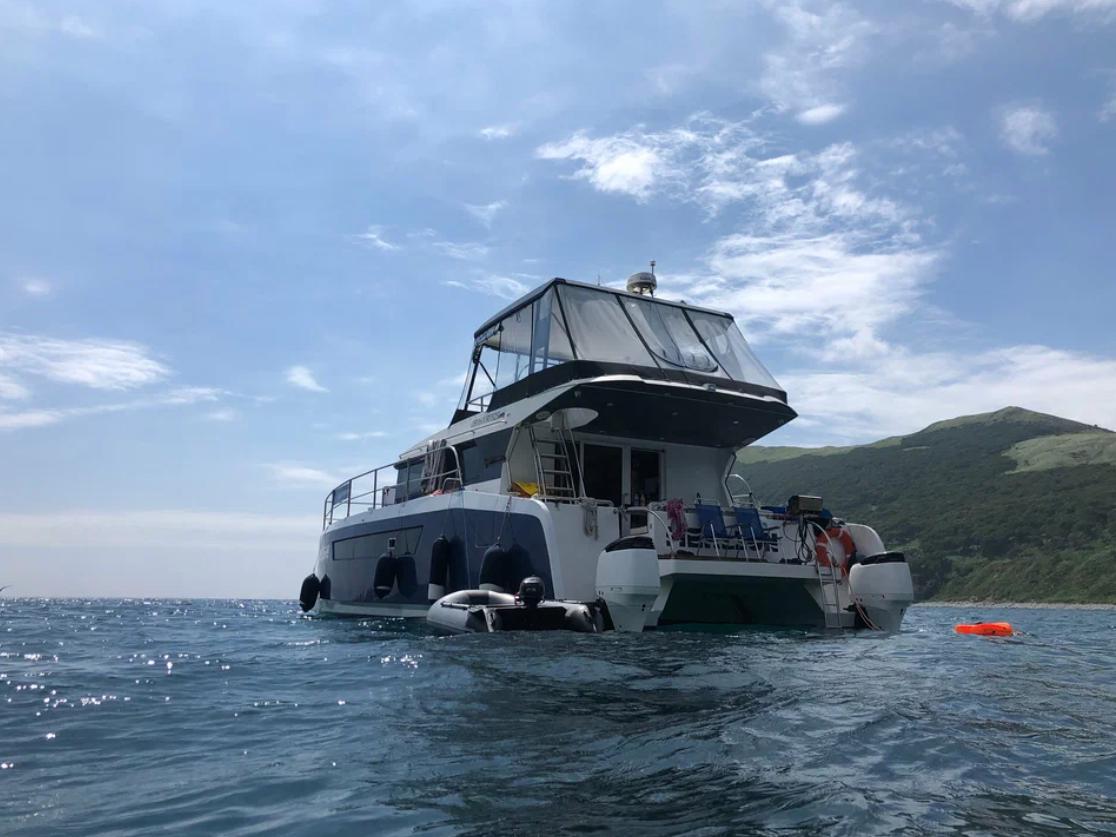

The incident with the catamaran «Merlion», which caught fire near Shkota Island on 29 June, caused a major outcry. There were 12 people on board when the fire started, who were successfully rescued. According to the investigation, the cause of the fire is arson. One of the sailors was transferring gasoline from one canister to another near a lit gas stove. This person is now under investigation.
Passengers from the burning catamaran were rescued by witnesses passing by in their own boats and those sent specifically from the shore after the captain reported the emergency. Border guards also headed to the scene, but the «Merlion» could not be saved. The fire destroyed the vessel in a short time.
The «Merlion» is owned by Korsar LLC, and director Konstantin Chernykh contacted VLADIVOSTOK1.RU, pointing out distorted details in published materials. In a conversation with him, it became clear that due to a flow of information from various sources, the media had formed a biased picture that could undermine the company«s reputation.
In this article, we recount from Konstantin Chernykh«s words what happened on the vessel, how passengers were rescued, and what the company did after the incident.
The catamaran «Merlion» was built in 2019. According to open data, it could reach speeds of up to 20 km/h. On board, there were four cabins, two toilets, and two showers, a mess hall with a dining area and kitchen, and a motorboat for going ashore.
The catamaran is owned by Korsar LLC. According to Kontur.Focus, it was registered on 24 December 2012. The general director since December 2016 is Konstantin Vasilyevich Chernykh.
Captain Turned Catamaran Around and Jumped into Water
Almost immediately, passenger Yekaterina Izraelskaya shared her version of events on social media. She claimed that the crew did not conduct any safety briefing and did not issue life jackets, allegedly because they were not visible. Chernykh explained that during every departure, the crew instructs on behavior, issues life jackets, and explains the location of fire extinguishers.
«People often neglect safety measures, and sometimes adults don»t even put life jackets on children. In such cases, we simply refuse to take them on board. But how do you instruct an adult if they remove the life jacket at sea? They take them off for pretty photos and videos,« said the director of Korsar.
On another Korsar vessel, our correspondent was shown how life jackets are stored and the location of all rescue equipment. The burned vessel was almost identical in design. Reviews on 2GIS show photos with and without life jackets, even on children.
According to Izraelskaya, during the emergency, the vessel«s crew was panicking and running around, and the captain was one of the first to jump into the water. The investigation results, which the VLADIVOSTOK1.RU correspondent reviewed, state that the man did jump overboard, but only after turning the catamaran against the wind to direct the smoke away from the passengers. However, this became a trap for him, and the only option was to jump into the water, escaping through the flames.
«If a vessel starts sinking, there is much more time to organize a rescue operation. The crew can act in a coordinated and precise manner, lower the boat, and evacuate people. But fire is different. It spreads instantly. The captain, seeing smoke billowing from the mess hall, turned the vessel against the wind so the smoke wouldn»t blow toward the tourists, saving them from gas poisoning. At that moment, our friends on boats arrived and helped evacuate the passengers. The flames spread with the wind, and the captain, finding himself in the heart of the fire, had no choice but to jump into the water because he was starting to burn. Thank God, no one was injured in this incident; everyone was safely brought to shore,« Chernykh noted.
Izraelskaya herself mentioned in her account that the boat was turned around, which allowed people not to suffocate. According to the woman, tourists left belongings in the burning cabin that no one could retrieve. Chernykh explained that immediately after the incident, the company contacted each person separately and resolved the material issue. He said the passengers made no claims, and the police confirmed this—no such statements were filed.
The VLADIVOSTOK1.RU correspondent attempted to contact Izraelskaya again, but she declined to comment.
«Is This Really All About Us?»
During the conversation with the journalist, Konstantin Chernykh noted several other points that outraged him. For example, information from the Russian Classification Society (RCS) on the technical condition of the catamaran «Merlion», which in the document is listed as «unfit». It turned out that this information does not relate to the burned «Merlion». The company provided all licenses and permits during a personal meeting, and these documents contain no information about rebuilding the vessel or changes to its design.
«A criminal case was opened based on the emergency, and inspections began. The media poured fuel on the fire by not waiting for reliable information, not understanding the matter, and writing whatever came to mind, just for sensation. 70% of what was written turned out to be lies. They dragged in everything... And they found an old document that was long invalid and, citing it, claimed the boat was unfit, and wrote that the company had no license, although it always has been and is, and that the catamaran previously belonged to some former fugitive oligarch Dremlyuga. Is this really all about us? We have always cared about safety and service quality from head to toe,» Chernykh stated.
In one publication, it was said that the vessel could not be used for transporting people because «a license could not be issued for a vessel with gasoline engines». This was stated by the chief designer of the Composite Shipbuilding shipyard, Sergey Voloshenko, in a comment to Vl.ru. But Chernykh assured that everything was obtained officially. This is confirmed by documents we also reviewed: the «Merlion» underwent an intermediate survey two years ago, and the next was scheduled for 2026. The company has a license for passenger transportation by sea, its number is 004081.
«Inspections with prejudice began by all relevant authorities. Yes, of course, minor violations were found, such as »Vladivostok« written on life rings instead of »Khabarovsk«—the port of registry. Also, that we did not notify port control of entry and exit from the port area, but we are not in a port area, so notification was not necessary. All who have traveled with us on various tours for many years have stayed with us because they know firsthand how good it is with us and how we work,» the director of Korsar noted.
In our materials, it was said that license violations were identified during the investigation. But the license violation concerns another vessel owned by Chernykh, which is not related to tourist transportation and is not used for commercial purposes.
In the material, according to Voloshenko, it was also said that work for Korsar LLC on illegal refitting was performed by former shipyard employees who fulfilled all fantasies but did not care about people«s safety. Chernykh refuted all this.
Took What Was There and Finished Building Themselves
At the time of publication, it was not possible to contact Sergey Voloshenko.
According to Konstantin Chernykh, he ordered the first catamaran, named «Korsar», in 2018 from the company Composite Shipbuilding (it was called that at the time, after which it changed several names. — Ed.). The head of the company came to the office and began negotiations on construction for his goals and tasks—sea excursions for residents and guests of Vladivostok.
«I was offered several projects to choose from. I chose one of them, the price was about 10 million rubles (approximately $100,000 at current rates), and this company Composite Shipbuilding, represented by Sergey Nikolayevich Voloshenko, the owner and, as he calls himself, chief designer, promised to build it in 3 months. That is, in May, June, July, August. In August, the vessel was supposed to join our company»s fleet,« Chernykh said.
«Since I am a practitioner and was more interested in technical aspects, I immediately rejected a whole range of things that are absolutely useless on a vessel. The price, naturally, dropped, but then I started adding things that are extremely necessary—for example, a bow ramp, thanks to which you can beach the vessel, lower it, and calmly step onto land. But the construction dragged on; every time I came to the shipyard, only one person was working there, one employee. How can you build a huge boat alone? To my complaints, Voloshenko had some excuses like »we«ll finish that project now and I»ll put people on it«, »and we«ll finish this project now and then I»ll definitely put people on it«, but time passed, and already in 2019 I announced that I would file a lawsuit. None of my arguments or requests to continue construction were successful,» the head of Korsar explained.
Chernykh could not simply get back the money already invested or the part of the boat built at that time, so he had to settle with Composite Shipbuilding, withdraw the lawsuit, and take what the company had built by then.
In Chernykh«s opinion, Voloshenko»s company intentionally set low prices on vessels to attract clients. After long waits, customers had to take what was there and finish construction themselves with third-party companies. But to get all licenses, they had to pay certain amounts to the Composite Shipbuilding shipyard again.
«People after this started finishing it themselves, but then they had to get documents, and no one except Voloshenko could make documents for this project. Here he again offered his clients to pay a sum—to make the documents. I fell into exactly this trap with my catamaran »Korsar«. But, fortunately, I went a different way. We made a completely different project under the register and managed to get a license for it. That»s what we did. Over two years, we finished building the catamaran, did everything necessary on it so that it would be safe and comfortable. Construction under this project was fully led and controlled by the RCS,« Konstantin explained.
RCS—Russian Classification Society (formerly Russian River Register). It deals with classification, survey, and issuance of documents for vessels and other floating objects to confirm their compliance with safety requirements and technical suitability. This means that the RCS inspects vessels, assesses their condition, and monitors technical supervision during construction.
In 2020, Chernykh met another client of Voloshenko. The new acquaintance was building the catamaran «Merlion» and could not wait for the work to be completed due to frequent delays from the company. In the end, the previous owner finished it on his own and leased it to Chernykh, and later Korsar LLC bought the vessel.
«The catamaran underwent new registration, all inspections, was equipped with all rescue means for the necessary number of passengers, namely an inflatable life raft (PSN) with capacity for 20 people. We also purchased certified life jackets. Therefore, Voloshenko»s statements about the impossibility of obtaining a license are unsubstantiated—we have all the documents in hand, we work according to the law and comply with all requirements. We have a large base of satisfied clients who return to us after trips,« Chernykh concluded.
PSN—inflatable life raft is intended for collective rescue of people in case of a vessel accident. This is an important emergency rescue means that provides buoyancy and protection from adverse weather conditions, and is manufactured according to international safety standards.
After Inspections
The conclusion of the Interregional Territorial Department of the Federal Service for Transport Supervision in the Far Eastern Federal District states that the company needs to «develop and implement measures to prevent similar emergency cases in the future». According to Konstantin Chernykh, these measures have always been observed and worked out, down to instructions and training.
«Every year, at the start of the season, I pay out of my own pocket to gather the entire crew, which is not small, we order training, whether new or old, we go through first aid: choking, jellyfish sting, fever, drowning, heatstroke, heart attack, and so on. We cover all of it. How to apply splints, how to perform artificial respiration, how to resuscitate a person—everything. But in 17 years of work, I never thought someone would be smart enough to start a fire like this,» the head of Korsar shared.
«We have more than one boat, and to gather even two for technical inspection, it cost us almost half a million rubles (approximately $5,000 at current rates). They need to be completely overhauled, prepared for the season. It»s required to overhaul them because there are dry rations, flares, mechanisms, check the pump, everything must be in working order. All this is checked by specialists,« the owner of the »Merlion« said.
What About the Sunken Catamaran?
The company tried to find the vessel, for which they hired specialists who, accompanied by an investigator, combed the presumed area but found nothing. About half a million rubles (approximately $5,000 at current rates) were spent on this, and if the remains are eventually discovered, lifting and transportation will cost a similar amount.
Inspectors from the Far Eastern Department of Rosprirodnadzor have already conducted an inspection on the harm caused to the water area. According to the agency, Korsar LLC will be required to pay 1.6 million rubles (approximately $16,000 at current rates), but a final decision has not yet been made.