Krasnoyarsk Woman Fights Aggressive Breast Cancer, Wears Tiara on Bald Head
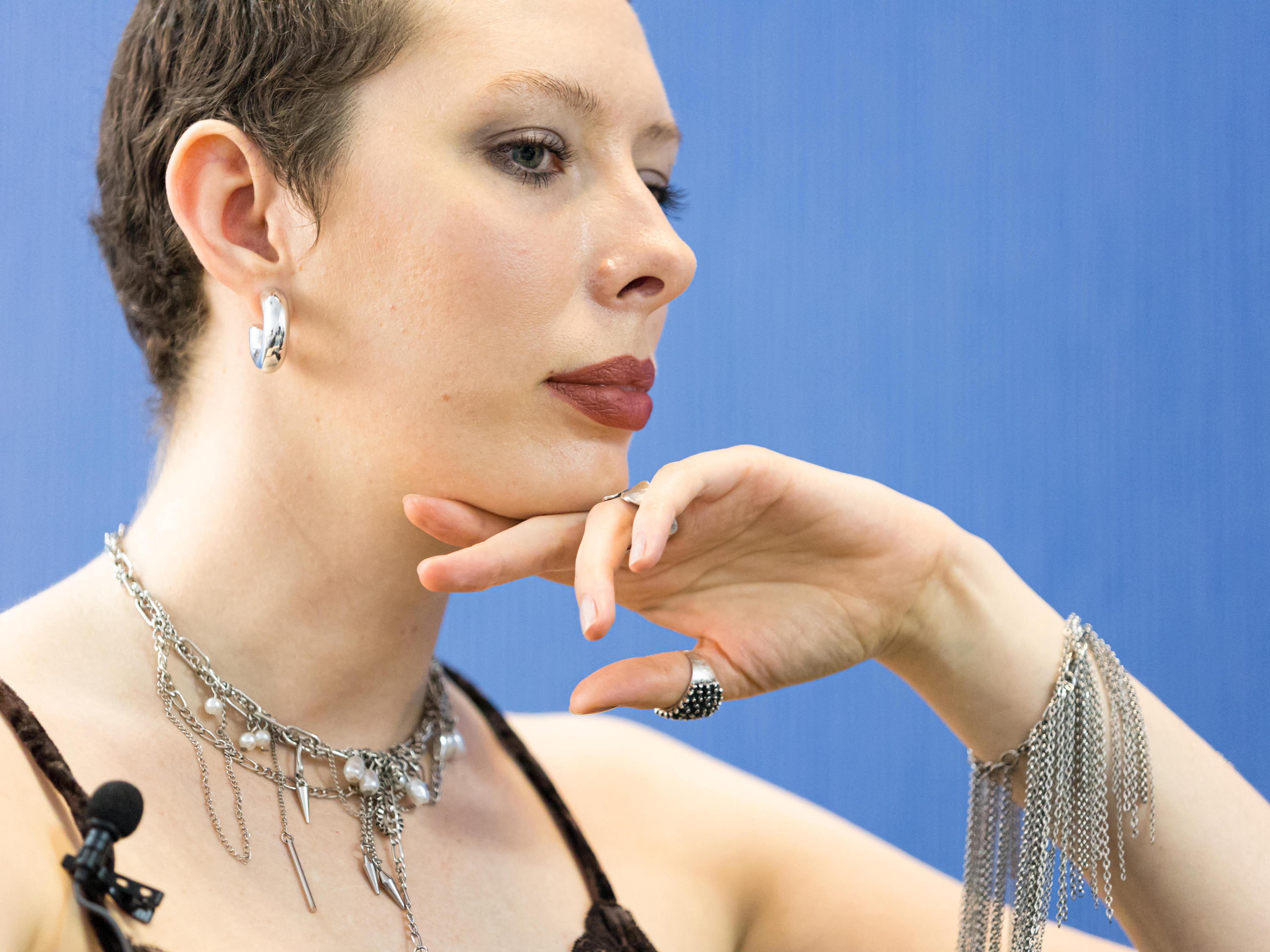

Yekaterina Deynega from Krasnoyarsk discusses her aggressive breast cancer battle and treatment experience.
Breast cancer is one of the most common in Krasnoyarsk Krai. According to the A.I. Kryzhanovsky Oncology Dispensary, 1,897 cases were registered in 2024. The percentage of patients whose cancer was detected at stages one and two was 78.2%.
32-year-old Yekaterina Deynega was diagnosed in early 2025 — the cancer turned out to be aggressive. The woman has already undergone surgery, chemo- and radiation therapy and reached a stage of stabilization. She continues treatment and is learning to live with her new self. Yekaterina agreed to share her experience of battling this disease with the NGS24.RU editorial team. Why it«s important to get checked even if everything seems fine — in the material by NGS24.RU journalist Polina Borodkina.
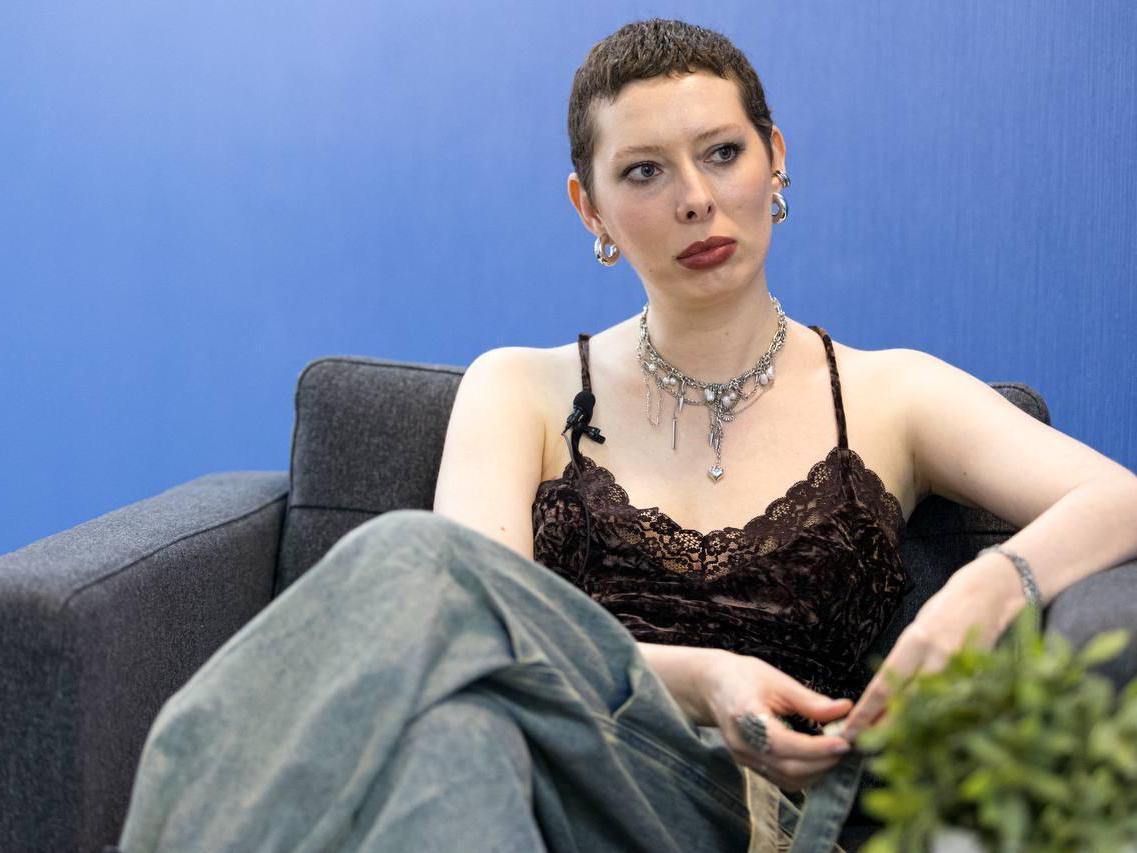
Yekaterina Deynega visits the NGS24.RU editorial office for an interview about her cancer journey.
«After 17 days they told me: you have cancer»
Yekaterina«s first thoughts about cancer came in February 2025. In the evening, the woman was taking a shower and felt something dense in her breast.
«It was like some flat pebble,» she recalls.
Yekaterina did not hesitate and the next morning was already standing before an oncologist. Ultrasound, biopsy, and, unfortunately, an inconclusive result.
«That same morning I called a private clinic. I asked when the nearest available time with an oncologist was. They said I could come in an hour. He palpated and said that it was most likely just breast tissue, but still sent me for an ultrasound. On the ultrasound, they looked and said that there was something, but it wasn«t cancer. But then, fortunately, they took a biopsy. That is, it wasn»t a core needle biopsy, but a small amount of tumor tissue. And after three days, the result came that there were atypical suspicious cells. And then the doctor told me that it was better to go with this to a state hospital. Because it would be very expensive to do it with them.»
To get a referral for a biopsy at the regional oncology dispensary, Yekaterina had to gather a whole stack of papers.
«CT, MRI, ultrasound, MSCT and more. They examine the whole body from head to toe to understand if there are any other suspicious foci or metastases. And here either you have money and you go do it all paid, or you sit and wait your turn. And I had to go through the head of the polyclinic and beg for quotas, because the therapists said: “In a month.” She said: “A young woman with suspicion of oncology, what month?”»
What happened after that threw the woman into shock.
«When they did the biopsy under ultrasound guidance, they saw that there was another tumor in the same breast. Three oncologists palpated me and didn«t feel it, because it»s in such a place. And on the first ultrasound, they didn«t see it either. I waited for the biopsy result for 17 days. All that time I was going crazy. After 17 days they told me: you have cancer,» says Yekaterina. «I knew it would be like that. Because the first biopsy showed the presence of atypical cells, well, what else could it be? But still, until the last moment, I hoped it was a fibroadenoma. I»ll never forget that, because it was my mom«s birthday. On 31 March I call and say that I have stage two cancer.»
Fibroadenoma is a benign breast formation that occurs in about 30% of women, more often in patients of reproductive age under 35.
Yekaterina did not hide the diagnosis from her friends either.
«I think this is the kind of story where you don«t have to leave the house to hide it. Because you start wearing a wig, you occasionally look sickly. I understand that everyone experiences this differently. Someone doesn»t want to talk about it and has the right to. And at the same time, I understand that people often don«t want to talk about it to avoid causing pity. But I didn»t see pity towards me. There was empathy. They asked how I was feeling, but fortunately, I didn«t encounter pity, on the contrary, if someone found out, they were just surprised.»
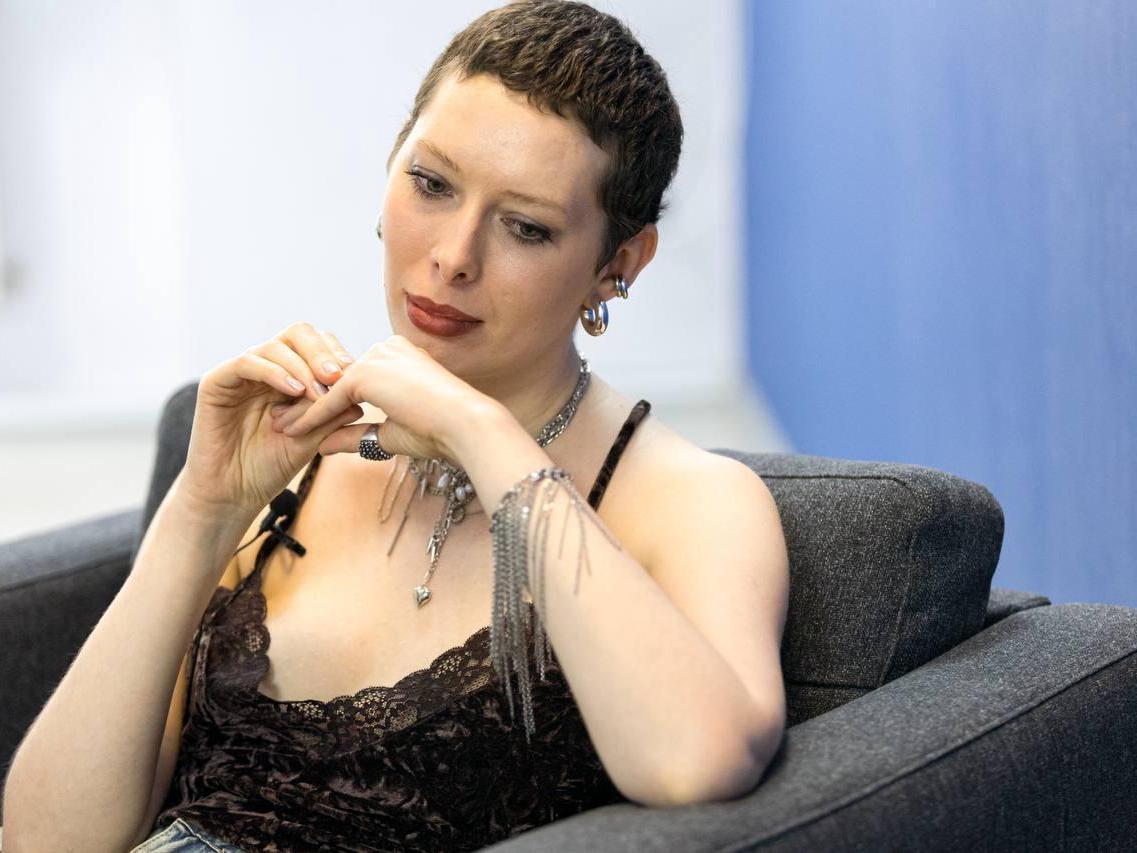
Yekaterina felt a lump in her breast and suspected it might be serious, leading to further checks.
More tests. And then Yekaterina is standing before the commission that makes the final verdict.
«They look to understand what kind of surgery it will be, whether medication is needed before it to shrink the tumor, or if it can be operated on right away. And they said that a sectoral resection could be done, that is, only the tumors themselves with a small amount of adjacent tissue would be cut out, and the breast itself would be preserved.»
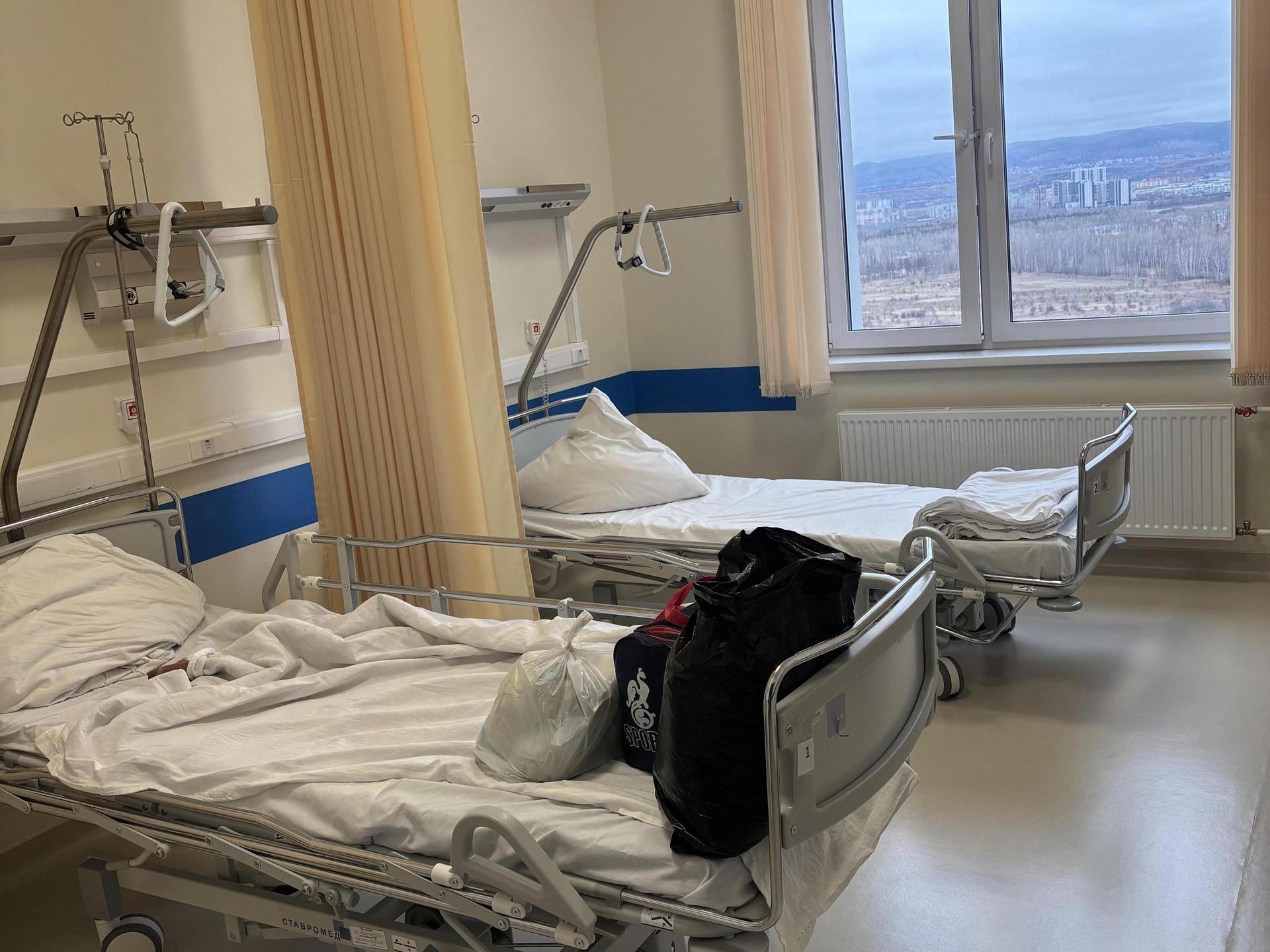
Checking into the hospital before surgery for breast cancer treatment and preparation.
Evening. Ward. The day before the surgery. And alone with her thoughts. Yekaterina burst into tears.
«It was spring. The windows faced Tatyshev Island. Everything was gray, dirty. That particular evening was so heavy. That feeling of uncertainty. It was in the moment. And I cried,» the woman admits. «During the entire treatment period, that was the scariest day, because two days ago they told me I had cancer, and now the most active part is starting. I was scared because it was my first surgery in life. I was very afraid of anesthesia. Besides cancer, I have nothing else. I am absolutely healthy in all other respects.»
40 minutes on the operating table and another two hours under observation in the ICU — doctors monitored Yekaterina«s condition because, as mentioned above, it was her first anesthesia in her life. And it was unclear how she might react to it. But, fortunately, everything turned out fine.
«They did the surgery surprisingly well. Despite a large amount of tissue removed, the breast remained almost the same. It shrank a bit, mostly in the upper part,» the woman says. «For a couple of days, I didn«t feel very well after the anesthesia, I was a bit wobbly, walked along the wall, but then it was fine. My arm on the surgery side hurt for a long time, but by the time I was discharged, everything was already worked out and moving normally.»
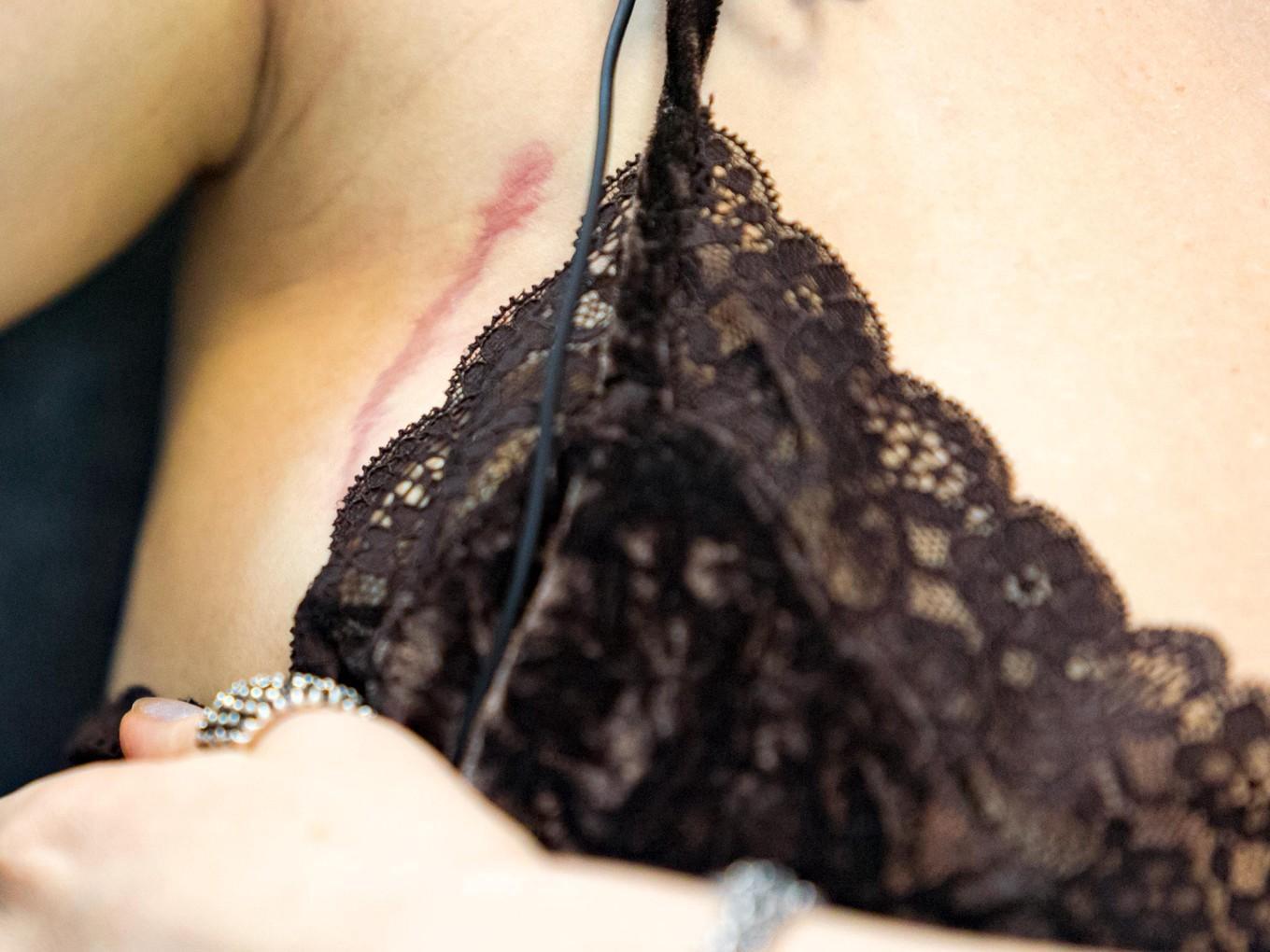
The scar left after Yekaterina«s surgery to remove tumors from her breast.
On the 12th day, the woman was discharged. However, it didn«t end with just one surgery.
«It was without drama and tears»
Next — chemotherapy. Four courses with a 21-day break. And side effects.
«The next day I woke up at five in the morning from severe nausea. And I had to go and get tests after chemo. I rode in a taxi with a bag. Artyom (Yekaterina«s husband — Ed.) warned the driver. The driver was very calm about it, but everything turned out okay. They gave me an antiemetic injection, and I also stocked up on these injections. Artyom constantly gave them to me. I remember that I got a rash. That»s also a common side effect of the drug. And there was a temperature, but not high, it lasted for several days.»
Hair loss — another side effect of chemo. Yekaterina didn«t wait for it, took a clipper and said goodbye to her curly bob.
«The moment of losing my hair was quite easy for me. I did the first chemo. They hadn«t started falling out yet. But I still shaved them off by that time so as not to pull them out in clumps, so they wouldn»t be all over the apartment. It was without drama and tears. Shaved, and that«s it. I started wearing wigs almost right away, because at that time I didn»t want it [the lack of hair] to raise questions. Honestly, we still live in a city where it draws attention.»
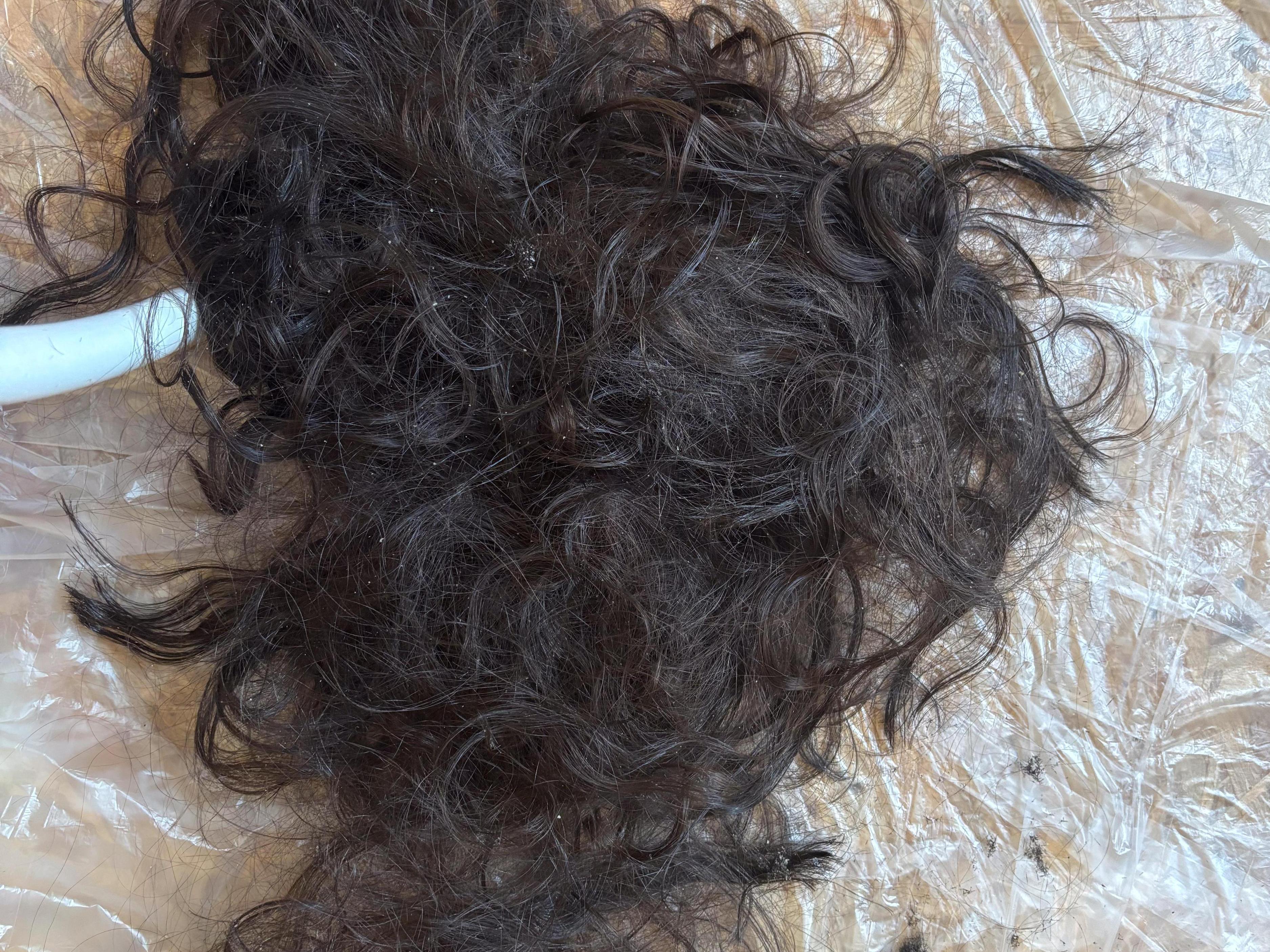
Yekaterina had to shave off her curly bob hair due to chemotherapy side effects.
That same day, Artyom also shaved his hair. With this gesture, he wanted to support his wife.
«Initially, we didn«t have that in our plans. He was asked: “And when Katya loses her hair, will you shave to support her?” We treated it like: “How will that support me? What does Artyom»s hair have to do with it?” But when I was shaving, he said it was important for him. He felt that he wanted to support that way.»
But that«s not all. Artyom also didn»t miss a single one of Yekaterina«s chemos, although it was hard for him.
«Mentally, it was very hard for him to go with me to oncology, but at the same time, when needed, he was there. I went once every three weeks — on Mondays, and on those days he didn«t schedule shoots (Artyom works as a photographer — Ed.). For example, I had a drug that can kill nerve endings in the limbs. It»s considered unproven, but still many oncologists advise holding some cooling elements in your hands. I took coolants and held them in my hands and on my toes. Artyom checked them and changed them if necessary.»
And also — he started a renovation to make the apartment even cozier for his Katya«s return after surgery. For example, he installed an air conditioner to make it easier to endure treatment in the summer heat.
«And in this photo, I«m in a tiara that Artyom gave me so that even in this state I would feel like a beauty queen. And I wore it on my bald head,» Katya showed us.
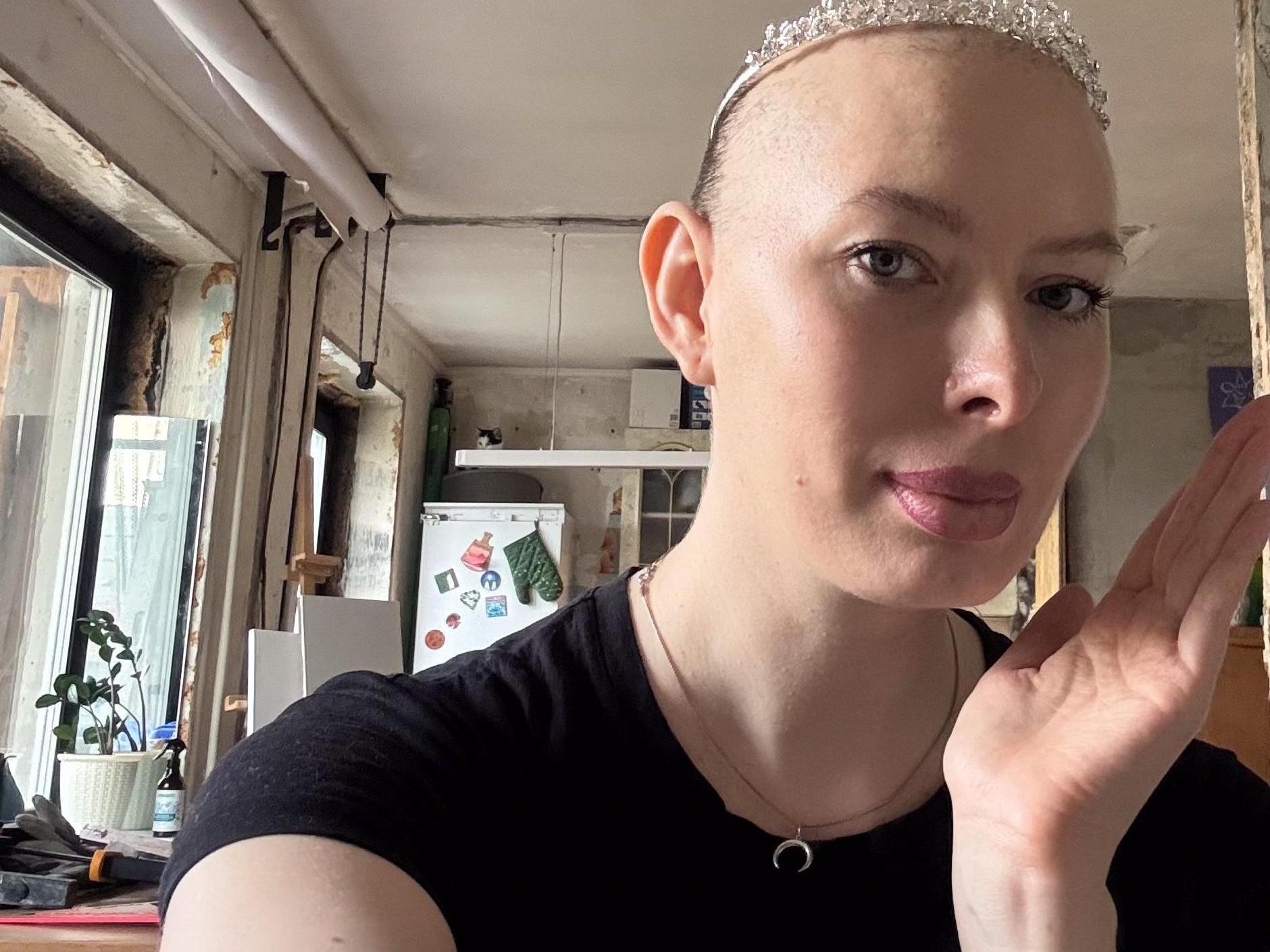
Artyom gifted Yekaterina a tiara to help her feel beautiful despite hair loss.
Chemotherapy… A word that many consider a death sentence. Even those whom cancer has bypassed. Yekaterina disagrees with this.
«I would like to dispel the myth that chemotherapy will necessarily be very hard and that people die from it. Actually, it«s something the body can withstand,» Yekaterina explains her position. «Here, probably, it should also be clarified: you can»t say that this chemo is very heavy, and that one is very light. It all depends on how the person tolerates it, what initial diseases they have, because chemo always hits the weak spots. If there are chronic ones, then it will be harder.»
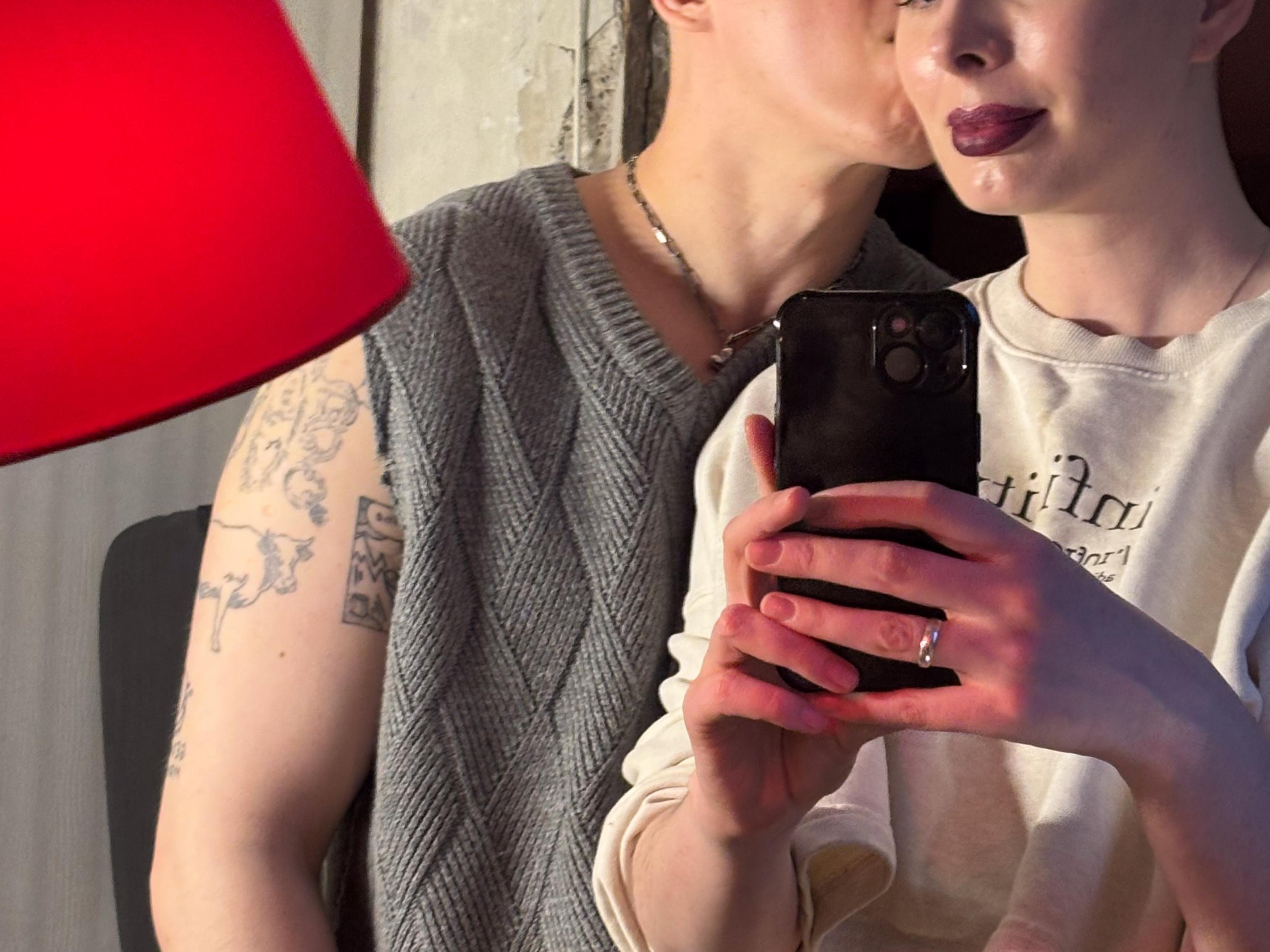
Artyom accompanied Yekaterina to every chemotherapy session to provide support.
But Yekaterina still thinks that this period passed easily for her.
«Perhaps it will sound strange, but I didn«t need to find strength. They were there, and I understood that I needed to undergo treatment. And I did everything that was necessary for that. Honestly, mentally it wasn»t very hard, I lived through this period of active treatment quite easily. It passed both quickly and intensely, and in this process, I had a lot of things happening in life in parallel, and it was all very interesting. So I won«t say that I needed to find strength, to claw my way out of something, to find meanings. No, I just continued to live and parallelly undergo treatment.» the woman said. «I even had the strength to move. During chemotherapy, you shouldn»t lie down — you need to move. It helps to tolerate it easier, so I moved a lot and it was even easier from that.»
Where there«s chemo, there»s also radiation and hormonal therapy.
«The radiotherapist made markings on me, which I wore until the end of therapy. That«s 19 sessions, five times a week, with breaks on weekends. It»s not painful, but a burn appears, similar to the one after sunburn,» Yekaterina explains. «Simultaneously with radiation, hormonal therapy began. It was prescribed for five years, but most likely, it will be extended to 10, because there is a trend now to extend it to reduce the risk of recurrence. And also because the cancer is aggressive and hormone-dependent.»
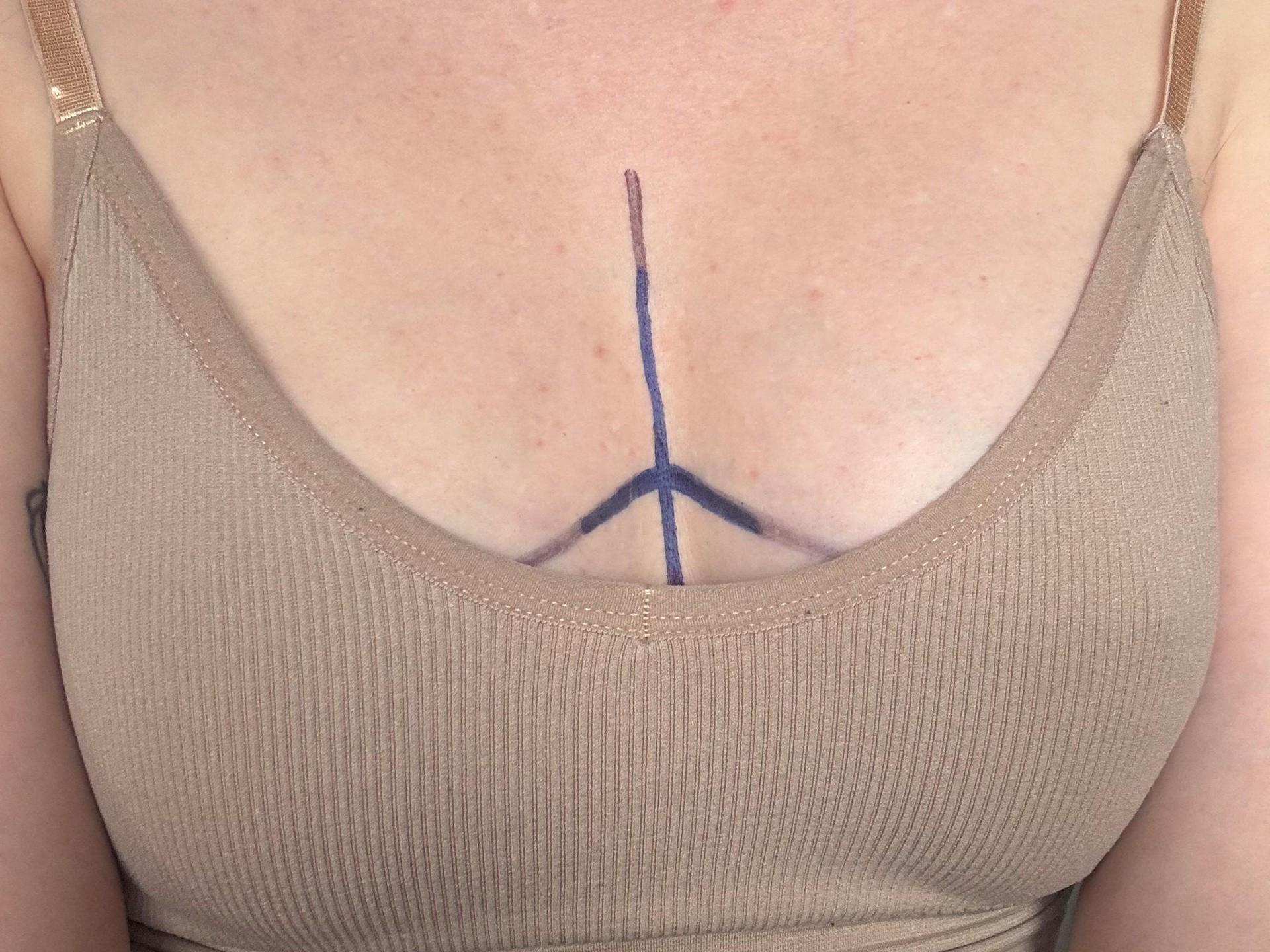
Markings on Yekaterina«s skin for precise targeting during radiation therapy sessions.
Now Yekaterina has been put in stabilization — not remission.
«Now I am under observation. To achieve remission with aggressive cancers, you need to wait some time for it not to progress. Because within the first year, it can return.»
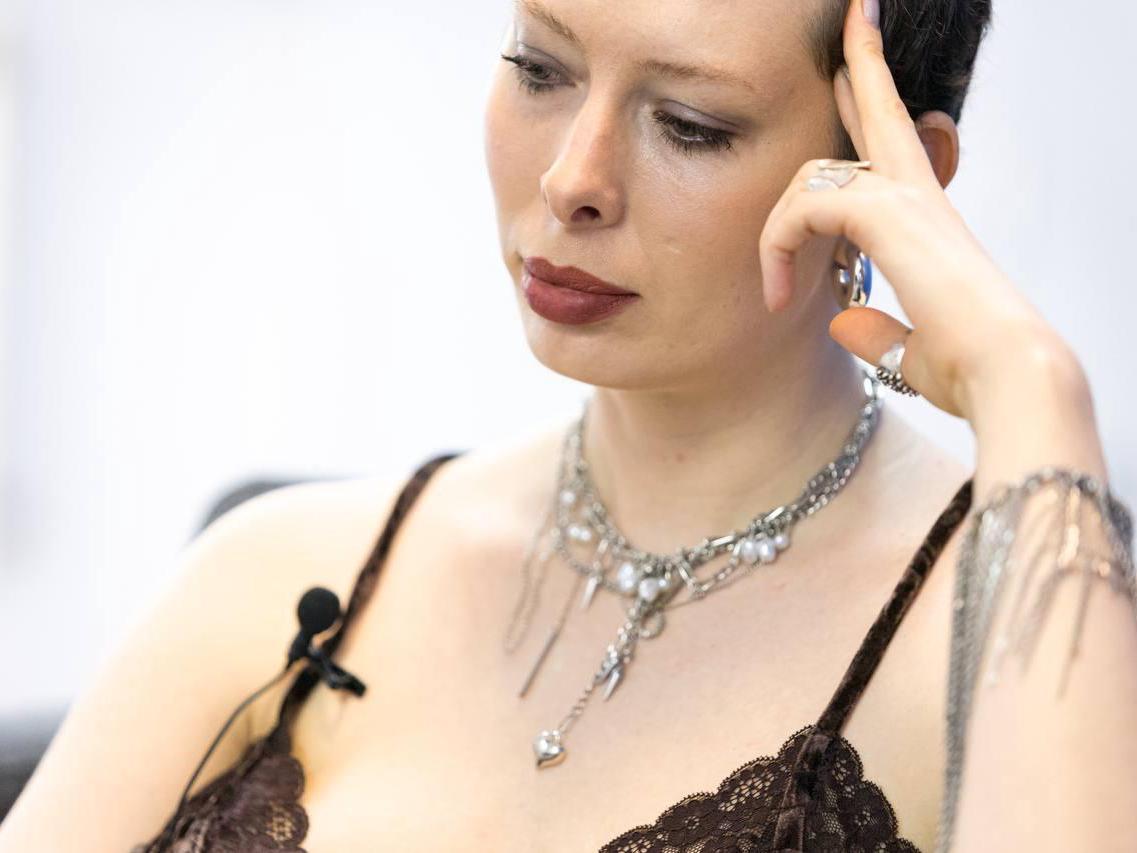
Yekaterina explains that achieving remission with aggressive cancer requires waiting for stability.
«It was a shock mentally»
Now, when active treatment has ended, Yekaterina is making many plans. She dreams of finishing the apartment renovation, escaping on some trip, and finding a job — two months after everything happened, the woman quit her previous job. And also — she is learning to live with her new self. After chemo, Yekaterina was put into artificial menopause.
«I wasn«t as afraid of surgeries, chemotherapy, and radiation combined as I was of artificial menopause. Because I»m 32 years old. You«re at the peak of your fertility, and then suddenly, you have no sex hormones at all. And it was a shock to the body and a shock mentally, that suddenly, everything is completely different. And how to live with it is not very clear.»
Cried quite a lot about this, but acceptance comes. Because I understand that I have no choice, that if I refuse hormonal therapy, the cancer will return. All that«s left for me is to learn to live with it, learn to understand my body in new conditions, find an approach to it. I understand that I now need much more effort, time, money to spend on keeping my body healthy, so as not to fall apart at 32, not to age, not to gain weight, and so on.
Artificial menopause manifests with symptoms similar to natural menopause, but due to the abrupt cessation of ovarian function, the body cannot gradually adapt to the hormone deficiency. This condition occurs in women of reproductive age due to medical intervention that blocks ovarian function and stops the production of natural female hormones (estrogens). Among these symptoms — hot flashes. That«s when first it»s suddenly hot, and then — suddenly cold.
And here, the support of Yekaterina«s mother played a big role.
«She helped me a lot with accepting menopause, as she herself faced it due to age. In general, she was by my side the whole time. And now, thanks to mom for treating me like a healthy person, for not pitying me, for us spending time together as we did before. Now she is with me, as in ordinary life, in which cancer, of course, still exists, but not in the same volume, not to the same extent as it was a couple of months ago.»
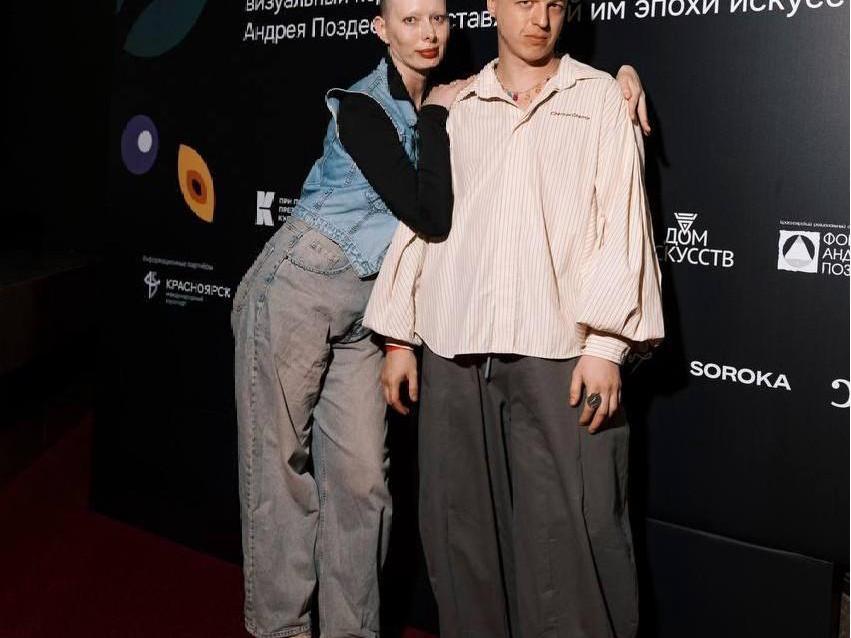
Yekaterina«s first public appearance without a wig after chemotherapy and hair loss.
Naturally, the question of children is not on the table for now. But Yekaterina doesn«t see a problem with that.
«They told me that I should freeze my eggs before treatment, but I didn«t do it because I have aggressive cancer. And I simply didn»t have time to deal with it. Secondly, the cancer is hormone-dependent, freezing eggs is additional hormonal stimulation, I was afraid.»
Since I«m in artificial menopause, now I can»t give birth to a child. Although recent studies show that after at least a year and a half of anti-hormonal therapy, you can pause this therapy to give birth, and then continue again. If I want, I have that opportunity. Now, the perspective is to achieve remission, attain a stable normal state of health, and then decide these issues. Although we discussed with Artyom that if we want children, we are generally considering adoption.»
Also had to give up physical exertion.
«I did boxing before all this. Not for long, but I really liked it. But it«s not the kind of boxing with sparring. We worked with bags, there was also a lot of intense load, strength, cardio. These were workouts from which I crawled out. Now I can»t do that anymore. First, there was bargaining that it would be possible. I went, asked the doctors: “Maybe it will be possible?” But still no, I can«t, I won»t be able to return to it. I was very upset about this. Because a certain number of lymph nodes are removed, so I don«t have a risk of lymphedema, which happens with a large number of removed lymph nodes, but it still remains. And there, you can»t do these intense impact loads. Now I«ve accepted it and found other types of physical activity that I like. I go to bachata with my husband.»
And Katya loves to experiment with style.
«Before, I had a desire to conform to conventional beauty standards, because I have, let«s say, not the most standard appearance, and I was bullied in school, but that»s not the point. Don«t want to talk about it, the topic is closed, no trauma, just this behavior pattern remained, that I want people to like me, so they don»t reject me, so I strived to emphasize femininity. I started moving away from this a couple of years ago.»
In the chemotherapy department, you can take a cap to cover your bald head. They are sewn by volunteers and given out for free. It«s a big deal. But I didn»t take that cap because on me it sat in such a way that it was immediately clear what I was sick with. We with Artyom nicknamed them — “cancer caps.” But many women look great in them. I decided to play up the bald head differently — wore wigs, and in the heat, wore turbans and put together boho-style looks with them.
Even more worries came when the hair started growing back.
«My active treatment ended. And while I was going to oncology, everyone there is the same, and you don«t pay attention to it, you feel comfortable and calm. But when you return to ordinary life, here everyone is beautiful, striking, with hair, and at that moment I felt discomfort. But I made a point to stop wearing the wig, even when there was this strange short crew cut. Because I understood that I needed a lot of time to grow them to the length that I would like, in which I would be comfortable. And I don»t want to not accept myself for this whole period, that I need to learn to live with short hair now.»
Now I«m not making plans, because hormonal therapy can badly affect hair quality. I»ll see what grows back. I«ve already looked at short haircuts that require growing at least some length, then try to look at them. I»ll see, maybe there will be some short haircut that I like so much, and I«ll want to stay with it. Or maybe I»ll watch how they grow and adapt in the process.»
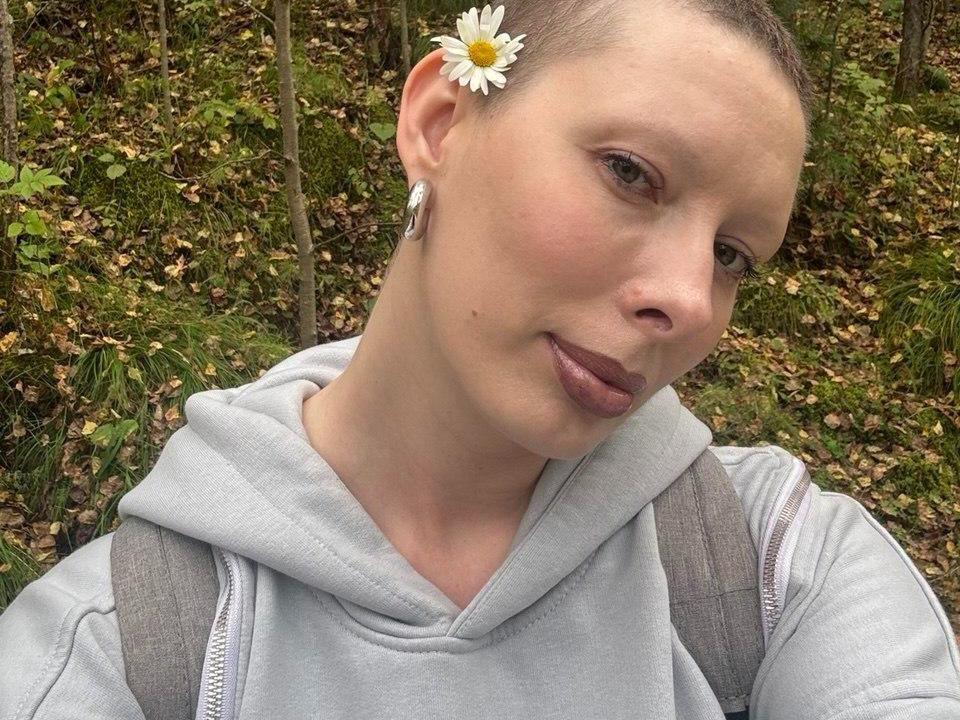
Yekaterina«s short, growing hair after chemotherapy, which she describes as a strange crew cut.
And finally…
Yekaterina advises not to neglect medical examinations, even if everything is fine. She strongly urges girls and women to undergo breast ultrasound.
«If we talk about breast cancer, this is a story where young women need to take everything into their own hands. Yes, there is mammography, which at best is done from age 35, but it«s not effective for young women due to high breast density. Here, only ultrasound is suitable, which you need to do yourself. Because young women are not considered at risk. I talked about this with girls who say: “Send me for a mammography.” And they tell them: “Why do you need it, you»re young.” And they don«t say: “Do an ultrasound.” Because my mammography also didn»t show any pathologies. And when you notice that something is wrong, it«s often too late.»
October is breast cancer awareness month. I hope that this will really be useful to someone and stimulate them to go and get an ultrasound. I would say, don«t focus specifically on breast cancer, but do check-ups of the whole body, because the breast is an organ that is on the outside, here you can still feel something. If it»s somewhere else, there, unfortunately, you can catch it too late.»
At the same time, the woman admits that before cancer, at least two years before encountering it, she didn«t do this diagnostic method.
«Of course, I would like to know what triggered it, but oncologists don«t have an answer to this question. To clutter my head, maybe even find some reason to start blaming myself, what»s the point?»