Blogger's Ectopic Pregnancy Went Undetected for Weeks


Sofia shared how she took pregnancy tests and analyzed results with her husband, along with the surgery«s aftermath.
Perm blogger Sofia Volegova dreams of a large and close-knit family — this autumn she and her husband conceived their second child. But the baby was never born. The beginning of the pregnancy turned into a series of stressful situations in which the girl tried to prove to doctors that there really was an embryo, but something was wrong with the pregnancy. In the end, both the fetus and the fallopian tube where it was stuck were removed from Sofia. We tell the story of a dream, intuition, and medical care.
Sofia is 23 years old; until she was 16, she lived in Dobryanka, and in 2019 she even won the title of «Miss Dobryanka». After 9th grade, the girl moved to the regional capital and enrolled in the Perm Aviation Technical College. Even then, she understood that she wouldn«t work in her profession or for someone else, but she needed to get a diploma and reassure her mother. Alongside her studies, the girl was involved in kettlebell lifting, dedicating three years to it.
Over time, after her studies, Sofia became interested in photography, but stopped doing it before her first childbirth, a year ago. With her husband Ilya — they met in the college dormitory — they dream of a large family. The girl»s own relatives serve as an example for her — she has two biological brothers and even more cousins.
Currently, most posts on her blog are dedicated to the theme of family: Sofia talks about motherhood, home renovation, and shows stylish outfits that she puts together herself. On Instagram* Sofia has 60,000 followers, on Telegram 2,900, and on TikTok almost 10,000.
Also on social media, the Perm resident openly shares what she had to face during her second pregnancy. She and her husband planned it, conceiving the child according to her cycle. A few days after the expected conception day, Sofia«s temperature spiked to 39°C (102°F), and nausea and diarrhea began. It turned out she had contracted rotavirus. At the same time, the result of the first test for human chorionic gonadotropin (hCG), which is used to determine pregnancy, was negative. Sofia didn»t believe it.
“Our first pregnancy happened very quickly, on the first try. And the second one also coincided with ovulation. In both the first and this pregnancy, I was constantly sneezing,” the girl reflects in a conversation with a 59.RU journalist. “I also read that when the embryo is just attaching, hCG can be 3, as it was for me. So I waited a few more days and took an electronic test.”
The electronic test showed one to two weeks of pregnancy, but immediately after the result, Sofia started her period. Then she realized that something was wrong with the fetus — the girl worried that she had an ectopic pregnancy or a miscarriage. The family called an ambulance, and doctors took her to City Clinical Hospital No. 4, where they performed an ultrasound, a test, and a pelvic exam. They told her she wasn«t pregnant and sent her home. But Sofia remained convinced that she was pregnant.
“If hCG is rising, the pregnancy is somewhere”
“A week later, the period continued, but the lines on the pregnancy tests were getting brighter (their brightness increases with hCG levels, — ed.). I called an ambulance again because I understood it was ectopic. The doctor remembered me and, without even examining me, said: ‘To the hospital’,” the girl shared with 59.RU.
For a week, the girl was given daily pregnancy tests, blood was drawn for hCG, and antibiotics were administered. Sofia had several ultrasounds — still no fetus was visible. Then the girl was surprised that daily the hCG test showed a result of 20, even though the test strip was getting brighter. According to Sofia, the doctor assured her that if the indicator was stable, it would soon disappear completely. The blogger left the hospital with a certificate stating “spontaneous miscarriage.”
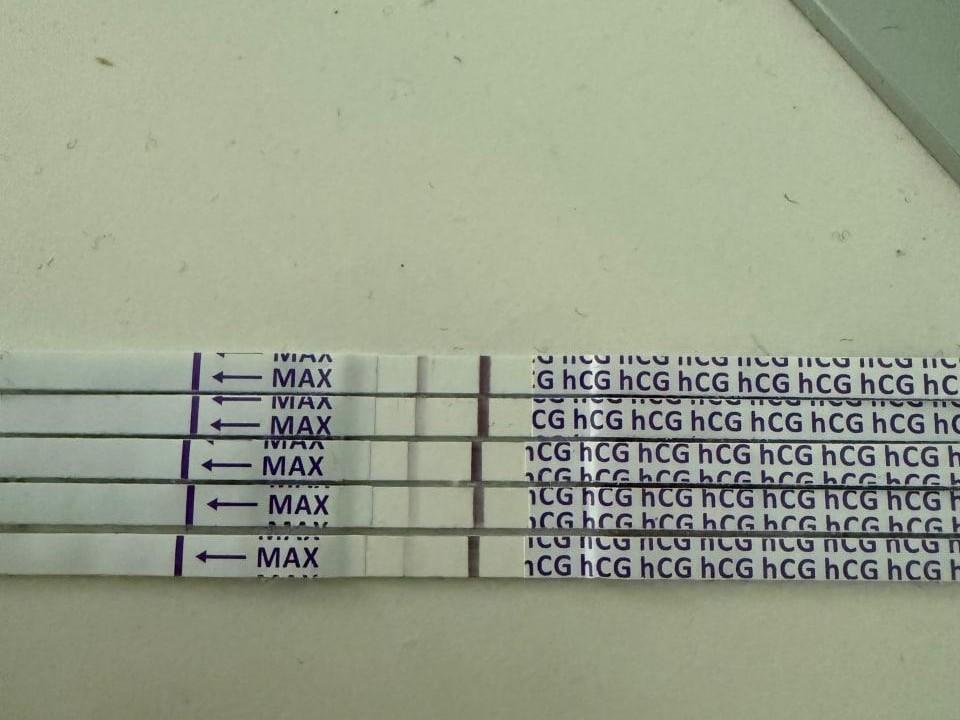
Sofia kept the pregnancy tests to track changes in the test strip«s intensity over time.
Despite the doctors« conclusion, Sofia didn»t calm down, and a few days after discharge, she had her blood tested at a private laboratory. The hCG level was 1300. The girl was sure — she had an ectopic pregnancy.
“It couldn«t have increased so sharply and quickly by 50 times because hCG doubles every 48 hours! Even if on the day of discharge it was really 20, by Wednesday it should have been only 40,” the blogger explains. “Since I had my period, meaning the endometrium was shed, there can»t be a pregnancy in the uterus. But if the tests show hCG is still rising, it means it«s somewhere. But where?”
That day, Sofia concluded that her future child was in the fallopian tube. In such cases, there«s a risk that the tube could rupture. She went to a private clinic, where she was examined with two ultrasound machines, but no gestational sac was found anywhere, including in the fallopian tube. However, the doctors noted that something was pulsating there, but what exactly wasn»t visible. The specialists at the private clinic themselves called an ambulance for her. With the emergency medical services medics, Sofia managed to arrange hospitalization at City Clinical Hospital No. 4 — she wanted to see the same doctor who had treated her before. The doctor sent her for tests and, after reviewing them, decided that Sofia needed a diagnostic laparoscopy.
Diagnostic laparoscopy is a surgical procedure that allows a doctor to examine the organs inside the abdominal cavity or pelvis using a laparoscope.
“They woke me from anesthesia after two hours and didn«t say anything. But I knew how long a laparoscopy takes and understood that in two hours, it probably wasn»t just diagnostics. They found something and were apparently removing it all that time,” the girl recalls. “The doctor came and said the ectopic pregnancy was on the right side. They removed my tube and a cyst on my right ovary. To be honest — I had been preparing myself for this for a long time. But you can«t ignore the human factor; it»s hard to face this alone. My husband supported me, but the words seemed to go into emptiness. It«s very heartbreaking to be left with one fallopian tube at 23 and a desire to have a large family.”
Sofia says that after the surgery, during rounds, the doctor confirmed that the laboratory had made a mistake in analyzing her blood. That«s why the hCG showed a level of 20 all week. Additional confirmation came from the fact that her roommate faced the same problem — the test came back with a reading of 20. Another patient was advised by the doctors themselves to go to a private laboratory. The girl did so — and according to Sofia, the result was different.
“The head of the department recalculated my hCG herself, and it came out with higher values. The doctor said that probably the student lab technicians miscalculated,” the blogger explained to 59.RU.
In a conversation with the doctor, Sofia found out what caused the ectopic pregnancy. At the very beginning of the story, we mentioned that she caught rotavirus almost simultaneously with implantation — meaning the girl fell ill at a time when the embryo hadn»t yet attached to the uterine wall.
“As a rule, infection provokes narrowing of the tubes. That is, my egg couldn«t pass through the tube and got stuck there,” the girl says. “That»s why it«s important not to catch anything during this time. I later discussed this with my gynecologist — she said it»s quite possible.”
Despite all the difficulties, Sofia and Ilya aren«t giving up and believe that even with one fallopian tube, they can create a large family.
What the Ministry of Health thinks about differing hCG results
The blogger didn»t pursue the matter with the medics, the hospital administration, or the Ministry of Health — she decided it was more important to preserve her nerves. Nevertheless, we contacted the ministry«s press service with a question about why, according to the hospital, the laboratory makes such mistakes. Ministry specialists believe that blood test results for hCG can vary between different laboratories. This is due to the specifics of the analysis methods used, differences in reference values (for example, in units of measurement), and individual patient health indicators.
Also, the Ministry of Health stated that the laboratory at City Clinical Hospital No. 4 employs staff accredited in the specialty of »clinical laboratory diagnostics,« and they monitor the quality of research daily. In addition to internal control, in 2025 the »Center for External Quality Control of Clinical Laboratory Research« checked how hormone assessments (including hCG) are evaluated and reported reliability. “In 2025, student internships are not conducted in the laboratory,” they added in response to 59.RU»s inquiry to the Ministry of Health.
*Instagram — a social network owned by Meta Corporation, which is recognized as extremist and banned in Russia.