Russians Complain of Soaring Food Prices After New Year
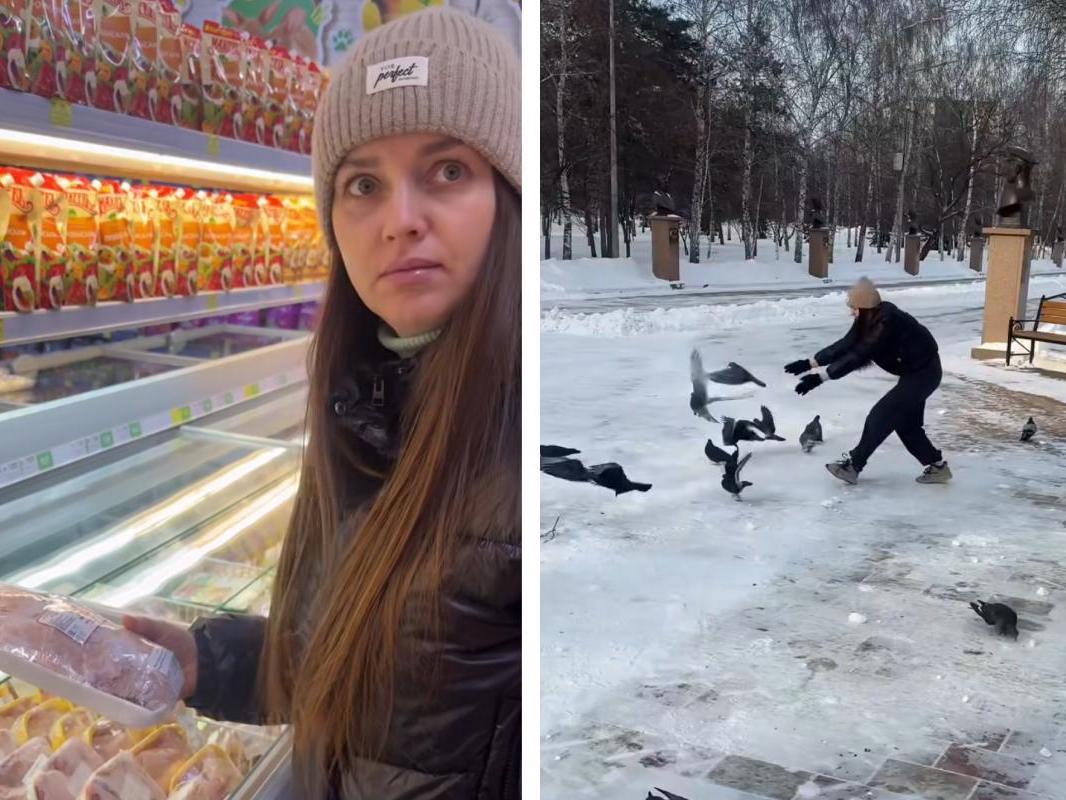

After the New Year, Russians are posting videos on social media where they express horror at store prices. Some jokingly catch pigeons, while others seriously weep. MSK1.RU found out how much products have actually become more expensive in January and whether we will have to economize even more.
Vodka is getting more expensive the fastest
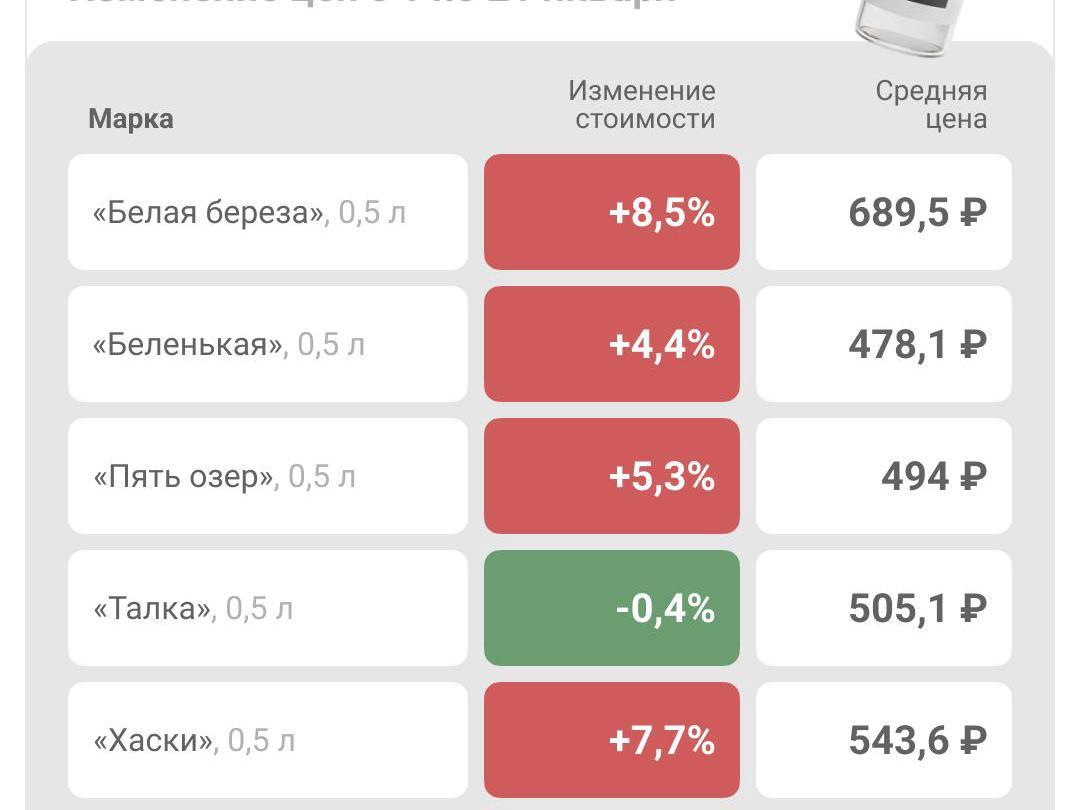
In the «Tsinozavr» price monitoring service, they told MSK1.RU that vodka has increased in price the most since the start of the year. Now a half-liter bottle costs from 494 to 690 rubles (approximately $5–$8 at current rates).
From January 1 to 21, «Belaya Bereza» became more expensive by 8.5%, the average price of a 0.5-liter bottle is 689.5 rubles (about $8). «Belenkaya» increased in price by 4.4%, to 478.1 rubles (about $5); «Pyat Ozer» — by 5.3%, to 494 rubles (about $5); «Husky» — by 7.7%, to 543.6 rubles (about $6); and «Horta» — by 4%, to 519 rubles (about $6). «Talka» unexpectedly became cheaper by 0.4%, to 505.1 rubles (about $6).
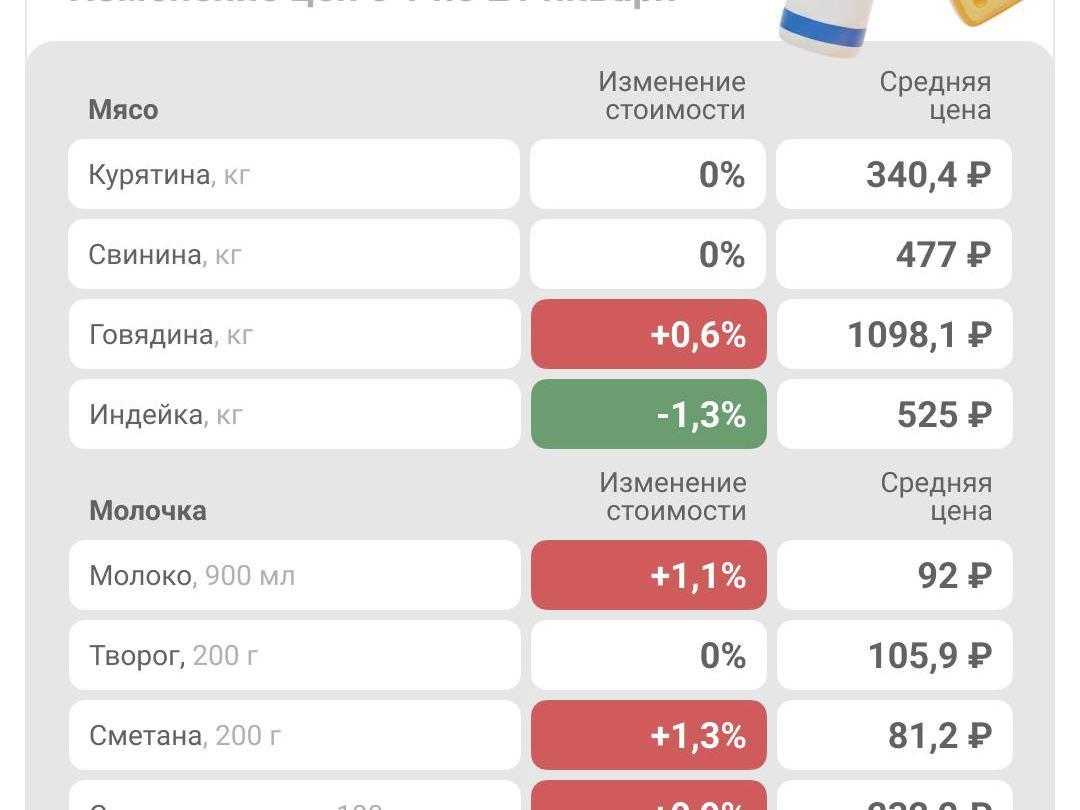
The most popular products in stores, according to analysts, are meat and dairy. Chicken and pork on average cost, as before, 340.4 rubles ($4) and 477 rubles ($5) per kilogram. Beef became more expensive by 0.6% — to 1098 rubles ($12), and turkey became cheaper by 1.3% — to 525 rubles ($6) per kilogram.
Average prices increased very slightly for milk (by 1.1%, to 92 rubles ($1) for 900 ml), sour cream (1.3%, to 81.2 rubles ($1) for 200 g), butter (by 0.9%, to 232.2 rubles ($3) for 180 g), cheese (by 0.7%, to 271.4 rubles ($3) for 200 g).
«There has been no explosive growth anywhere. As strange as it may seem, many goods have not changed in price or have even become slightly cheaper,» commented a representative of «Tsinozavr.»
Vegetables are also getting more expensive
Rosstat (Russian Federal State Statistics Service) notes that over the last week, vegetables and fruits have increased in price the most actively: from January 13 to 19, their cost rose by 2.7%. Cucumbers soared in price by 6%, tomatoes — by 3.3%, and potatoes and carrots — by 2.6%.
Executive director of the Union of Potato and Vegetable Market Participants Alexei Krasilnikov reported that the situation was discussed on January 19 at a meeting with the participation of Deputy Minister of Agriculture Maxim Borovoy.
«The agenda focused more on the situation with tomatoes and greenhouse cucumbers, while with potatoes and [other] vegetables the situation is relatively stable, with no threats,» recounted the interlocutor to MSK1.RU.
According to him, vegetables became more expensive due to additional strain on storage facilities in the cold, but no sharp price increases are expected further.
«We do not expect anything out of the ordinary,» said Krasilnikov.
Is VAT to blame for everything?
According to Rosstat data, which often differs from the real picture in stores, on average vodka indeed became more expensive (from January 13 to 19 by 1.4%), margarine (by 1.3%), lunches in canteens and cafes (by 0.7%). Overall, consumer prices increased in January by 1.7%.
Director of the Center for Economic Policy Research at the Faculty of Economics of Moscow State University (MSU) Oleg Buklemishev, in a conversation with MSK1.RU, advised not to rely on weekly indicators.
«The New Year is a milestone when prices are revised, especially since the value-added tax was also increased. In short periods, specific goods should be measured, and Rosstat calculates based on broad product groups sufficiently. The price may be one in one region, another — in another,» said the expert.
As for VAT, according to analysts, its increase provoked only a one-time jump in prices, and there should be no new ones. However, it is difficult to rejoice at this, as the tax may well be raised again.
«It is the biggest tax. If there is not enough money, what will they grasp for? For VAT, that»s clear. But for now, it has only been increased, and to immediately raise it again — that doesn«t happen, one must wait,» stated Buklemishev.
What else is getting more expensive
Coffee has been getting more expensive for three years, prices for it are hitting anti-records in 2026 as well. We have nothing to cheer up lovers of the invigorating drink: apparently, they can expect a «stepwise» and cautious, but still, price increase.
«The era of cheap coffee is over. We are entering a »plateau« phase with moderate volatility, where the price will be determined by currency, competition, and consumer habits. The main restraining factor now is consumers» unwillingness to pay more,« said Anna Belikova, SEO of the coffee brand Elbeans, to MSK1.RU.
You can save on a trip to the store in three ways: plan your menu around price-stable products, track the seasonality of vegetables, and use cashback programs. If you have bad habits, we have nothing to advise. In the country, excise taxes on alcohol and cigarettes have been increased, and consumers will definitely feel it.