Consumer Optimism: Russians Spent More in December, Not Just for Holidays
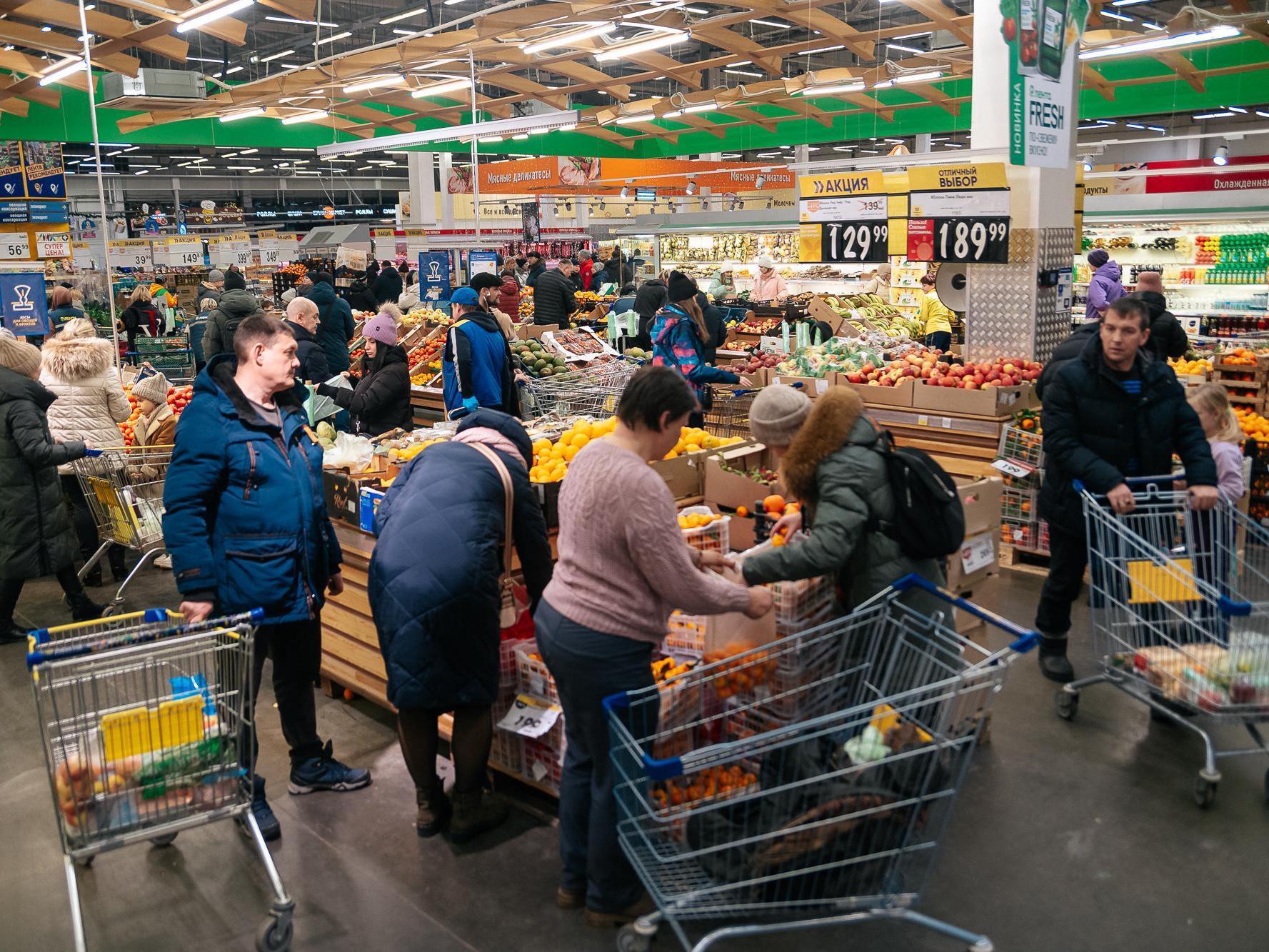

Russians went on a spending spree in December 2025: they spent 8.4 trillion rubles (approximately $84 billion at current rates), 10.8% more than a year ago. One might blame it all on inflation, but even after adjusting for it, growth remains, and it«s significant.
What caused this unprecedented consumer optimism and what consequences it will lead to in the coming months, Fontanka learned from experts.
New Year Bonuses and VAT Increase
According to data from the analytical service SberIndex, Russians« spending on non-food goods (which include, in particular, household appliances and electronics) in December was 9.3% higher than a year earlier. Even accounting for inflation, growth was 6.2%. Spending on food rose by 9% (in real terms, i.e., adjusted for inflation — by 3.2%), on services — by 14.3% (4.9%). The most significant change was shown by the food service industry: on eating out, citizens spent 20.6% more than before (8.4% adjusted for inflation).
At the same time, compared to November, Russians« expenses adjusted for inflation increased by only 0.5%. In November, which saw sales and »Black Fridays,« citizens spent 7.4 trillion rubles (approximately $74 billion at current rates). Spending on services and food service rose by 0.7%, on non-food goods — by 0.8%, on food — by 0.1%.
In October, slightly less was spent — 7.3 trillion rubles (approximately $73 billion at current rates). But in both this and the next month, citizens« expenses in real terms grew — by 2% and 4.3% respectively, while in previous months the increase averaged 1.6%.
«In December, people always spend more money. They stock up on food and gifts before the New Year, receive bonuses, 13th salaries, and some additional income, and naturally, they want to spend it all. In 2025, the trend was even more obvious, because everyone knew that in this, already begun, year, prices for goods and food would rise again due to the VAT increase. Accordingly, people wanted to stock up as much as possible before the holidays to treat themselves to some goods at the old prices,» comments Mikhail Lachugin, an independent consultant for retail network suppliers and founder of the Telegram channel Product Media.
«The increase in expenses at the turn of the year is a usual trend. First, people receive some annual bonuses. Then, accordingly, they need to stock up on gifts. Plus, not everyone planned trips to stores during the holidays. Also, people were afraid that prices would rise due to the tax increase,» says Dmitry Prokofiev, an economist, author of the Telegram channel Money and the Arctic Fox.
Spending on Food Service and Inflation
Nominal expenses on food service in October and November were also significantly higher than a year ago — by 22% and 24.7% respectively. Data from the service SberAnalytics shows that overall in the first 11 months of 2025, country residents spent 12% more money in cafes, restaurants, and bars than a year earlier. However, this is explained not by an increase in visits, but by an increase in the average check — by the same 12%. The number of visitors over the same time grew by only 2%.
In 80% of cases, Russians chose the most budget-friendly establishments. This is fast food, where prices are low (the average check is 415 rubles, approximately $4 at current rates) and stable relative to other categories (over the year they rose by 8%).
16% of transactions were in cafes and restaurants with an average check of 1,151 rubles (approximately $12 at current rates, +24% over the year). The remaining 4% of operations were in bars, where on average people pay 820 rubles per visit (approximately $8 at current rates, this amount grew by 11% over the year). Most often, people aged 35-44 visit food service establishments. Among visitors, there are slightly more women (54%), but men have a 22% higher average check.
Incidentally, 9% of all money that Russians spend on food service comes from St. Petersburg. On average, visitors leave 1,720 rubles (approximately $17 at current rates) in city cafes and restaurants. This is the highest average check in the country — after Moscow, of course.
«We have a sufficiently large layer of people in St. Petersburg, in Moscow, who for various reasons cannot or do not want to travel abroad, but they have money. They want to spend it on something, so they go to restaurants and spend money there, that is, they increase the frequency of visits to food service establishments,» notes Mikhail Lachugin.
At the same time, there are no signs that people have started going to cafes and restaurants significantly more, the expert says. On one hand, prices for everything are rising, on the other — food service is being seriously pressured by retail networks that offer customers ready-made food. For many, this is more convenient and cheaper. Therefore, double-digit growth rates resemble a temporary phenomenon.
In the expert«s opinion, food service will stagnate in the future. Moreover, even grocery retailers in December of last year did not get the sales they were counting on.
«I know from some networks that they have a sales drop of 15–20% from what they planned to get. They were very upset by this fact… The traffic is completely not what they expected,» Lachugin said.
Movies and Entertainment Instead of Food During Holidays
However, during the New Year January holidays, consumers, although they spent 9.8% more money, all this growth is explained by inflation. Mainly, they spent on online purchases and services that can be converted into impressions and vivid memories. People preferred going to movies, beauty salons, massage, and spa procedures. To cafes and restaurants during the New Year holidays, citizens turned out to be unexpectedly indifferent. This is because for many of them, going to a cafe has become part of everyday consumption, not a holiday category, explain analysts from SberIndex.
«We see a similar shift in the pre-New Year week. Consumers shifted the focus of holiday budgets to impressions and emotions during the holidays from gifts and alcohol on New Year»s night,« they continue.
For example, the number of purchases in wine stores decreased year-on-year by 12.8%, in money terms the decrease was 2%. Spending on health and beauty goods decreased by 31.1% in the number of purchases and by 7.9% in money terms. Similarly with jewelry — citizens made 18% fewer purchases and spent 9.5% less money on decorations than last year.
Instead, they stocked up on marketplaces: in the last week of December, users made 21% more purchases than during the same week a year earlier. In money terms, expenses grew by 39%. Overall in December, people spent 17% more money on marketplaces than the December average. Last year, this excess was fixed at 9%. That is, consumer behavior before the New Year is changing, and they are leaving more and more money on online platforms.
«The main increase in real (i.e., after subtracting inflation) expenses fell on the period before the traditional pre-New Year rush. Consumers rationalized purchases and started acquiring necessary goods in advance. And the fall in demand for the luxury segment indicates a serious change in consumer priorities. In conditions of economic uncertainty, spending becomes more utilitarian. Therefore, the growth in spending on marketplaces during the holidays is related to associated factors — sales, the convenience of inexpensive online purchases, and the choice of more affordable options for traditional gifts,» comments Dmitry Tortev, a member of the Expert Council of the State Duma Committee on Competition Protection.
At the same time, the expert notes that, according to research data, Russians in 2025 still made the majority of purchases (60%) in offline stores. To successfully compete with marketplaces, traditional retail, including St. Petersburg«s Lenta, is forced to actively work with suppliers on reducing purchase prices against the backdrop of increased attention from FAS Russia due to high markups on certain food products.
«Thus, the joint work of antitrust authorities and traditional retail leads to slowing inflation, which is a strong social irritant. Namely, the level of inflation and the dynamics of real incomes remain key factors that will determine the population»s willingness to spend money in the first quarter of 2026,« says Tortev.
Dmitry Prokofiev also links the population«s desire to stock up on marketplaces with the reaction to statements that the activity of digital platforms will gradually be limited — that discounts will not be available there and lending will be regulated. »That is, while there is an opportunity to buy something on a marketplace as part of promotions, people did it,« he notes.
What Will Happen in 2026
«New Year spending gives a signal about a pause in the impulse of consumer expenses,» states the study from SberIndex. Usually, after vigorous December spending, the pause in consumer activity lasts one and a half to two months. So far, not all goods have become more expensive, and those that are already sold at higher prices, as a rule, do not relate to food. In the opinion of Mikhail Lachugin, over January–February people will psychologically get used to the new prices.
The trends that are already observed will intensify, the expert believes. Retail networks will continue to remove from the assortment goods that have become too expensive for buyers (for example, imported alcohol, chocolate), demand will be redistributed within categories to different goods, retailers will introduce cheap analogues or products of their own brands into the assortment.
«If you look at the first data from Rosstat [from the beginning of 2026], which are now available, then indeed inflation jumped. Several factors coincided at once: and growing taxes began to be included in prices, and fruit and vegetable products returned to their usual indicators of price growth rates — well, and the usual consumer rush. Prices need to be watched in order to assess how much this will affect inflation. The financial regulator, as always, will see this at the end of January — beginning of February. For now, apparently, inflation will turn out higher than expected,» concluded Dmitry Prokofiev.