Bank blocks million on Chelyabinsk entrepreneur's card over fraud suspicions
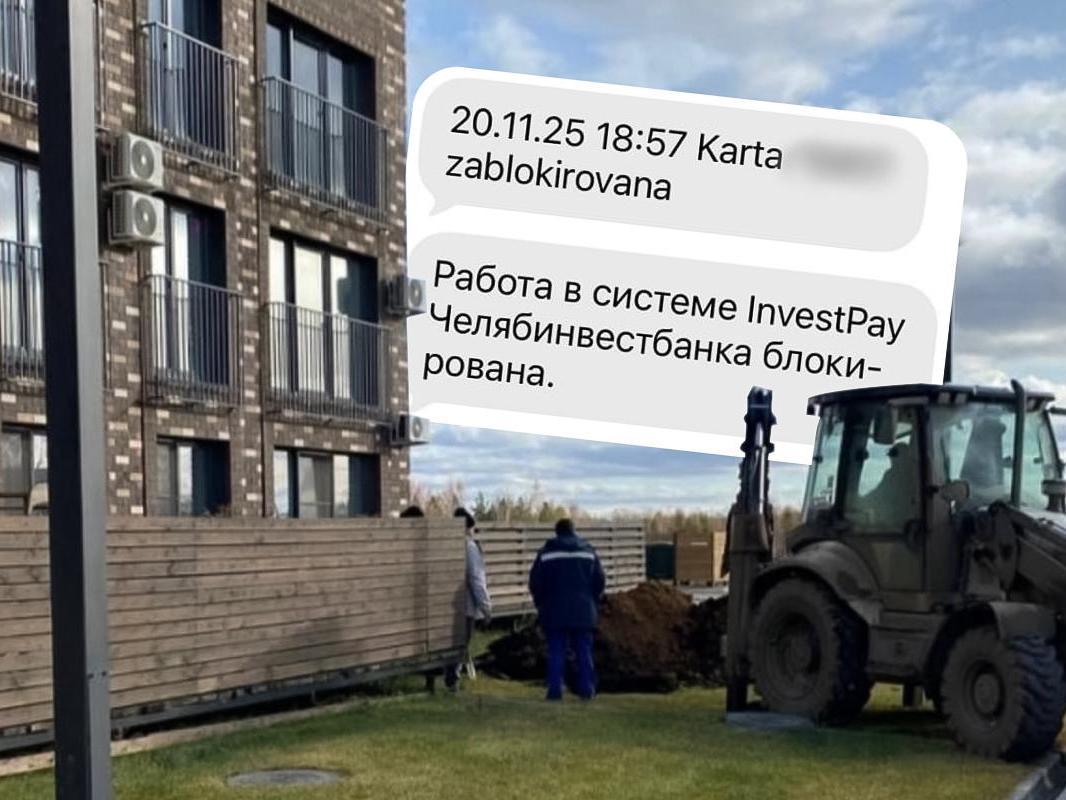

Russia is experiencing an «epidemic» of mass card and account blockages. Banks are increasingly freezing client operations not only when withdrawing money, but also when transferring between their own accounts. The editorial office of 74.RU was contacted by Chelyabinsk resident Alexander, who received payment for completed work, but due to a card freeze, he was effectively left without money. Moreover, according to Alexander, the bank does not specify the reason for the blockage. We examine with lawyers how legal this is, how to avoid problems, and what to do if your card or account is frozen (prepare folders of papers).
«I earned the money, but I can«t manage it»
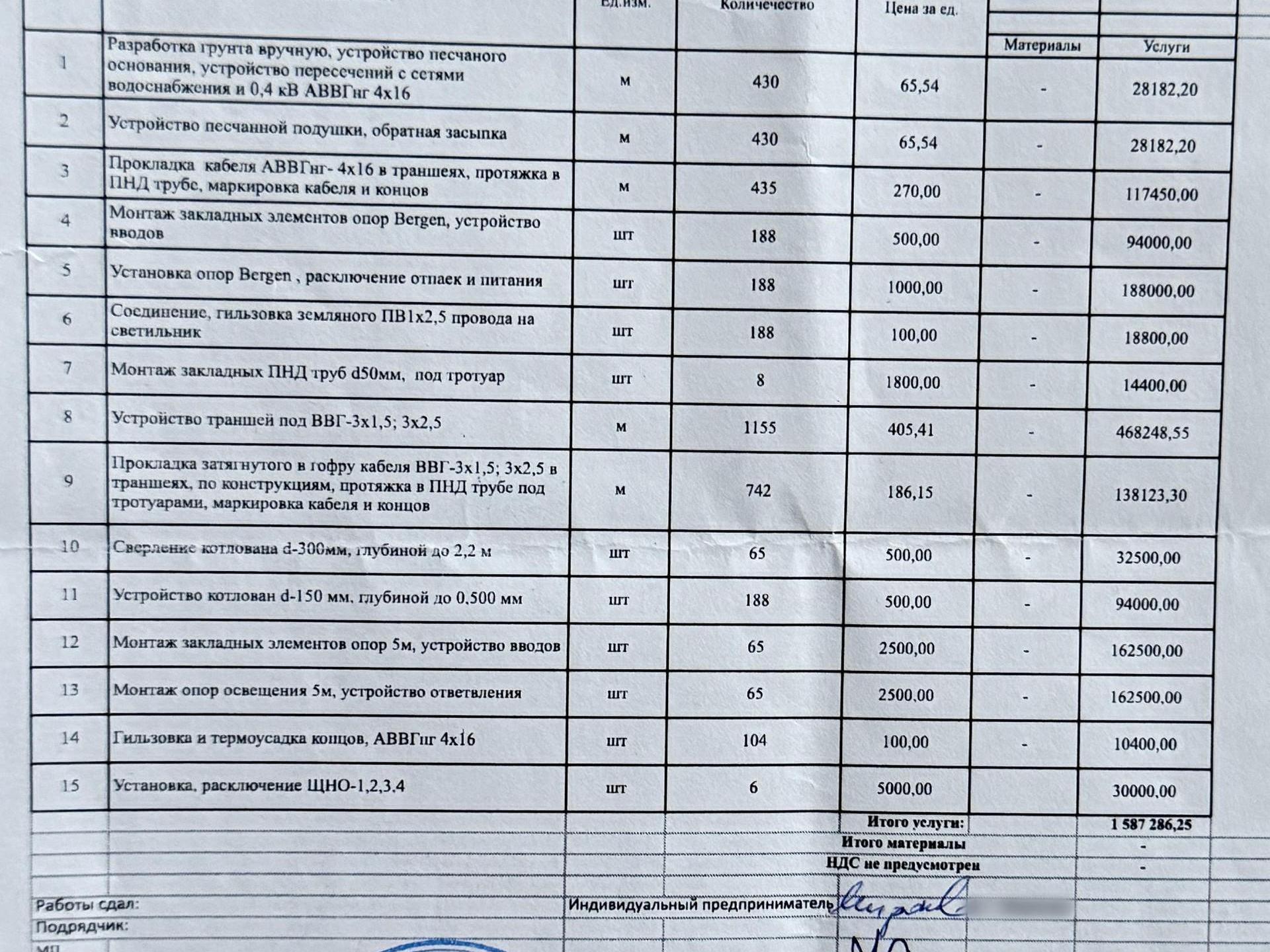
Alexander worked as an electrician on site improvement at a residential complex under construction. He installed exterior lighting along buildings and interior decorative lighting. He performed the work as an individual entrepreneur under a contract with a developer«s representative.
«I have two contracts — in August and November 2023, each for over two million rubles (approx. $22,000 at current rates). Work volumes were closed every three to four months. I installed 60 poles — closed, laid 700 meters of cable — another certificate [of completed work]. So, different amounts came to the account, at one time — 400–700 thousand rubles (approx. $4,400–$7,800), then 900 thousand, 1.5 million rubles (approx. $16,700),» Alexander said. — «I opened a settlement account in «Chelyabinvestbank». They themselves suggested that I could open a card as an individual to avoid paying a percentage for cash withdrawals at the counter.»
In October last year, the bank suddenly requested documents. Alexander was surprised but, according to him, brought them the next day — contracts, calculations, types of work, certificates of completed work, and so on.
«I completed these works, passed construction control, the customer signed, everything is legal, transparent, and justified for me. I earned the money with my sweat and labor. But I was blocked,» the entrepreneur expressed surprise. — «In 2023, I worked with the same developer — all normal, 2024 normal, but 2025 — suddenly a blockage. They said — transfer the money to another bank.»
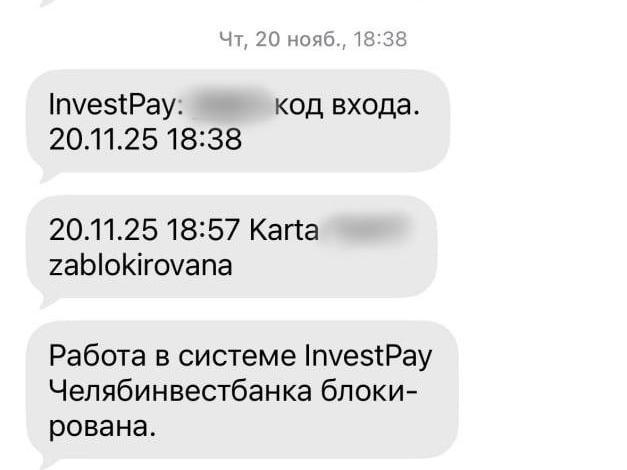
Alexander opened an account in another bank and transferred the available amount there. Two weeks later, the customer transferred the final tranche to him — 1.5 million rubles (approx. $16,700). But now the new bank blocked this money and transferred it to the «Chelyabinvestbank» card.
«My account and card were immediately blocked. I call the «Chelyabinvestbank» hotline, ask on what basis. They answer: under Federal Law No. 115-FZ, there are no specific review periods, when we review — we will notify you,» Alexander continued. — «They ask, where does the money come from? Did it fall from the sky, or what? Sorry, some kind of idiocy. As a client, I was set up to be served by the bank, not to go around proving where my money comes from. Time passes, what other documents need to be provided, they don«t say. I call the hotline — one answer: »Await review.«»
Currently, Alexander has 1.1 million rubles (approx. $12,200) stuck in «Chelyabinvestbank». The entrepreneur wrote a pre-trial claim to the bank — according to him, there was no reaction. He filed a complaint with the Central Bank of Russia, received a response saying, we cannot influence credit institutions, sort it out yourself or go to court.
«I wanted to buy a mini-excavator. To not hire, but use my own. Because previously the customer provided equipment. But now he requires coming with your own,» Alexander added. — «In the end, I earned the money, but I can«t manage it. I»m in a stupor — how to fight this lawlessness?»
Did they go too far?
The editorial office of 74.RU contacted «Chelyabinvestbank» with a request to explain the reason for the situation.
The credit institution declined to comment, citing that the bank cannot provide information about clients to third parties.
Currently, banks indeed have many grounds for blocking client accounts. Meanwhile, back in November last year Chairman of the Central Bank of Russia Elvira Nabiullina noted an increase in complaints about unjustified account blockages.
«Complaints about fraud have fallen… But at the same time, complaints about unjustified account blockages have grown. That is, in fighting fraud, we have somewhere gone too far,» the head of the Bank of Russia acknowledged, speaking at the «Focus on the Client» conference.
«The situation is not hopeless»
The bank acted on the basis of Federal Law No. 115-FZ dated August 7, 2001 (the «anti-money laundering law»), lawyers indicated. Its goal — countering the legalization of criminally obtained income. Banks are obliged to monitor client operations and, in case of suspicions, have the right to block accounts. There are many reasons for blocking: suspicion of money laundering, terrorism financing, tax evasion. Moreover, the list is constantly expanding, so a card can be blocked for almost any unusual operation.
The Central Bank recommends timely informing the bank and tax authorities about changes in Unified State Register of Legal Entities (USRLE) and Unified State Register of Individual Entrepreneurs (USRIE) information, filling out payment documents in detail and carefully, promptly submitting documents upon the bank«s request, not splitting business into many different firms, minimizing cash expenses and not withdrawing large amounts in cash, independently checking counterparties, monitoring incoming correspondence, timely submitting reports and paying taxes.
«I believe the problem is that the entrepreneur received funds not to a special account opened for business activities, but to personal accounts, which are not intended for such purposes. And therefore, the bank«s actions are quite justified and logical, and the entrepreneur will have to explain the source of these funds, as well as why he did not use a business account for these purposes,» noted managing partner of the Yug law firm Yuri Pustovit.
The lawyer advised coming to an appointment at the bank, explaining the nature of his activities, approximate circle of counterparties, amounts of receipts and expected annual turnover, providing a tax return for the past year, exchanging phone numbers with an authorized bank employee for prompt communication in case of questions. Yuri Pustovit added that in case of expecting a large payment, atypical for his turnover, it is better to visit the bank in advance and explain in what amount and for what work the payment will come, providing copies of documents confirming the source of funds.
According to managing partner of the Genesis legal company Artem Denisov, in the situation with an individual entrepreneur, the bank could consider the following signs suspicious (they often lead to blockages):
«unusual» nature of payments: receipt of large sums (from 500 thousand to 1.5 million rubles, approx. $5,600–$16,700) to the entrepreneur«s account, which may look like one-time, large, and irregular transactions;
signs of «transit» operations: possibly, the bank analyzed fund movements and deemed that operations do not correspond to the normal business cycle (for example, absence of accompanying payments for materials, rent, etc.);
low tax burden: turnovers on the account might not correspond, in the bank»s opinion, to paid taxes and contributions.
Courts often support banks if they reasonably suspected an operation of «money laundering» or other violation, added Artem Denisov. For example, in one case, the court recognized as lawful the blocking of an individual entrepreneur«s account, who received a large advance but could not quickly provide documents confirming the reality of the transaction.
What should an entrepreneur do: a step-by-step plan
The situation is not hopeless — it is necessary to act consistently and persistently, noted Artem Denisov and proposed a step-by-step instruction.
Accurate clarification of the reason. Need to obtain a written request from the bank indicating which operations caused suspicions and what documents are required.
Preparation and submission of documents to the bank. Collect and provide the most complete set of documents proving the legality of activities and origin of money. Remember, success depends on the speed and completeness of the response.
Appeal to the Interdepartmental Commission (IDC). If the bank refused to unblock after receiving documents, need to file a complaint with the Interdepartmental Commission at the Bank of Russia. This is a pre-trial but important stage — the IDC«s opinion carries weight.
Appeal to court. If the IDC did not help or the response is delayed, need to prepare a statement of claim to the arbitration court to recognize the bank«s actions as illegal and lift the blockage.
According to the lawyer, thorough preparation of the evidence base is required. The document package must be exhaustive and include:
documents on the deal with the customer: contracts for electrical installation work, certificates of completed work (acceptance-transfer acts, KS-2, KS-3), invoices (if the individual entrepreneur is on the general taxation system);
documents confirming the reality of the object: this could be a subcontract agreement with the customer linking the work to the residential complex, extracts from the Unified State Register of Real Estate (USRRE) on the objects, photographs from the work site, correspondence with the customer;
financial and tax documents: account statements showing the legal origin of funds; tax returns confirming payment of taxes on received income; receipts for payment of insurance contributions;
an explanatory letter with a clear, structured description of the business process: who the customer is, what work was performed, why payments were irregular and large (for example, stage payment upon completion of work volumes).
What operations are possible during a blockage
Even with a blocked account, an individual entrepreneur is obliged and has the right to make a number of payments, lawyers indicated. According to Article 855 of the Civil Code, the bank cannot refuse to conduct operations in the following order:
Payments for compensation for harm to life/health and alimony.
Payment of severance pay and salaries to those being dismissed.
Payment of taxes, fees, and insurance contributions.
Other enforcement requirements.
Other payments.
In practice, this means: to pay taxes or employee salaries, need to submit a paper payment order to the bank (if online banking is disabled). The bank is obliged to execute it on a priority basis.
«The client will have to prove it»
Summarizing the situation, lawyers pointed out several important conclusions.
«The bank«s actions are legal under Federal Law No. 115-FZ. The complexity is that the law gives the bank the right to act on the basis of suspicion, and the burden of proving innocence falls on the client,» emphasized managing partner of the Genesis legal company Artem Denisov.
According to experts, the Central Bank is formally right: it does not interfere in operational decisions of commercial banks, but created a mechanism for appeal through the Interdepartmental Commission.
«The main path to unblocking — not complaints, but constructive dialogue with the bank providing irrefutable evidence. If that doesn«t work — appeal to the IDC and then to court,» advised Artem Denisov. He recommended the entrepreneur focus on the first and second stages of the plan, preparing the most detailed response to the bank»s request.
In court, according to lawyers, there are chances: judicial practice is ambiguous. Courts side with the entrepreneur if the bank acted formally, set unrealistic deadlines for document submission, or did not take into account provided evidence.
«With a complete set of documents confirming the reality of business operations, chances of success are substantial. Courts proceed from the fact that the bank is not entitled to arbitrarily restrict the client«s right to manage funds in the account (clause 3, article 845 of the Civil Code). The bank must justify its suspicions with specific criteria and circumstances, not limit itself to a formal reference to Law No. 115-FZ,» summarized attorney, partner at INTELLECT Anna Sungurova.